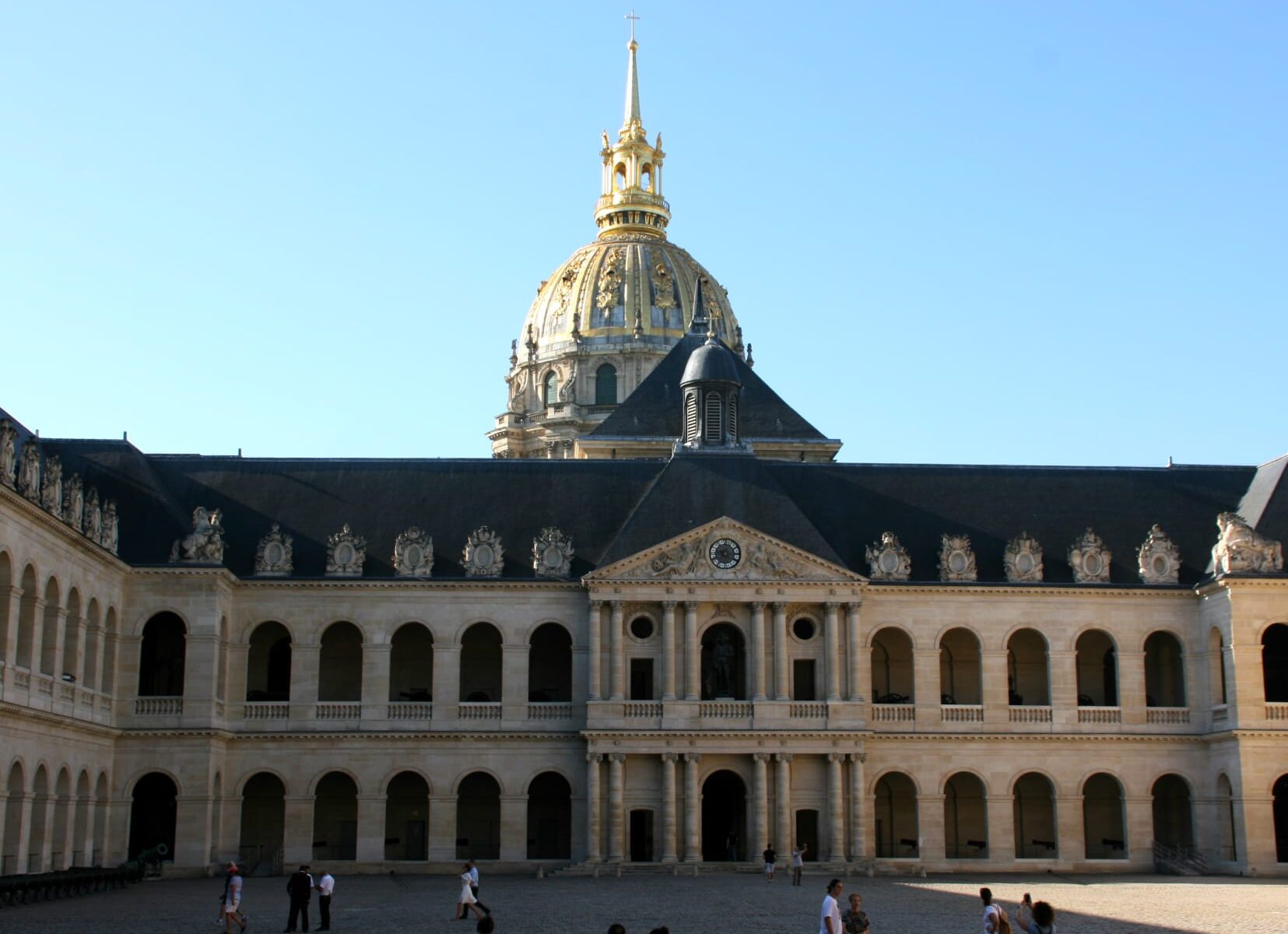
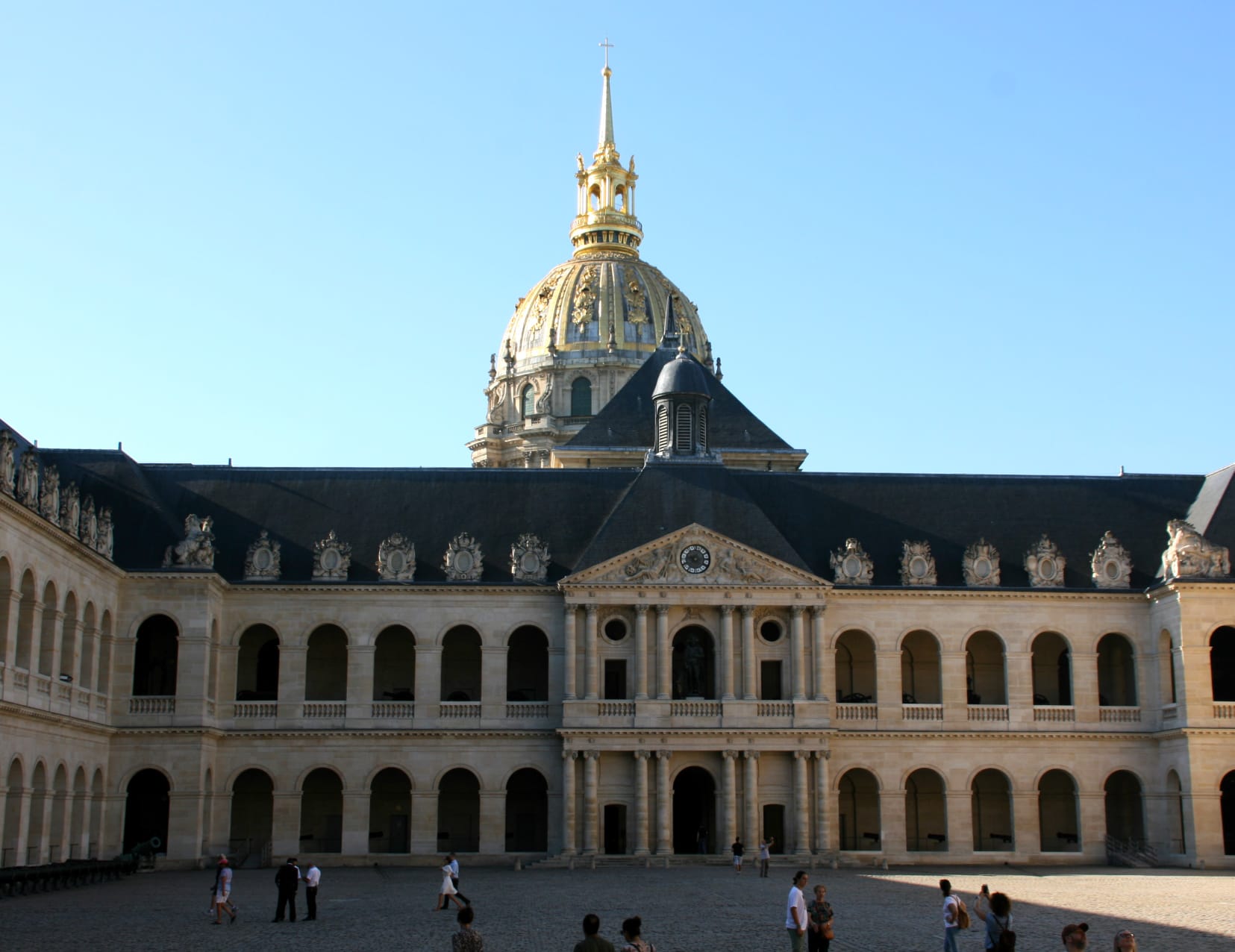
In the 7th arrondissement of Paris, you will find the Hôtel des Invalides. Reference could be made to the Musée de l’Armée due to the large military museum that is part of the vast complex. The Hôtel des Invalides dates from 1670s. Built close to the banks of the River Seine and in what appears to be military precision, the complex was commissioned by Louis XIV and designed to provide a sanctuary for the wounded and aging soldiers.
I had made my way to the Hôtel des Invalides as I was interested in visiting the tomb of Napolean Bonaparte (Napoleon I). Surely, he was an important person not only in France’s history but that of Britain as well. I dread to think how many times I have watched the TV series ‘Sharpe’ and ‘Hornblower’ which portrays tales of this period.
My visit to Hôtel des Invalides proved to be a thoroughly educational visit. I hope that this full-on history lesson doesn’t bore you. It certainly fascinates me. Names of key figures in France’s history are discovered and help form an understanding of France’s intriguing history. Join me as I explore this incredible monument in Paris.
Origins of Hôtel des Invalides
In the 17th century, France was ruled by a certain Louis XIV (B 1638; d 1715). Louis XIV was known as the Sun king and was head of Europe’s greatest army. I’m sure more detailed discoveries will be made when I visit the Versailles Palace – Louis XIV is inextricably linked with this palace.
Louis XIV was fully aware of the sacrifice that the soldiers of France had given to guard France that he wanted to build them a hospital and retirement home. The site first opened in 1674 with a hospice, barracks, convent, hospital and factory.
By the time the building works were completed in 1676 the façade fronting the River Seine spanned an impressive 196m (try capturing that on camera!). Entrance is made through the archway in the middle with Louis XIV proudly carved in the brickwork at the top along with the words, ‘Louis the Great, providing for his soldiers by royal bounty’. The original designs are credited to Libéral Bruant and needed not only to be practical but aesthetically pleasing.
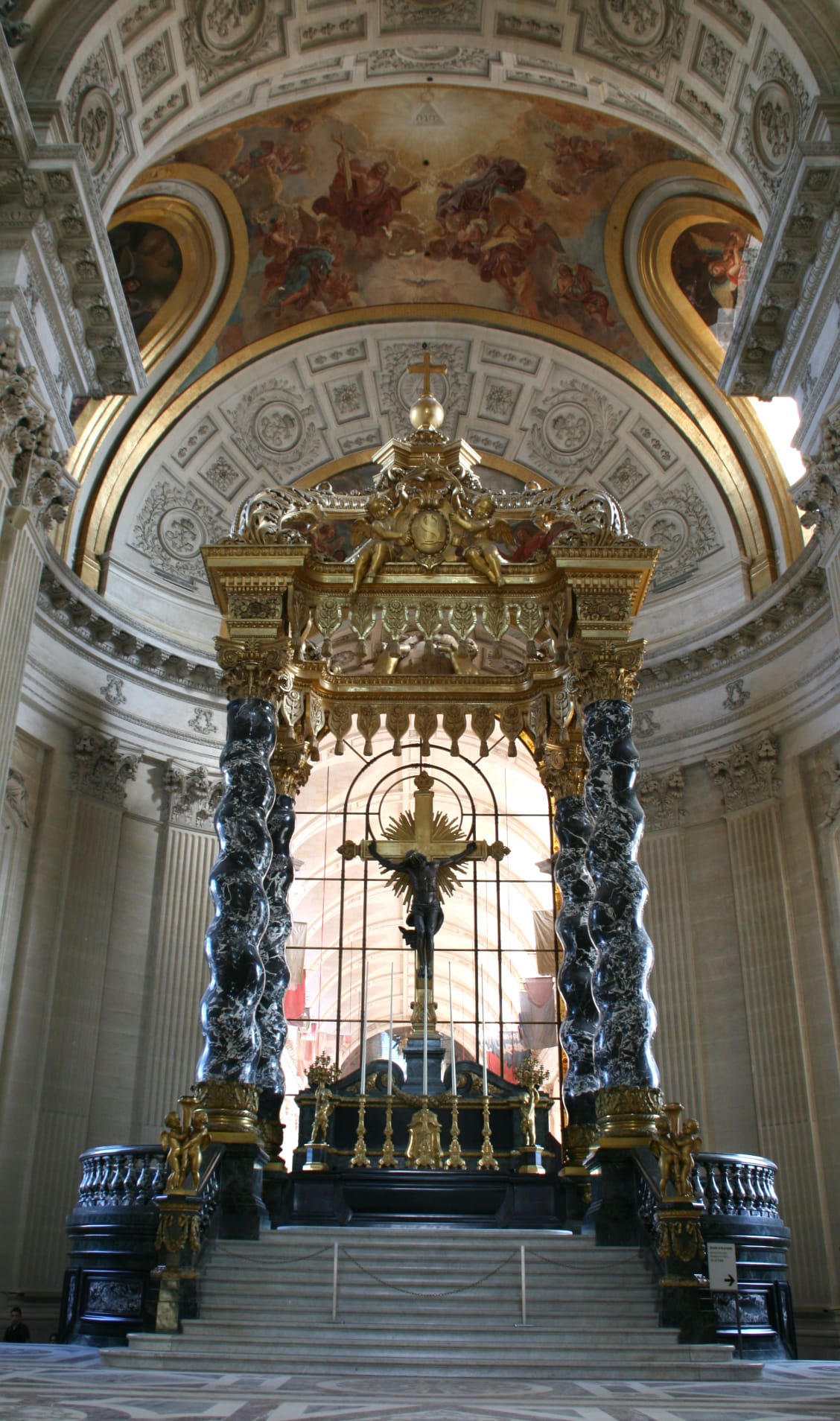
Part of the complex of buildings is the Cathedral of Saint Louis des Invalides. An interesting concoction, this is a church (later cathedral) and a royal chapel combination. The dome on top of the chapel is a striking part of the Parisian skyline which appears to draw everyone to investigate the rest of the building on which it sits. The Cathedral was finished after Bruant’s death in 1697 by Hardouin-Mansart. Louis commissioned Mansart to build a separate private royal chapel. The iconic golden gilded dome chapel was finished in 1706.

Saint Louis Cathedral
As cathedrals go this one, in my opinion, seems rather dull and bland in appearance. I only find one fascinating item to view – the flags that are hung from the top of nave. These flags were captured by the French army in various wars and conflicts throughout its history.
The cathedral is dedicated Saint Louis. Louis IX was a former King of France from 1226 to 1270 and the only French king to be declared a saint. Pope Boniface VIII proclaimed the canonization of Louis in 1297. Louis built the Royal Chapel – Sainte-Chapelle – in Paris. It is a miracle of medieval engineering and a wonderful building more of which I will discover later this trip.
Saint Louis Cathedral is part of the Roman Catholic church and was built to allow the soldiers to attend mass. In 1957 the position of vicar was created to look after the spiritual needs of the army. In 1986 the position of Bishop of the armies was created and established within the church and, with it, the church became a cathedral.
The soldiers who attended mass were to be kept away from royalty which is where the dome chapel comes in. The whole building is split into two separate sections – the cathedral and the dome chapel. A large piece of glass creates clear separation between the two structures. Entry is free to enter the cathedral, but the dome and Napolean’s tomb is part of the paid ticket for the whole site. I assume this is the reason for the clear segregation between the two remains.
The Dôme des Invalides
The Dôme des Invalides was the tallest structure in Paris until the Eiffel Tower eclipsed it and took the title. Externally the gold leaf that covers the dome adds a touch of opulence in keeping with Parisian architecture. It symbolizes the grandeur of the French monarchy. Internally you will be greeted with a stunning display of Baroque artistry. The frescoes that seemed to have been forgotten in the cathedral grace the ceilings of the chapel. These are the evidence of the clear divide between royalty and veterans.
This part of the Les Invalides complex houses many tombs. One of particular interest is that of Turenne. Turenne was a ‘Marshal of France’ (the most illustrious rank in French military) and was heavily involved in many of King Louis’ battles. This brought him great distinction, and he was buried among the kings of France in St Denis (former medieval abbey in northern suburb of Paris). Unlike the monarchs his remains were saved during the revolutions of 1790s.

Napolean admired Turenne and his military successes. In 1800 he decided that he should be buried in the church of Invalides. Napoleon wanted to turn the building into a pantheon of military worthies.
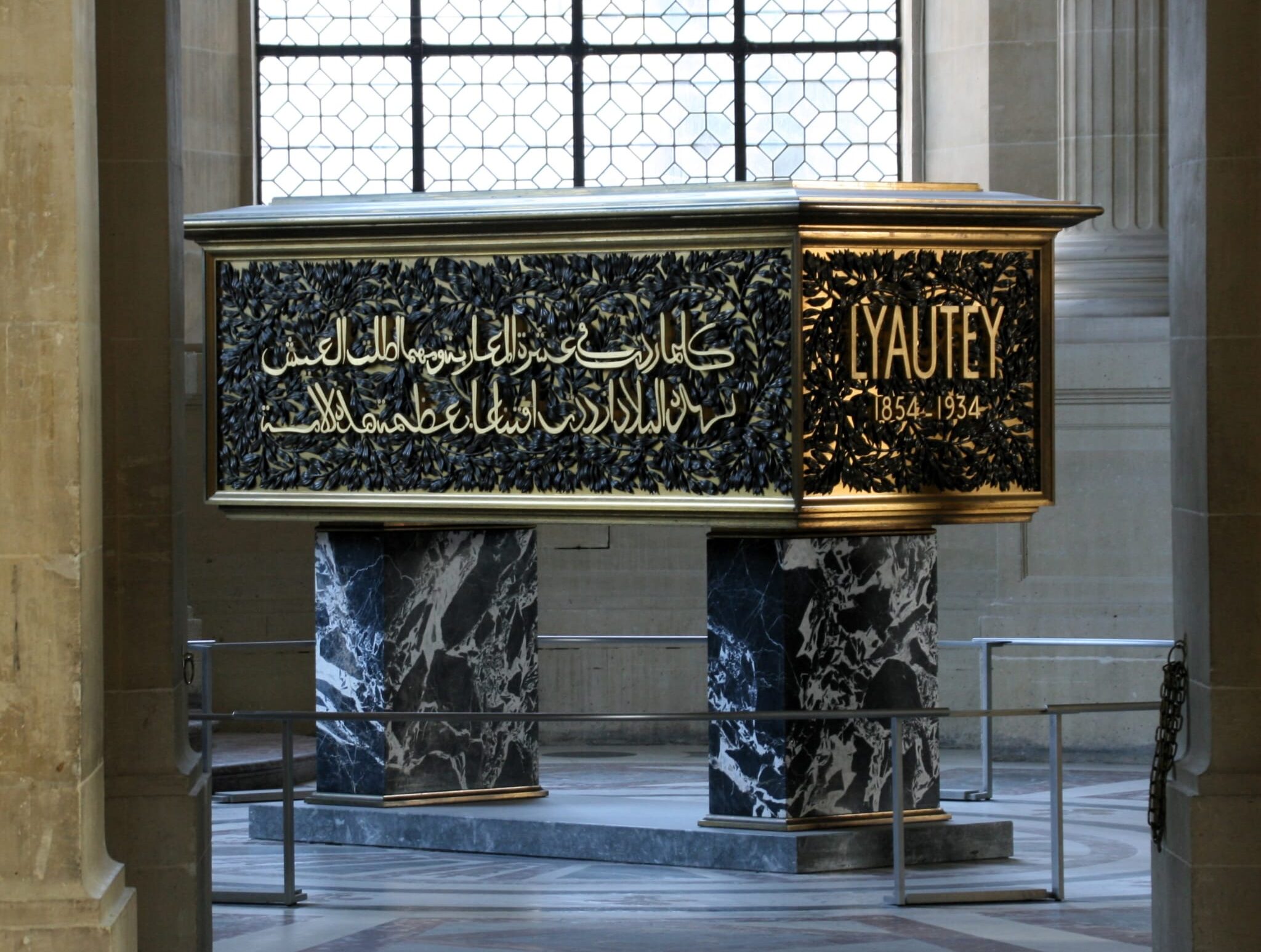
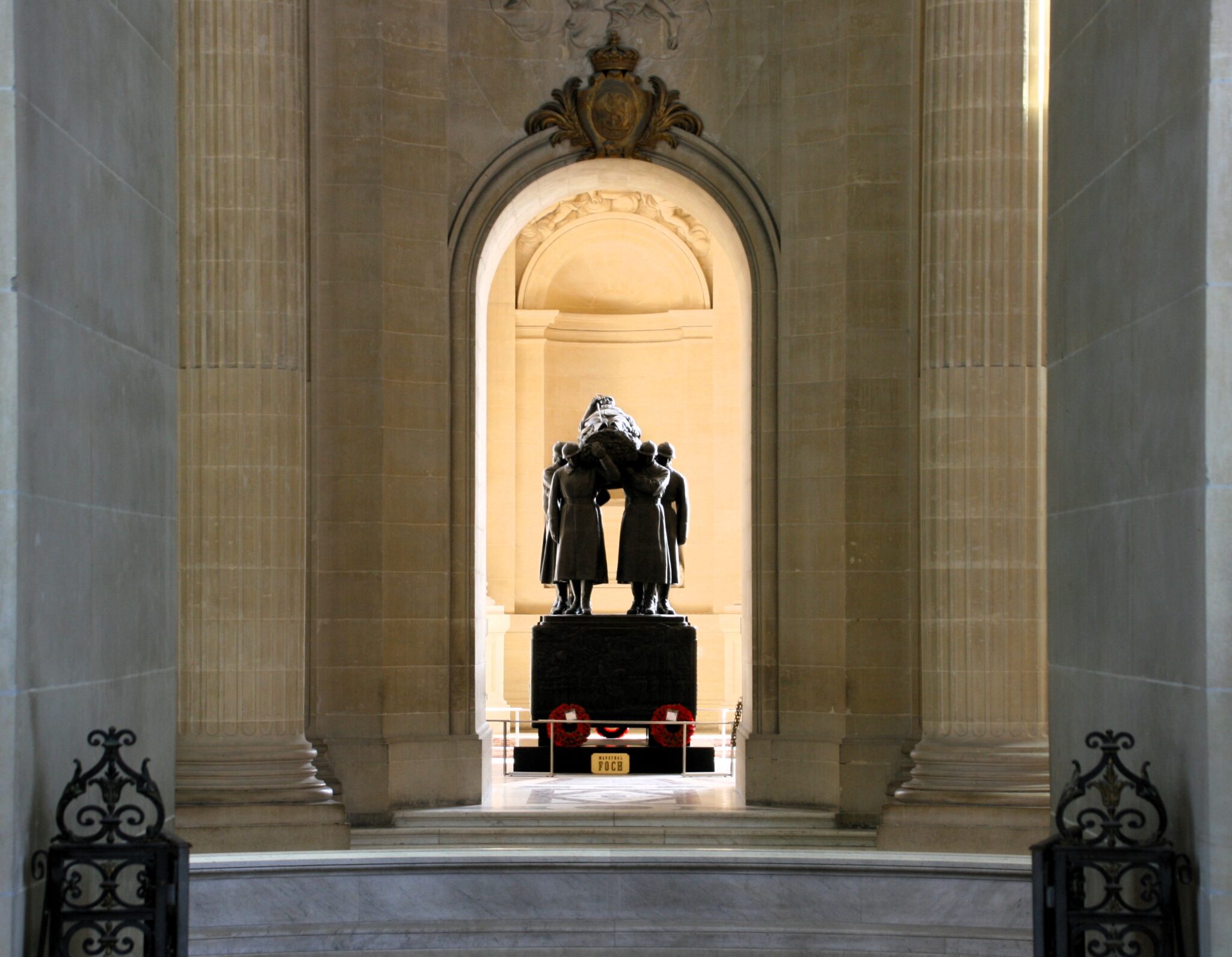
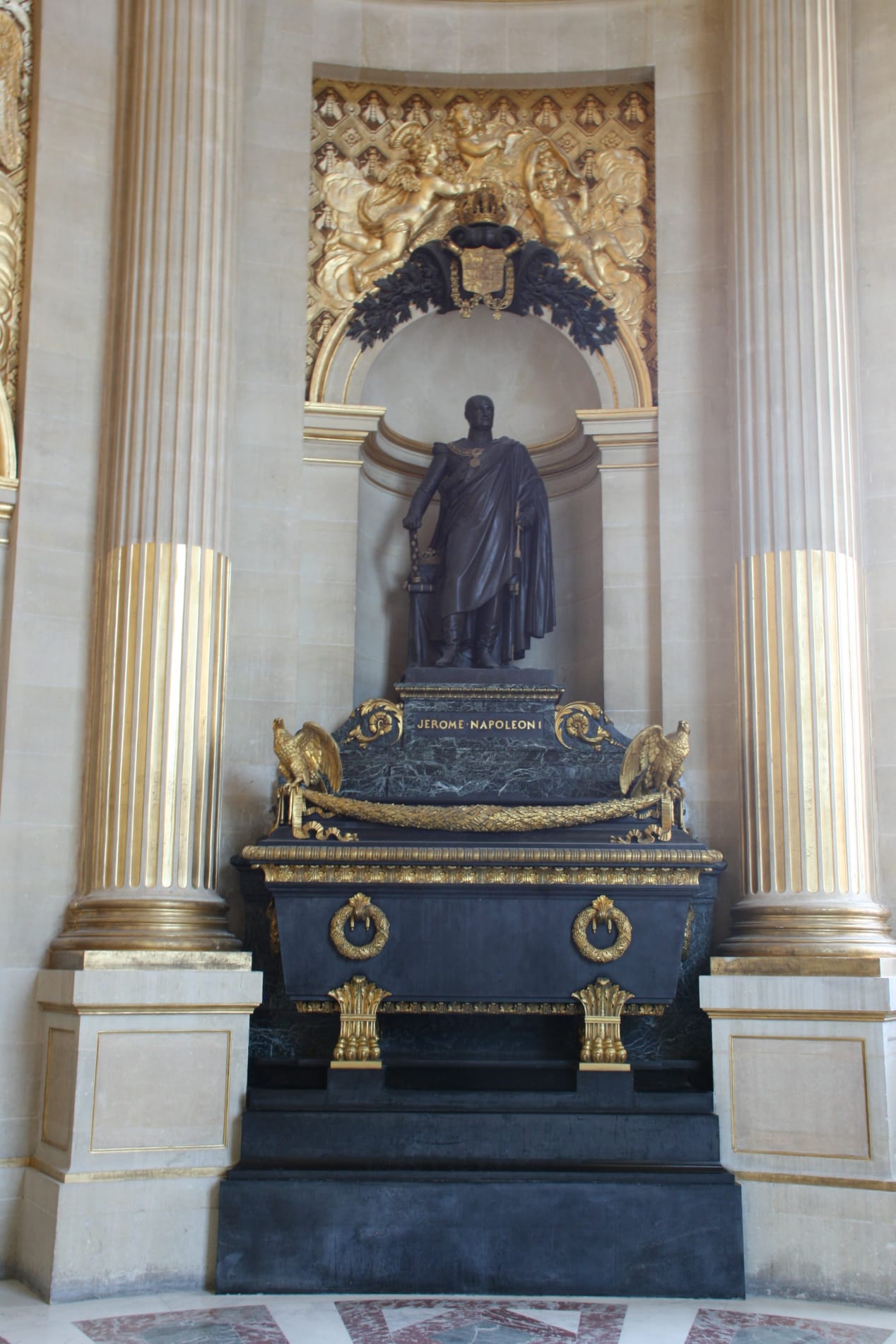
On a visit to the chapel, you will find other military tombs – the generals Bertrand and Duroc and the famous Marshals Foch (WWI) and Lyautey (Morocco). Also buried here are Napolean’s oldest and youngest brothers Joseph (King of Spain) and Jérôme Bonaparte (King of Westphalia).

Bringing Napolean back to the banks of the Seine
In May 1840 during the reign of King Louis-Philippe I, a bill was submitted to the Chamber of Deputies. The bill was for the transfer of the ashes of Napolean I from the island of St. Helena (where he had died in exile after his defeat at Waterloo) to the church of the Invalides. The bill passed by 280 votes to 65.
The frigate La Belle Poule was tasked with collecting Napolean I and brought him back to Le Harve where he transferred to the steamship La Dorade. He was then taken up the River Seine to Paris. On 15th December 1840 a procession formed to bring Napoleon I in a chariot through the streets of Paris, under l’Arc de Triomphe and down le Champs-Elysées, across Le Place de la Concorde, and to Les Invalides.
Napolean I was received at the chapel in the presence of King Louis-Philippe I. This fulfilled Napolean I’s wishes he should rest forever, “on the banks of the Seine, in the midst of the French people he loved so much”.
The tomb of Napolean I
Directly underneath the dome in a crypt is the ostentatious tomb of Napolean Bonaparte – Napolean I. His final resting place is surrounded by scenes from history. Etched all around his red porphyry sarcophagus in the crypt are scenes of his famous victories. I’m unsure of how much Napolean would have known about its design but the completion of the tomb area is down to architect Louis Visconti who designed the tomb. Napolean I spent several years in the chapel of Saint-Jerome whilst Visconti completed his work, and his coffin was transferred to its present permanent location in 1861.
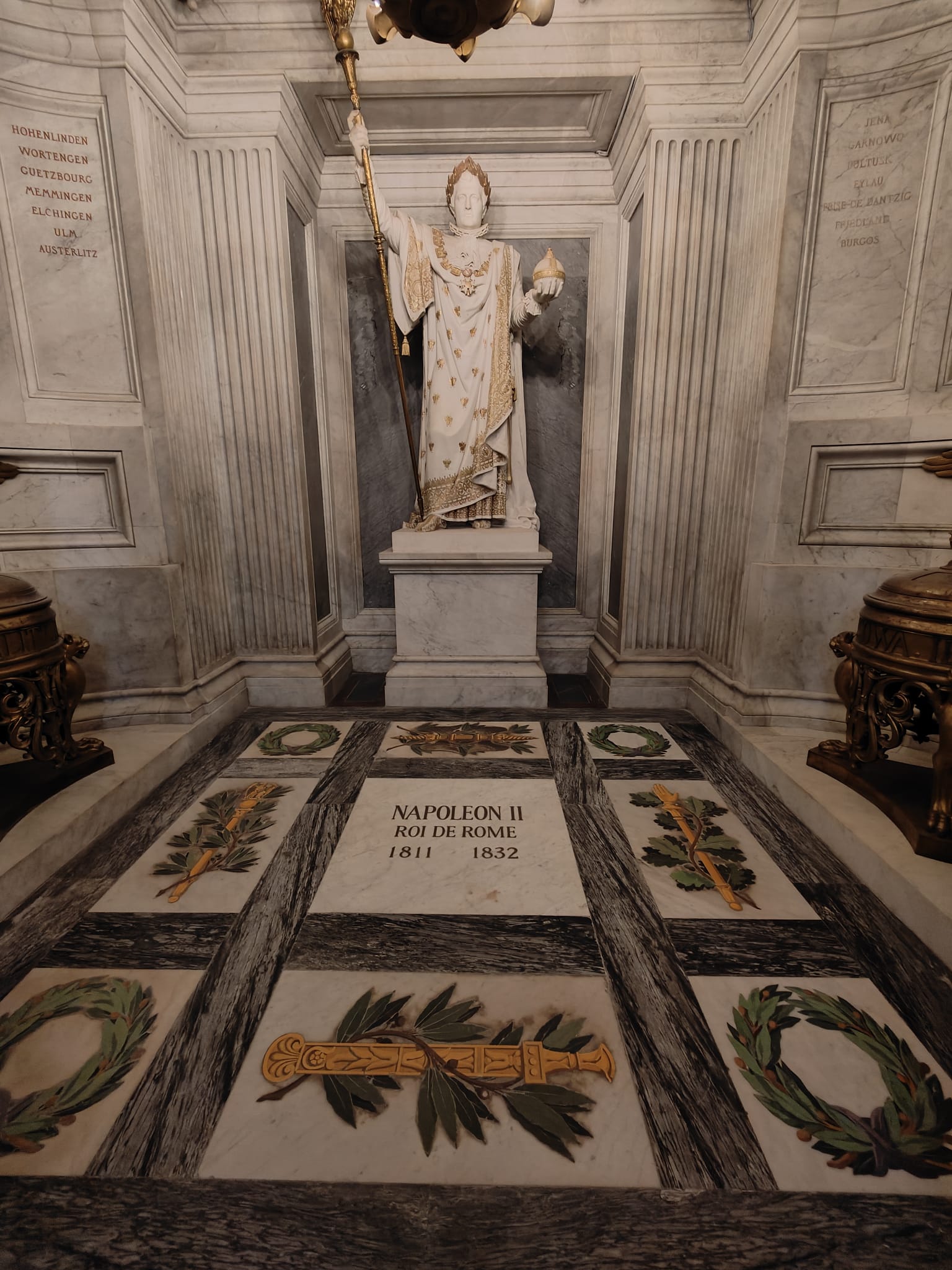
Entrance is made through a bronze door which was forged from canons taken at Austerlitz (Battle of the Three Emperors in 1805). Above the lintel is an inscription of Napolean I’s wishes to be buried among the French people mentioned previously. This access is permitted into Napoleon’s crypt where, halfway round, you will also see the tomb of his son Napolean II (1811-1832). He had been Prince Imperial of France and King of Rome from birth but only reigned as Emperor of France (disputed) for few days in June/July 1815. His remains were transferred to this final resting place on 15 December 1940, 100 years to the day after his father’s journey up the Seine.
Surrounding Napolean I’s tomb are 12 pillars. On each one are 12 different Victory statues by Pradier. Walking around the circular gallery you will be able to view ten white marble bas-reliefs by Pierre-Charles Simart which display different episodes from Napoleon’s reign.


Musée de l'Armée at Hôtel des Invalides
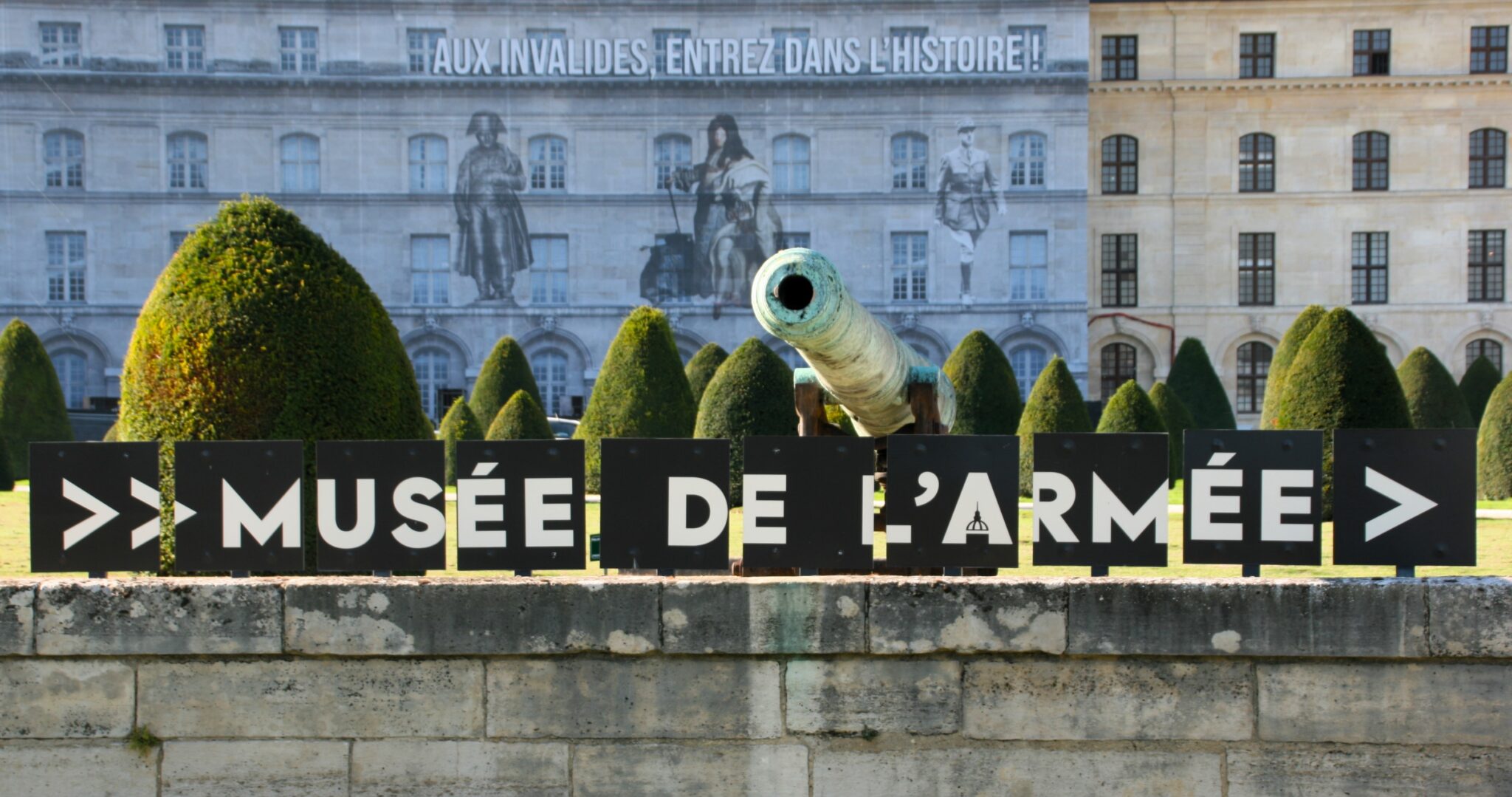
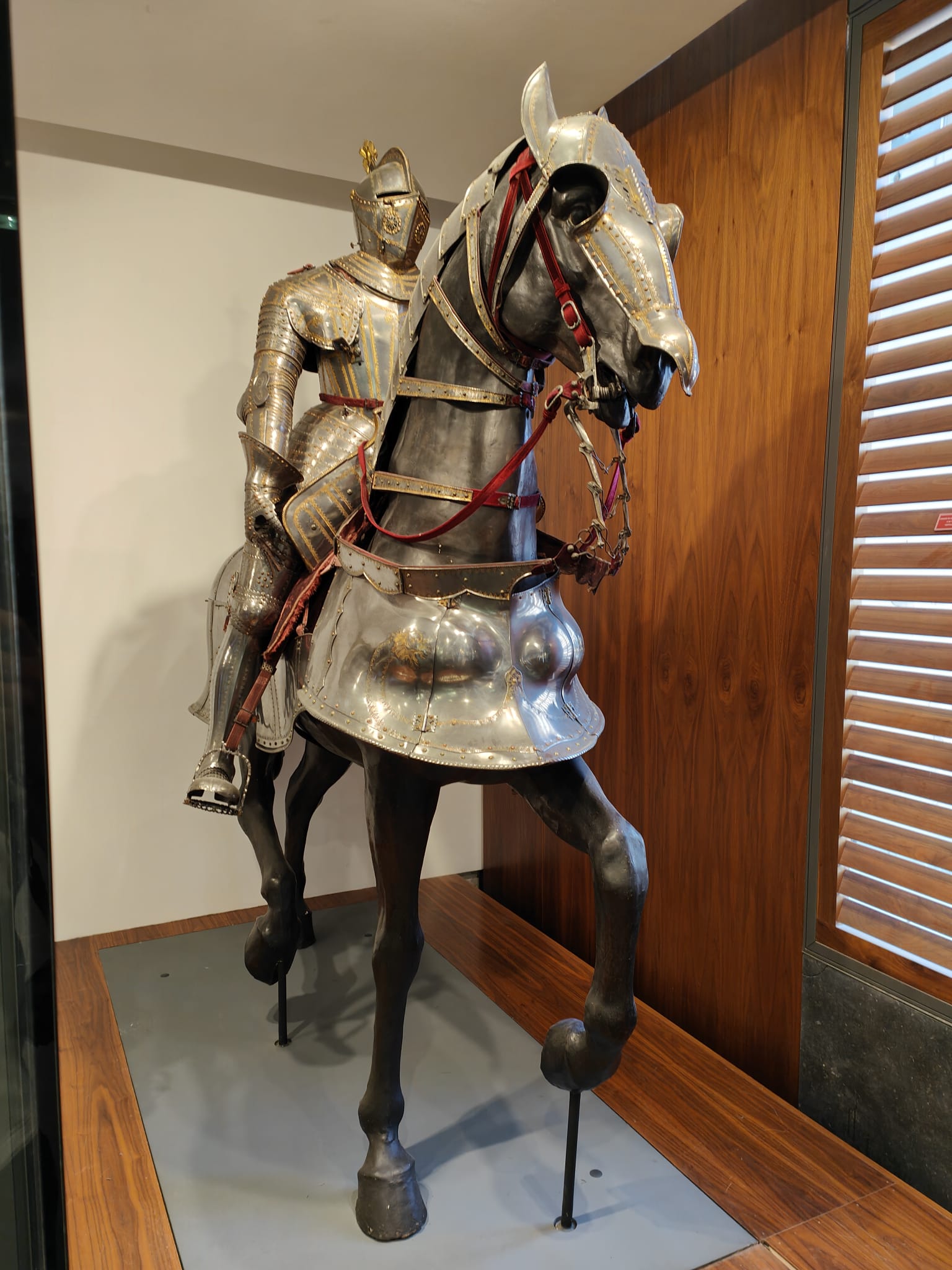
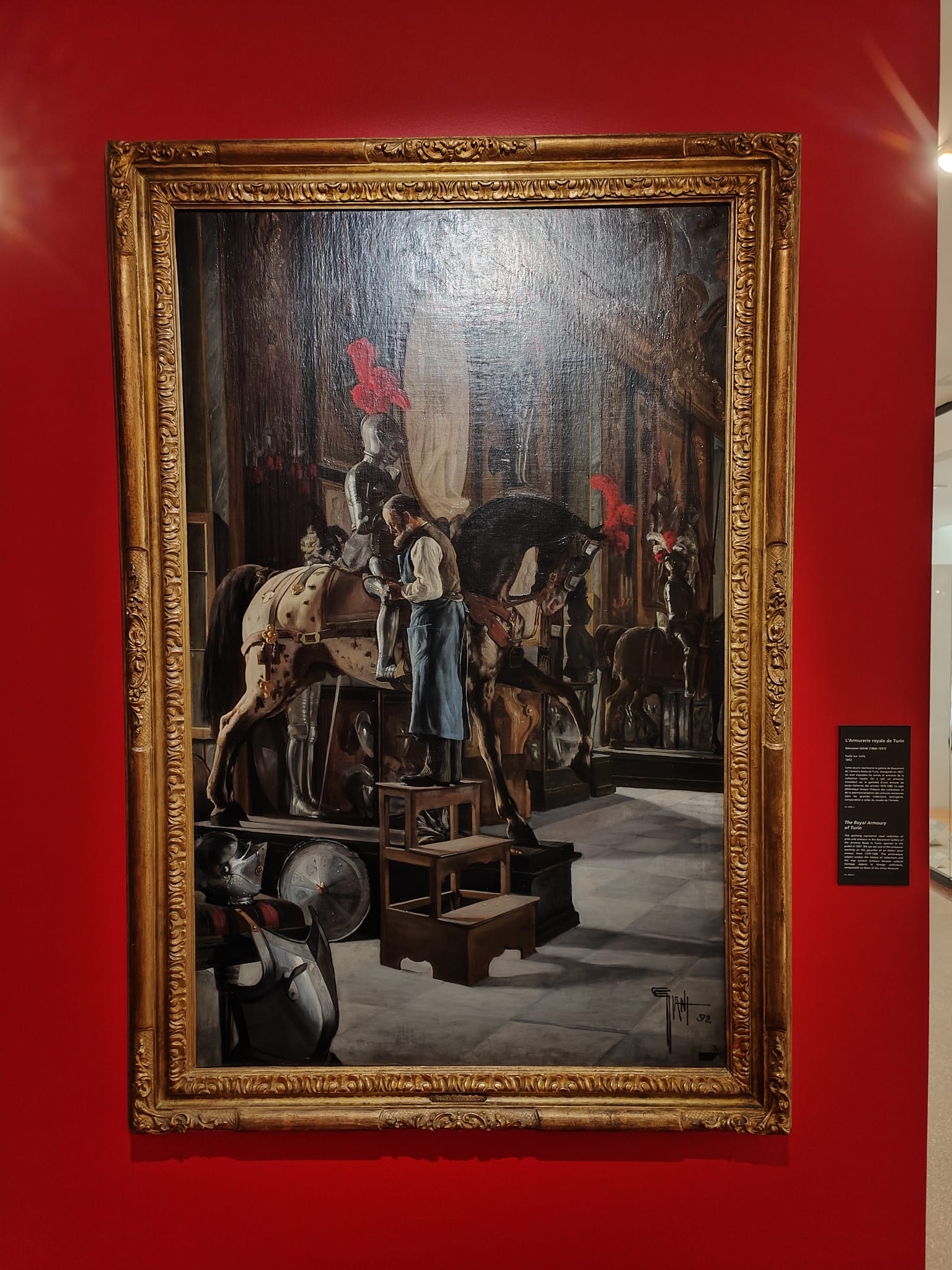
This is an exceptional collection of artefacts which takes you on a journey through France’s glorious military history. The museum was founded in 1905 and displays an impressive array of armour, weapons, uniforms and artwork.
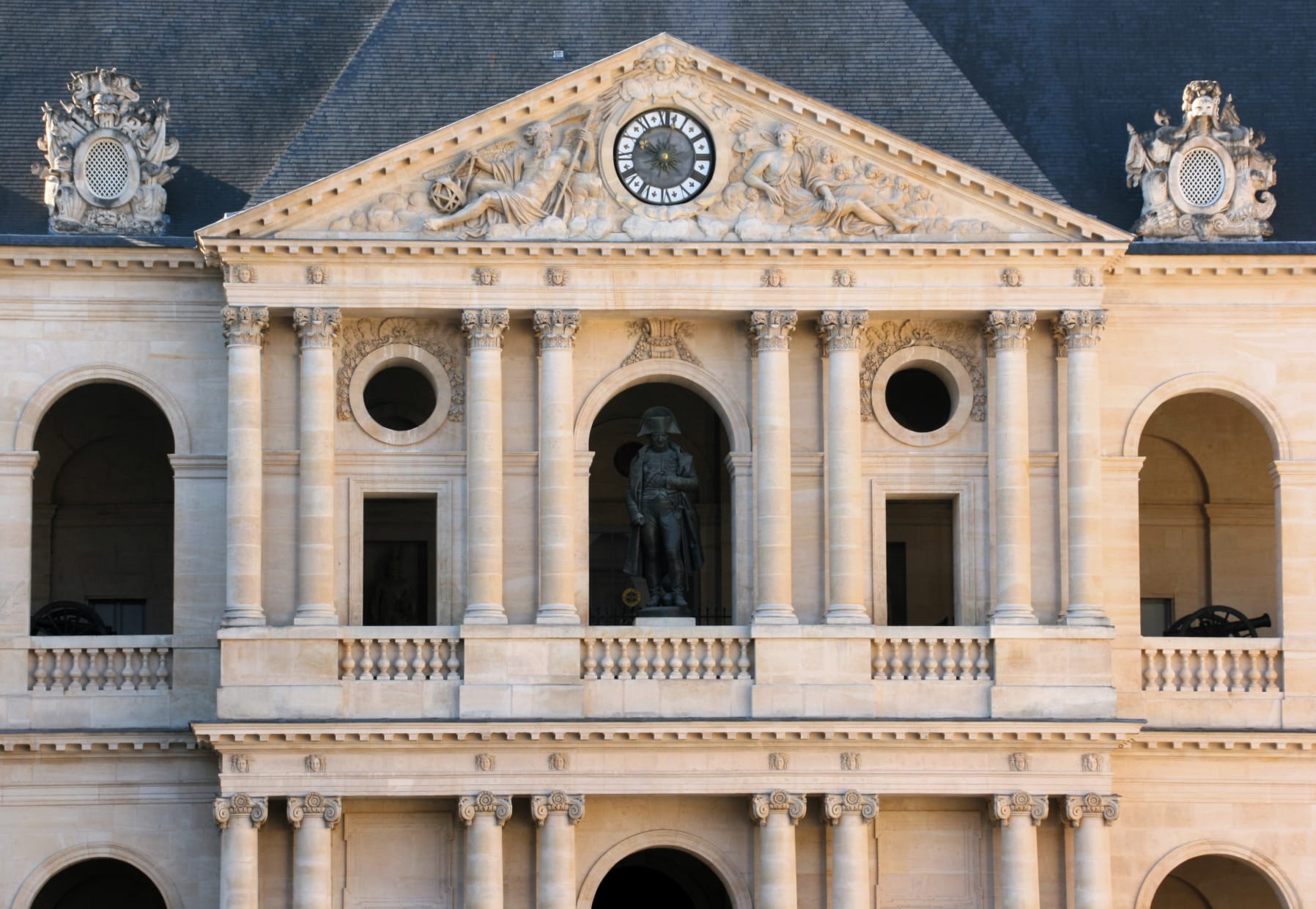
The evidence of France’s military begins at the entrance to the museums. Canons are placed all along the perimeter. After getting your tickets checked you walk through the main arch and into Cour d’Honneur (court of honour). This is the largest courtyard in the complex and is still used today for military parades. At the southern end the spectre of Napolean I looks down over the parade ground in the form of a statue of the former military man. In the corner of the courtyard are 60 conventional cannons.
From the courtyard you can pick and choose which museums you wish to visit. The museums cover: ancient weapons and armour 13th – 17th century; the two World Wars; museum of Relief Maps; Charles de Gaulle Historical Society; Louis XIV – Napolean; Les Invalides – between history and memories. Then opposite the cathedral is one final museum which is referred to the Order of Liberation. Sadly, I didn’t visit them all.

Hôtel des Invalides Summary
I hope that this post may have inspired you to visit to the Hôtel des Invalides complex when in Paris. Galleries, a chapel and courtyards are the backdrop to a fascinating insight into French history. Its idyllic setting on the banks of the Seine commands your attention. Towering above the complex of buildings is the golden dome which is such an attractive beacon in the Parisian skyline. More attractive than the Eiffel Tower? That I’m sure is a debate for another time….
This museum complex delivers so much more than I had anticipated. Serious time and dedication must be given to this place, more than I planned or managed on my visit. The museums house a wonderful collection of military artefacts – I think I read somewhere that there are over 500,000 of them.
With blinkers on my sole focus was on visiting was on the tomb of Napolean. The grandeur of the golden dome and its military mausoleum beneath meant I was ignorant to the fact that this place is advertised primarily as a museum and not a mausoleum. Thank goodness I dared to enter some of the museums on the way out of the royal chapel. I’m sure other visitors, like me, fall into the trap of focusing all their attention to visiting the royal chapel and its historical connections.
The Hôtel des Invalides is more than a mausoleum. It’s so much more. My visit and subsequent research I hope shows the confusion between the Hôtel des Invalides (site) and the Musée de l’Armée (tenant). It is easy to forget this place wasn’t built as a museum but as a sanctuary. The architecture of the complex is just as impressive as the museums themselves. The Hôtel des Invalides and Musée de l’Armée go hand in hand in remembering France’s glorious past. Perhaps that should be the question on everyone’s email notification.
Where Next?
In trying to visit as many Parisian monuments as possible in a brief visit means mistakes are made, monuments missed, architecture not appreciated and gardens ignored. On this whirlwind trip it means that I also ignored the grounds, much to my chagrin. So, I leave the Hôtel des Invalides and head towards the banks of the River Seine and, just like the Palais Garnier, this a place to which I would return on another visit to the city.
I have made mention of the Palais of Versailles in the post, but I will leave that until I have exhausted all posts on Paris. Many people wrongly assume the Versailles Palais is in Paris. Sadly, it is not but it is a beautiful day trip from the city, much like Windsor is from London. In discovering the Saint Louis cathedral, I mentioned Sainte-Chapelle. This could be a possible next destination or, maybe, continue the Napolean theme and visit the l’Arc de Triomphe – let’s see which it is.
Been to Paris plenty of times on business trips and was taken up the Eiffel Tower by a Parisian but never taken here. Says it all really.