
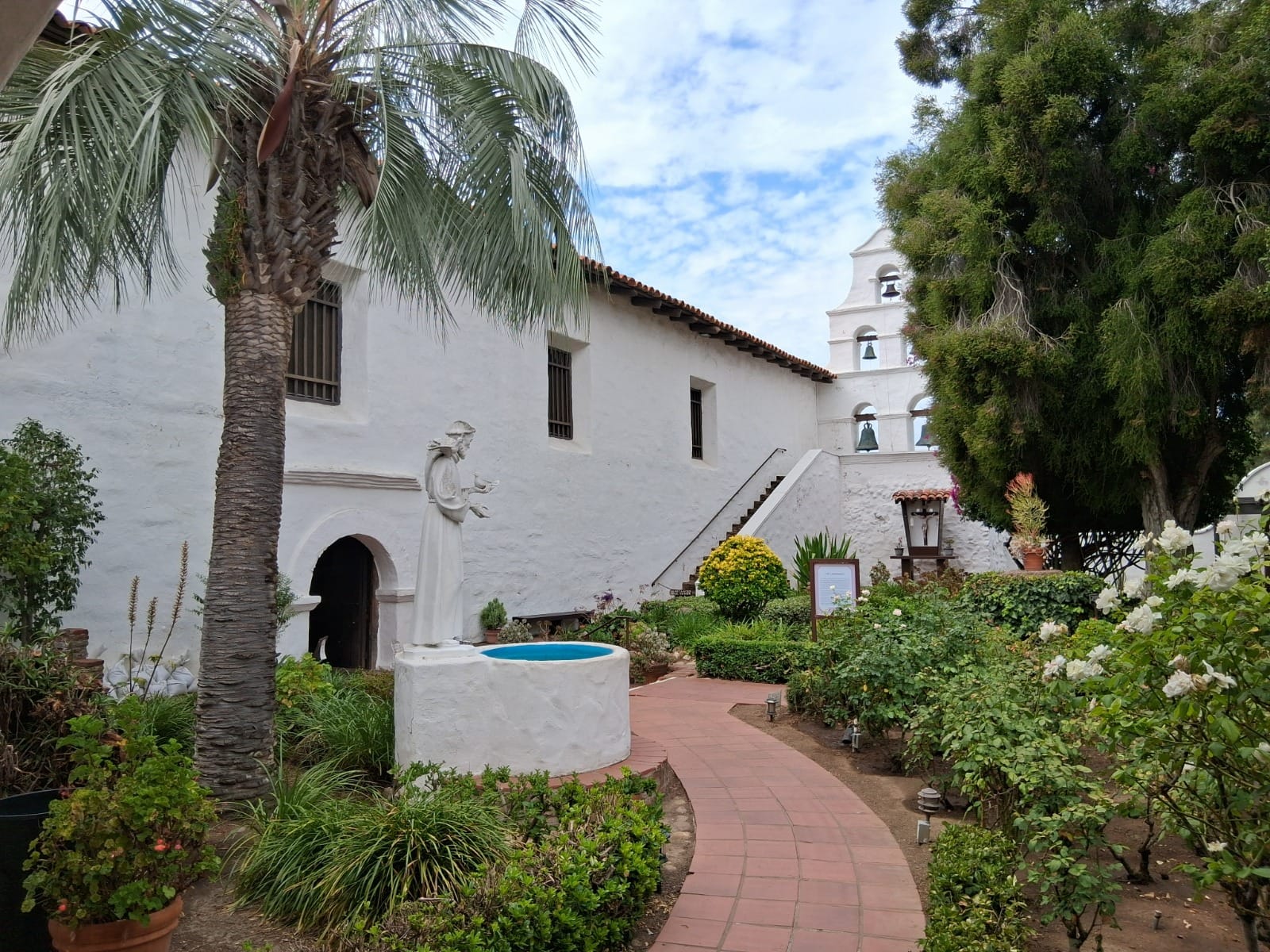
The Mission Basilica San Diego de Alcalá was founded on 16th July 1769. It was the first of 21 historic missions built in California. Built by Father Juniper Serra, it is often referred to as the ‘Mother of the Missions’. It also marks the birthplace of Christianity in the American West. Let’s see why the Mission Basilica San Diego de Alcalá should be on your San Diego itinerary.
Why Mission San Diego de Alcalá is a Must-Visit Landmark
A little way from downtown San Diego and the recently visited Cabrillo National monument is the Mission San Diego de Alcalá. Nestled in the Mission Valley and between bustling freeways and built-up houses is a quiet oasis of whitewashed adobe, blooming bougainvillea and towering palm trees. It is the perfect destination to continue this educational journey and build a picture of how San Diego was formed.
American churches don’t have the long history that Britain and Europe are blessed with, but there is still enough for fellow meanderers to appreciate. Mission Basilica San Diego de Alcalá is much more than a beautiful photo backdrop; it is a cornerstone of West Coast America history.
After visiting Cabrillo National Monument and learning about the first European steps taken in this part of the world, the Mission Basilica San Diego de Alcalá offers a chance to see the first church built in California. It was built as part of the Spanish colonisation of the area and was to be a key tool in converting the Kumeyaay (local tribes) to Catholicism.
The church is now a fully operational Catholic parish with Pope Paul VI designating the Mission church as a minor basilica in 1976. For the San Diego history buffs, it houses a small museum and was made a National Historic Landmark on the 15th of April 1970.
This serene hillside retreat offers a profound window into the state’s complex past. For anyone compiling a San Diego travel itinerary, missing this architectural and cultural treasure means missing the very beginning of the California story.
The Birthplace of California Historic Missions
To understand the significance of this site, we must travel back to July 16, 1769. For those who haven’t read about the Cabrillo national monument this was 60 years on from the first steps by Cabrillo on these shores.
It was on this day that Franciscan priest Saint Junípero Serra founded the first California mission, Mission San Diego de Alcalá. Serra was a member of the Franciscan order, something that I discovered on my visit to Santa Croce in Florence.
Saint Junípero Serra had arrived in New Spain (now Mexico) in 1749 to be a missionary. After landing in Veracruz, Serra proceeded to walk to Mexico City to meet at the Franciscan Missionary headquarters.
20 years after his arrival in Mexico Saint Junípero Serra headed north into California and established the very first link in California’s historic missions’ chain. This iconic site (Mission San Diego de Alcalá) earned the legendary title “The Mother of the Missions”. Junípero Serra went on to establish 9 of the 21 missions across California.
The first California mission marked the official launch point for El Camino Real (The King’s Highway). This trail would eventually connect 21 missions stretching all the way north to Sonoma.
Sadly, it no longer exists in its original entirety but does provide inspiration for a potential 600-mile road trip through California. So, the Mission Basilica San Diego de Alcalá stands as an undeniable landmark of Spanish colonial expansion and western religious history.
The Fascinating History of Mission San Diego
Today the Mission San Diego de Alcalá is a peaceful, sun drenched and immaculately maintained. When you visit and walk through the church and grounds it belies a dramatic history, shaped by survival, conflict and constant reinvention. Over the last two and half centuries the structures admired today have been relocated, built, destroyed and raised from the ashes multiple times.
Moving from Presidio Hill to the San Diego River
Incredibly the church we see today isn’t the original site of the “first” church. This was 7 miles to the west of its current location in a place now called Presidio Hill. Presidio Hill overlooks San Diego and, more importantly ‘Old Town San Diego’ (which will be my next destination)!
Presidio Hill provided the perfect spot for the Spanish to build a fort. The original mission was built adjacent to the fort. This made perfect sense, however, the location proved problematic.
Firstly, it proved intimidating to the local indigenous population who were hesitant to visit because of the military presence. Secondly, the sandy soil and lack of water made agriculture difficult. The settlement’s survival was at stake.
So, in 1774, the decision was made to pick up sticks and relocate inland to Mission Valley, where the San Diego River provided a reliable water supply and fertile land for crops.
The Impact on Kumeyaay History and the Local Culture
The relocation brought the Spanish friars into direct, daily contact with the area’s original inhabitants: the Kumeyaay people. With the introduction of the mission so close to their villages it completely disrupted the traditional Kumeyaay way of life, forcing massive cultural and religious shifts.
As you might imagine the indigenous population were not best pleased with this decision. So, in 1775, a year after the move, they decided that a raid on the Mission was a suitable course of action. I can only assume that Father Juniper Serra was further up the coast at this point establishing other mission churches. Father Serra is known to have built 9 out of the 21 in California.
The results were destructive and deadly. The Mission church was burned and substantial damage caused. Padre Luis Jayme was killed during this attack, which resulted in him becoming the first Christian martyr in California. He is entombed beneath the Church’s sanctuary floor and a reminder of the complex legacy of this site.
Destruction and Rebuilding: Rising from the Ruins
With such a turbulent past, it is easy to see why the original buildings no longer remain. The structure seen today is possibly the 5th structure to stand on the site. After the attacks in 1775, Father Serra returned to rebuild the Mission.
This time though Father Serra added an outer defence wall for protection. The new layout was a quadrangle around the courtyard. The works were completed in 1790, 6 years after Father Serra had passed away at the age of 70.
At the beginning of the 19th century the church continued to grow. 565 Indians received baptism into the church with the mission lands growing to over 55,000 acres and owning over 20,000 sheep and 10,000 cattle. An earthquake in 1803 crippled the structures. So, in 1813 a major rebuild took place with enlargements made to the church with buttress wings added.
My history of America is a little hazy, but my understanding is that Mexico won independence from Spain in 1821 with parts of California becoming Mexican territory. During this time lands were divided for Mexican families to own. These landowners were known as “Ranchos”, and the Mission Basilica San Diego de Alcalá was passed to Santiago Arguello.
After the U.S. / Mexican War the mission took on the role of military base. With the United States Calvary based in the Mission between 1850 and 1857. Their presence wasn’t all doom and gloom as they undertook some repairs to the decaying buildings.
After years of wars and military presence the buildings were given back to the church in 1862. This was under the orders of President Abraham Lincoln. After years of trauma a massive reconstruction effort in 1931 took place to restore the mission to its 1813 glory.
What to See: Must-Visit Highlights on the Mission Grounds
If I haven’t inspired you to visit, I’m sorry! This Mission church is surely a must for Old Town San Diego history. After purchasing tickets to enter I was given a detailed and useful guide to show me around the church and grounds on a self-guided tour. Here are the must-visit sights
The Iconic Campanario (Bell Wall)
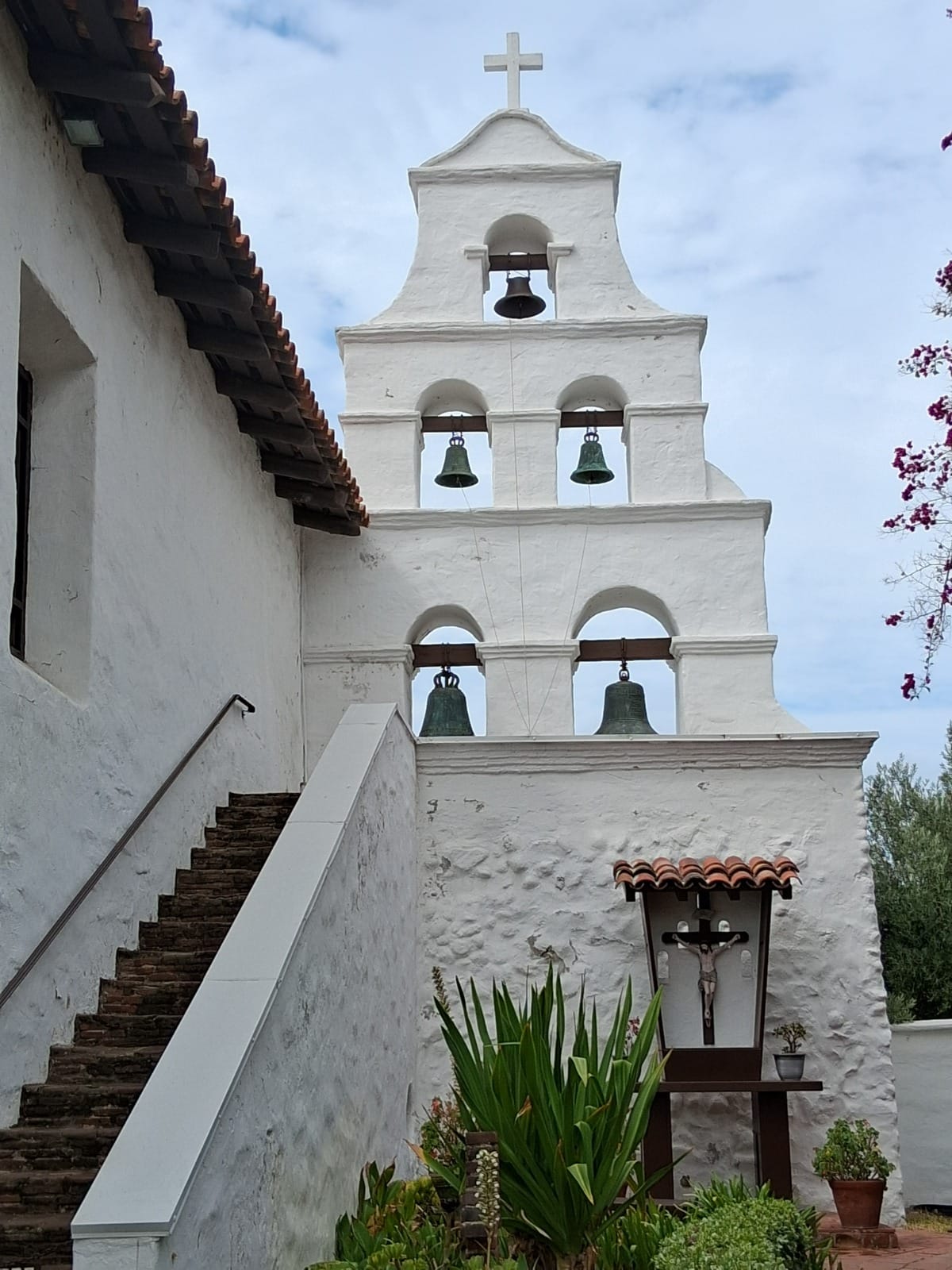
When arriving you will notice the stunning Campanario. An impressive 46-foot-tall white bell wall with distinct alcoves. It is equally admired from the meditation garden. The bells were an incredible communication system. When they rung it signalled mealtimes, work hours, religious services and emergencies. One of the bells is of particular interest as it is an original cast bell dating 1802.
The Historic Mission Church and St. Joseph’s Choir Stall
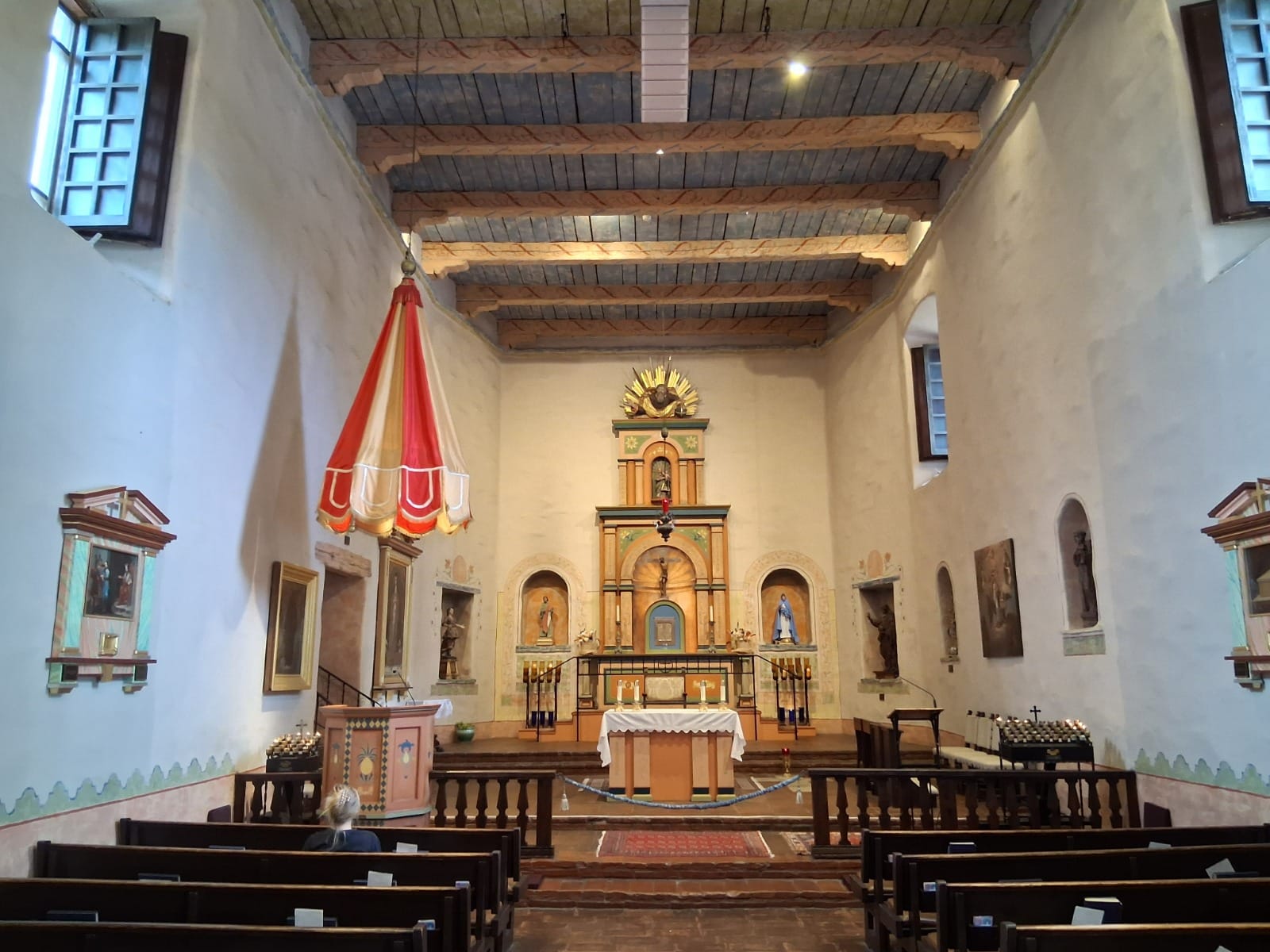
The first stop on the tour is church. Stepping inside the nave is a contrast to European churches. This church boasts a long and narrow nave and is incredibly plain and simple. No towering arches support an elaborate ceiling, no display of artwork, just plain whitewashed walls. As you enter, walk to the left end where you will find the main entrance. As you would expect you will find the font here, although it is tucked away slightly in an alcove.
Walking back to the nave, directly in front of you is the sanctuary. All points of interest can be seen here, although difficult as access to the altar area is restricted. A cross on the floor marks the spot where the martyred Luis Jayme is buried. Also buried with him Friar Juan Figuer (d.1775) and Friar Juan Mariner (d.1784).
Also, around the altar you will be able to see a few pieces of artwork. Most of them dating from the 19th century, there is one of particular interest. It is a painting of the Saint Didacus de Alcala, it was brought over on one of the first expeditions to these shores.
The Peaceful Courtyard and Meditation Gardens
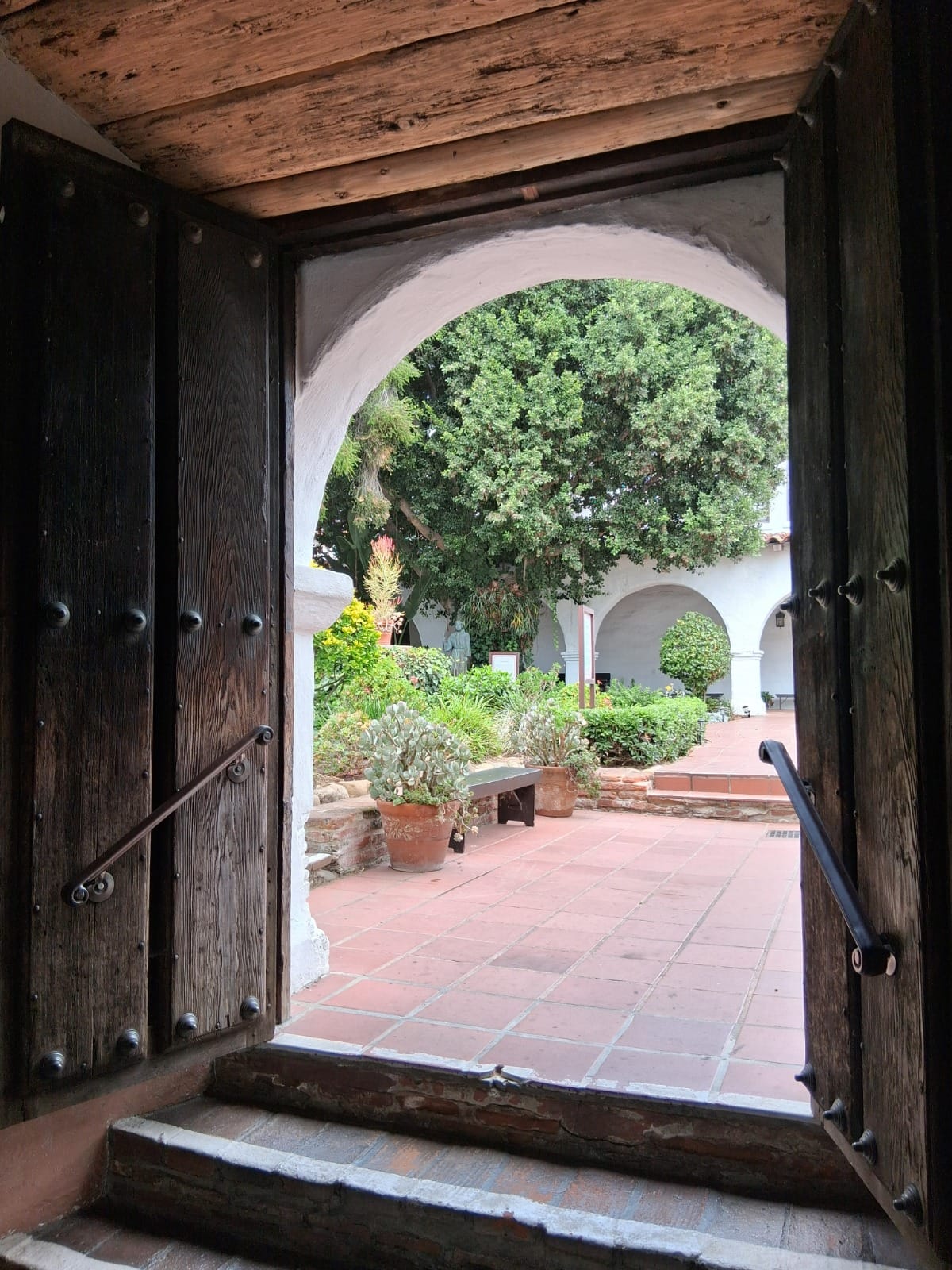
In spring the courtyard is alive with colour, as budding roses add a kaleidoscope of colour to the courtyard. On this hot summer’s day, the whitewashed walls blind you with their brightness as you step out of the church. Carefully placed trees offer some respite from the beating sun. The white walls surround a peaceful courtyard which is home to several statues. These include statues of St. Joseph, St. Francis, St. Anthony & St. Junipero Serra. Don’t forget the view of the bell tower from here.
San Diego Travel Guide: Planning Your Visit
Ready to experience the “Mother of the Missions” for yourself? Here are some quick, practical tips to seamlessly add this cultural landmark to your San Diego travel guide itinerary.
How to Get to Mission San Diego by Trolley or Car
Mission San Diego de Alcala is located at 10818 San Diego Mission Road. The mission sits conveniently in the heart of Mission Valley. If you are driving, it is fairly simple. Use the address above or map below and drive to the site. Free parking is offered with an upper and lower deck. The upper deck offers the easiest access to the reception and courtyard.
For those without a car, arriving by public transport is also simple. You will need the San Diego Metropolitan Transit System (MTS). Easy to use, you will need to get on the green line trolley (San Diego’s name for trams) and exit at the San Diego Mission Station. Then make a short walk from the station to the Mission church.
Mission Hours, Gift Shop, and Visitor Etiquette
An important thing to do in San Diego for history buffs and to help you plan your trip smoothly, here is everything you need to know before visiting Mission San Diego de Alcalá.
- Opening times: The Mission San Diego de Alcalá is open every day of the week from 9:00 AM to 4:00 PM
- Prices: Adults ticket – $8.00. Students – $5.00. Children (6-12 years) $3.00. 55+ / Active Military / Students – $5.00 (accurate at time of writing).
- What to wear: As an active Catholic parish daily mass takes place visitors are asked to dress respectfully, have their mobiles on silent and be mindful of ongoing religious services.
- Self-guided tour: As part of your ticket, you will receive an information booklet. In the booklet you will find a map of the site and suggested route is highlighted in here. Link to map can also be found on the website here.
- Accessibility: There level access throughout the site and shop. I believe there is a lift to take you from the shop level to the church level. Staff and volunteers are here to help.
- Duration: Allow yourself 1 hour to visit and explore the Mission San Diego de Alcalá, add another hour if you do the audio or tower tour
Conclusion on Mission San Diego de Alcalá
Mission San Diego de Alcalá is truly a remarkable place where California’s vibrant, complex history comes to life. For the history buffs it is the perfect follow up to Cabrillo National Monument as you follow the history of the creation of San Diego and California.
So, whether you go for the stunning Spanish architecture, the peaceful gardens, or the historical roots, it is a stop you shouldn’t miss when visiting San Diego. Now, I want to hear from you! Have you ever visited any of California’s 21 historic missions? Which one is your favourite? Let me know in the comments below!