More to Pisa than the iconic ‘Leaning Tower’

Pisa

Pisa – city in Italy – Tuscany

Piazza del Duomo – square of miracles

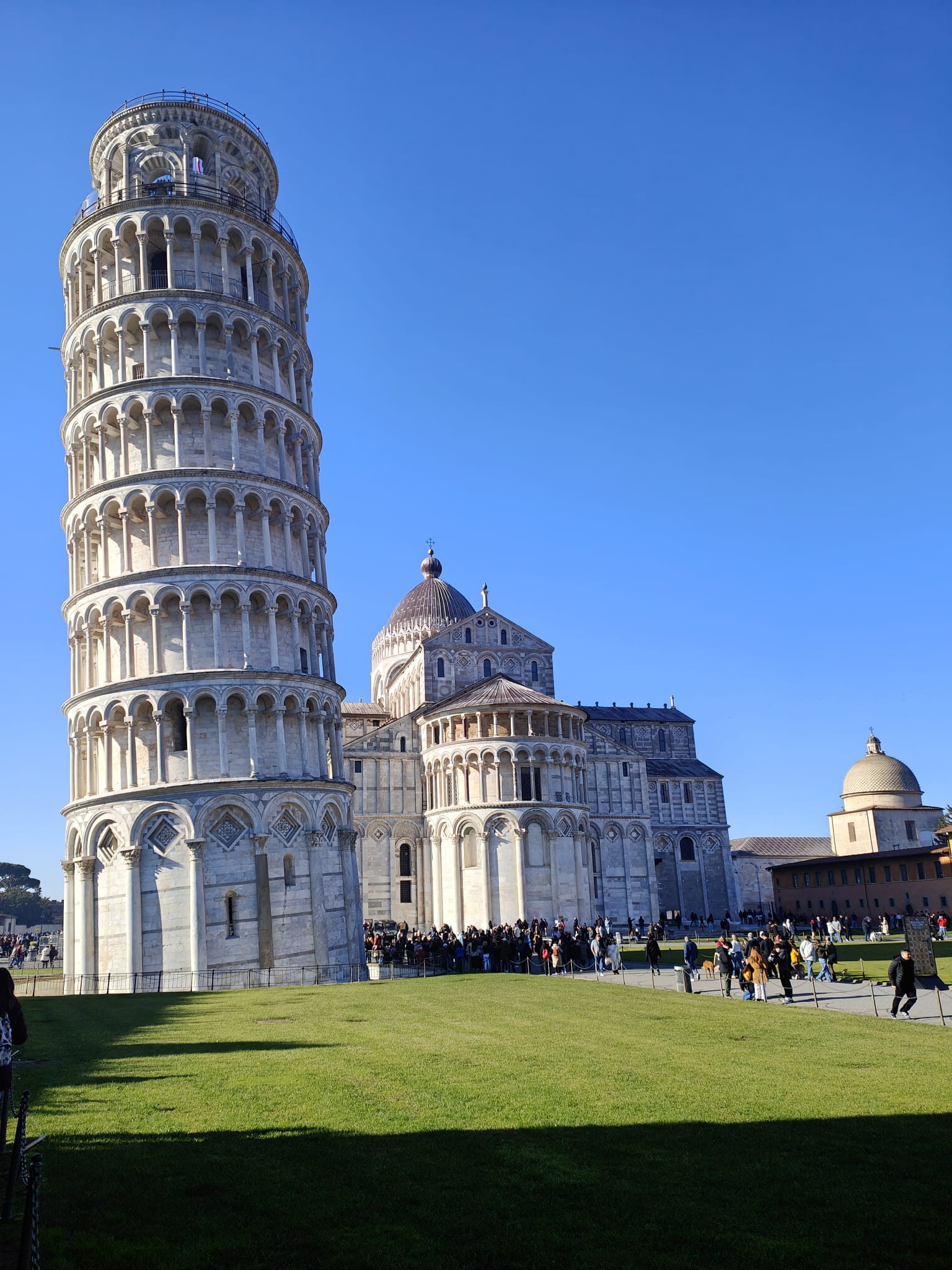
To many a visitor, Pisa is the place to pose. I start my visit to Pisa at the iconic tower which is Italy’s famous landmark. It certainly draws a crowd. The cobbled walkway between the tower and the rest of the city is a sorry state of exuberance. Crowded with wannabee influencers, they fight for a space, which hopefully excludes others from their shot.

Flaunting their search of potential Instagram fame or becoming the next viral sensation is the name of the game. As poses are engineered and the weary photographer is often sent back to take another shot from a different angle, it is hard not to fall into the trap of copying the latest photo trend. But sneak away from the obsessive self-gratification and you find there is more to Pisa than a photo op.

I would hate to guess at how many people just visit to “get that picture”. Can you say you’ve really visited if you haven’t climbed the tower? Spontaneity is a distant memory these days; turning up on a whim is a fool’s dream. The ease that pre booking gives you is stark contrast to the mayhem of people queuing and trying to get tickets. Some leave with the satisfaction of climbing the tower and visiting the cathedral. Others you imagine are equally satisfied with their picture!

Tower of Pisa aka ‘Leaning Tower of Pisa’

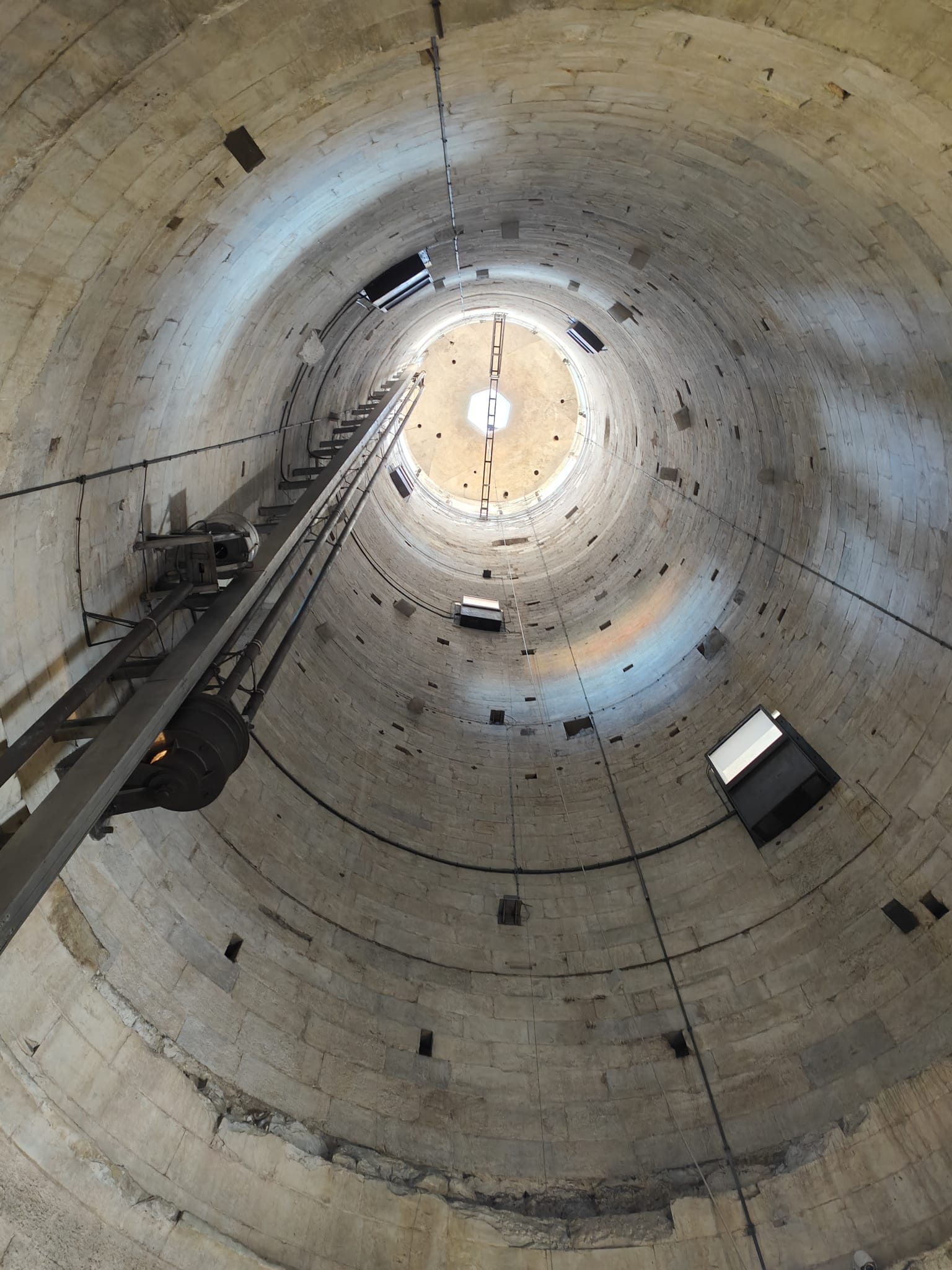
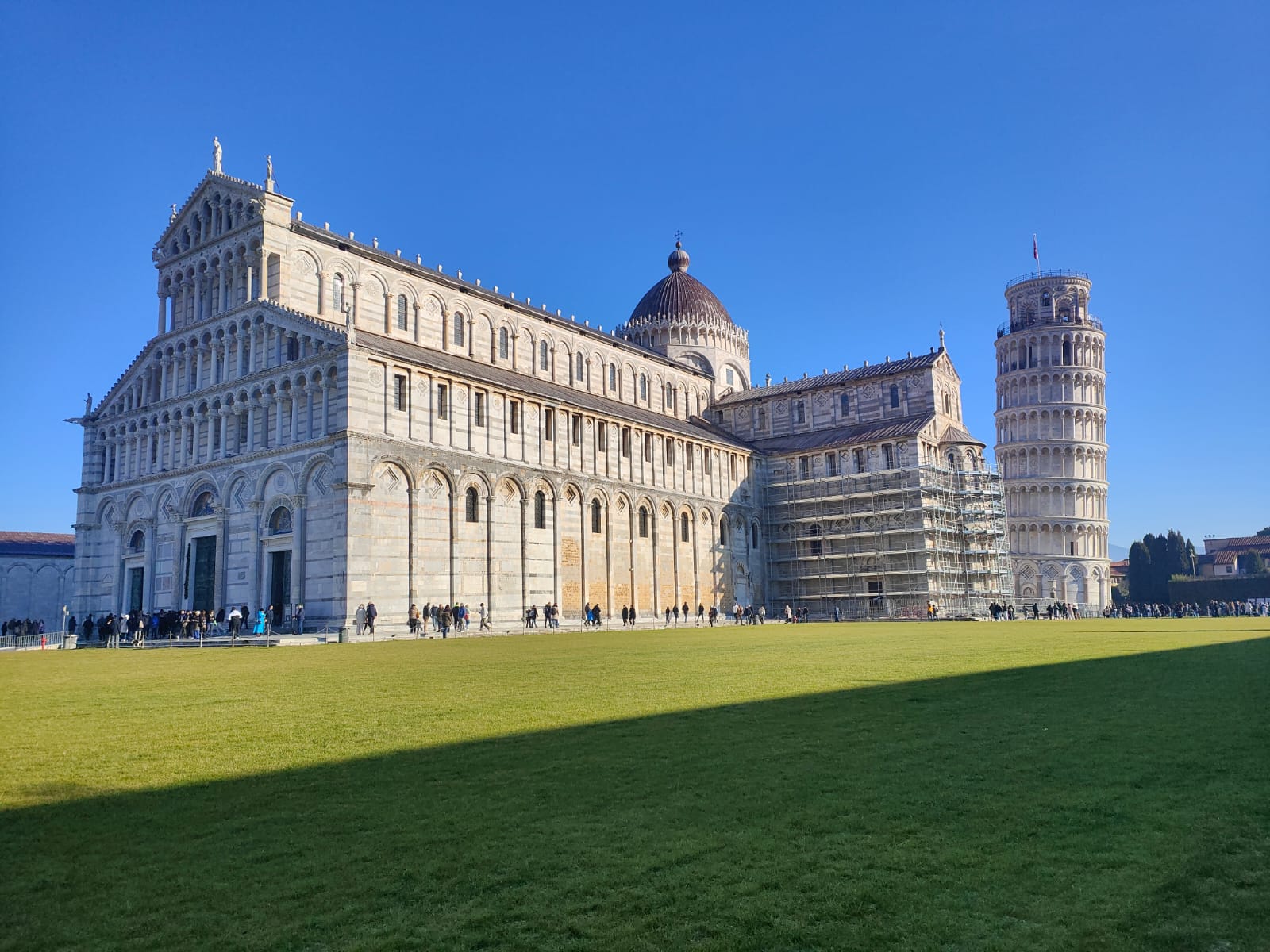
The tower is a real tick in the tourist checklist. Climbing the 294 steps up the tower is surely a must! Even without it’s lean the tower is rather impressive. The tower was built to house the cathedral’s bells and is unusual as it is set completely apart and to the rear of the cathedral.

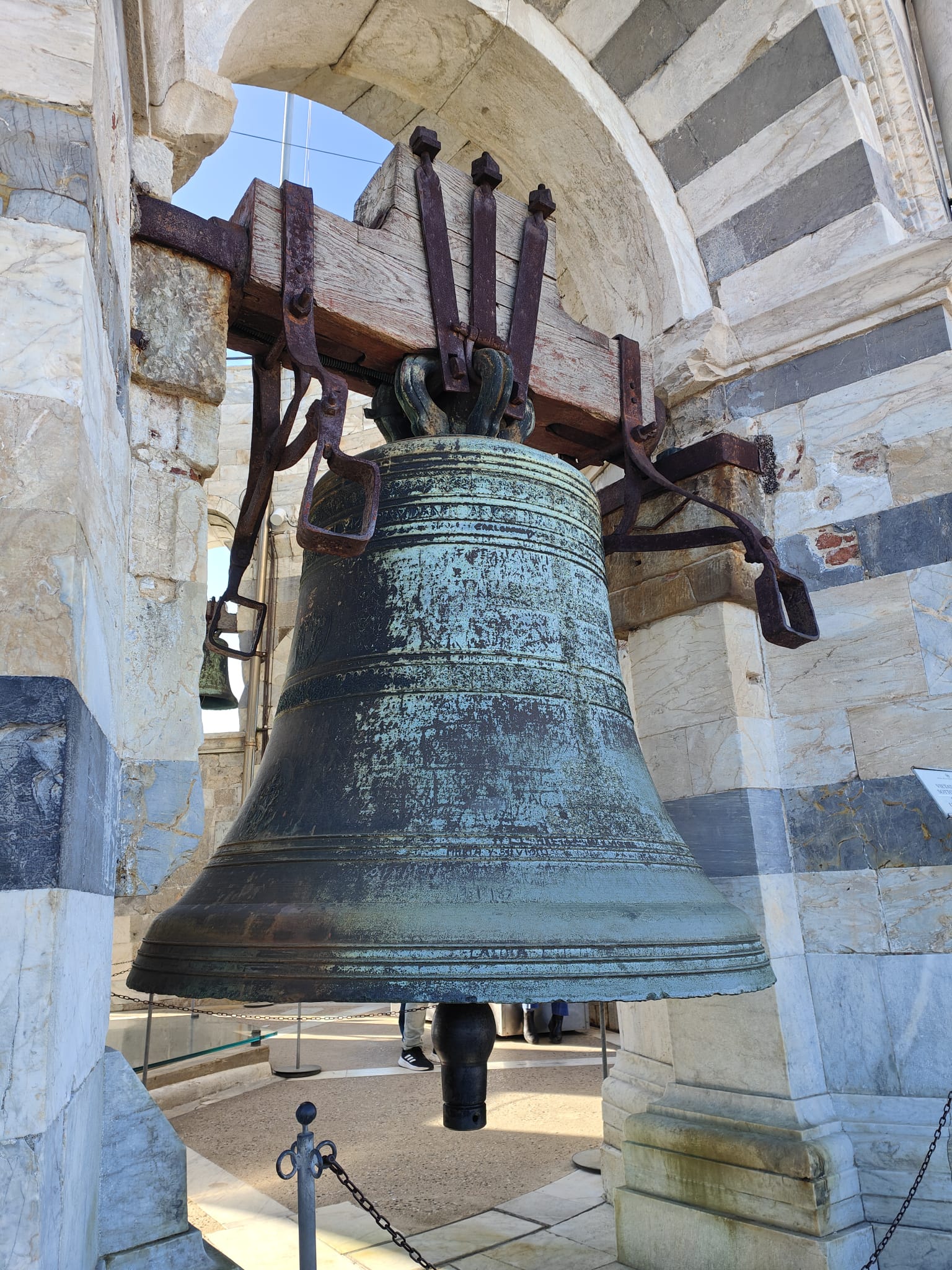
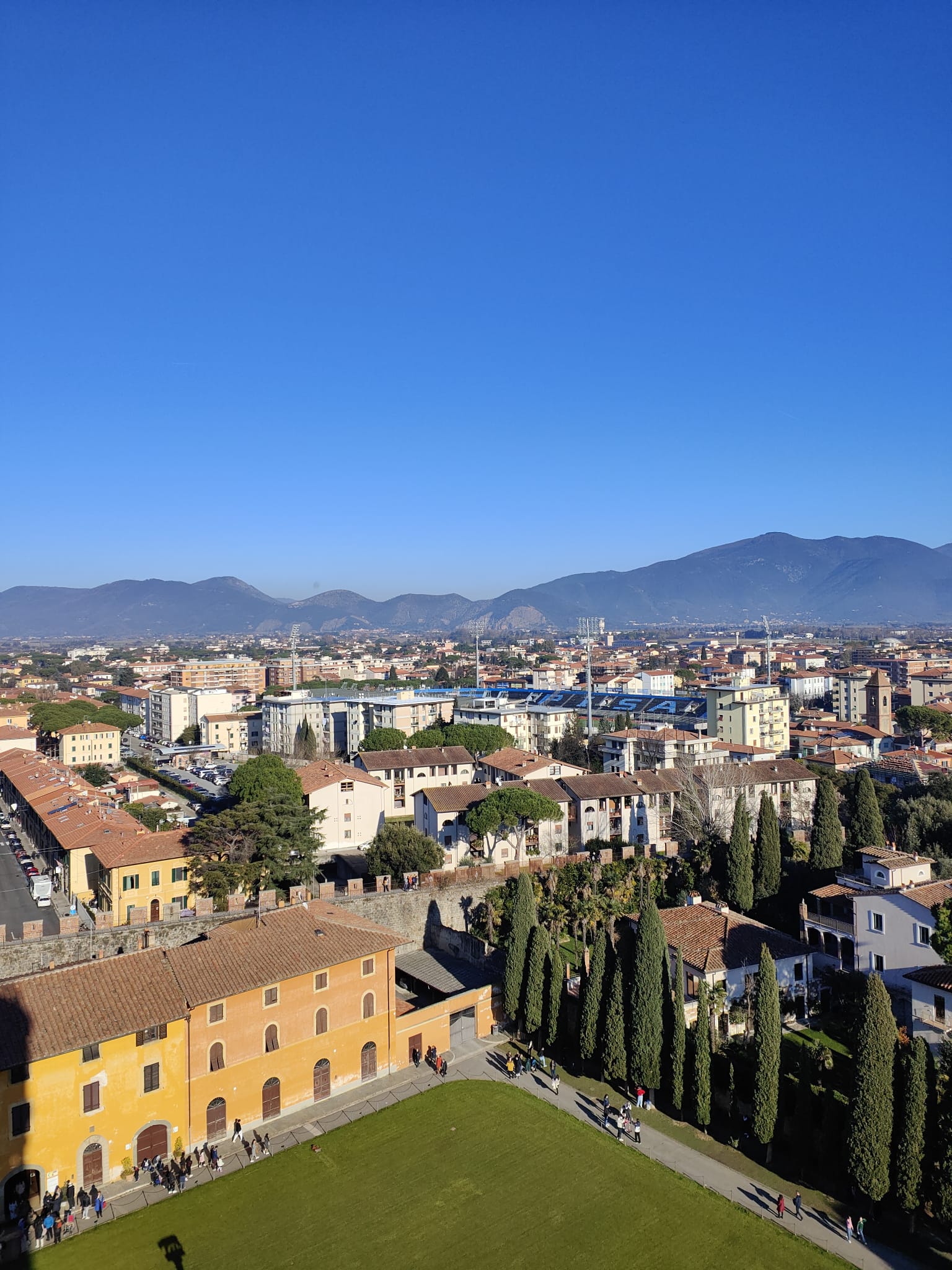
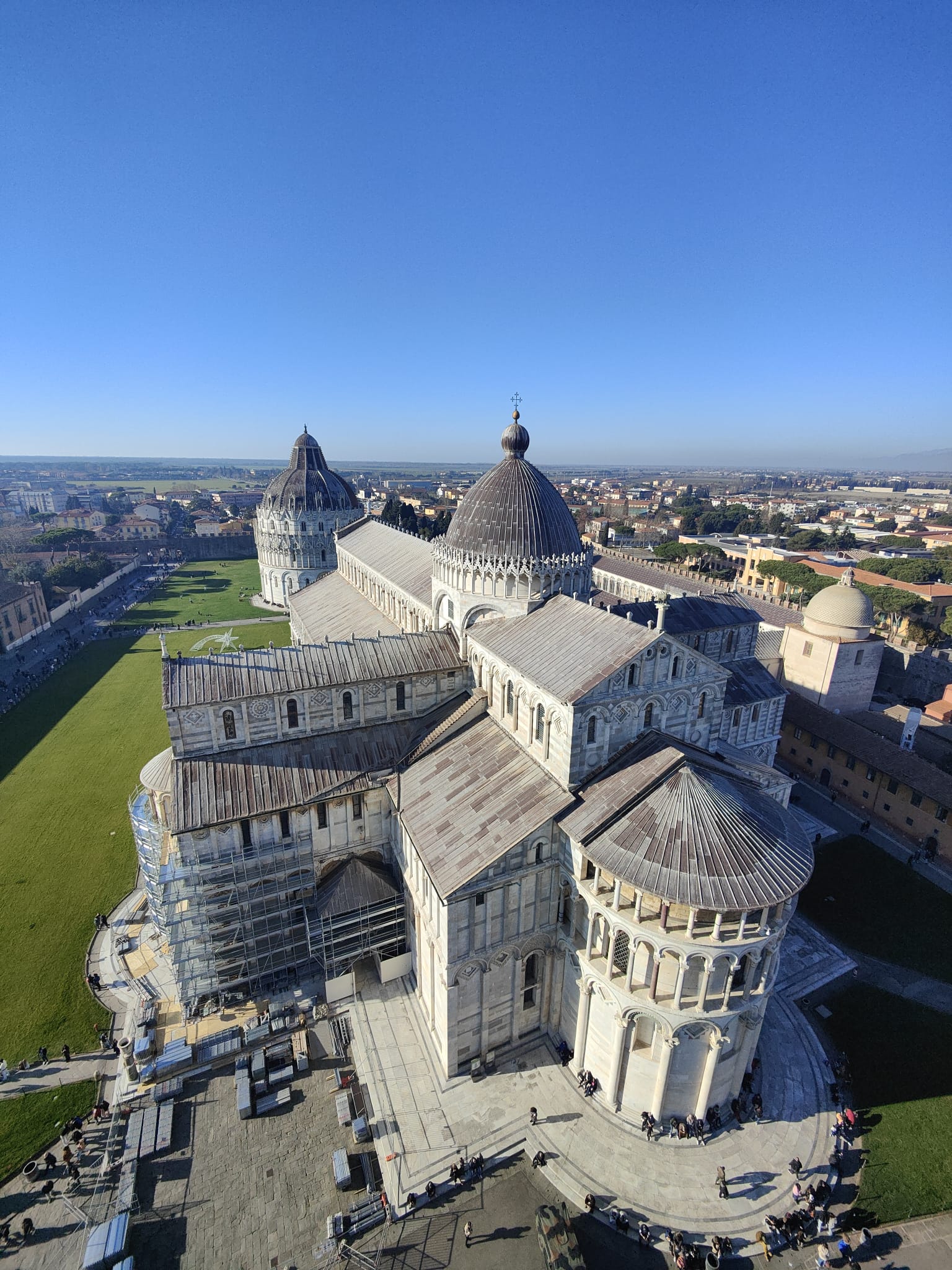
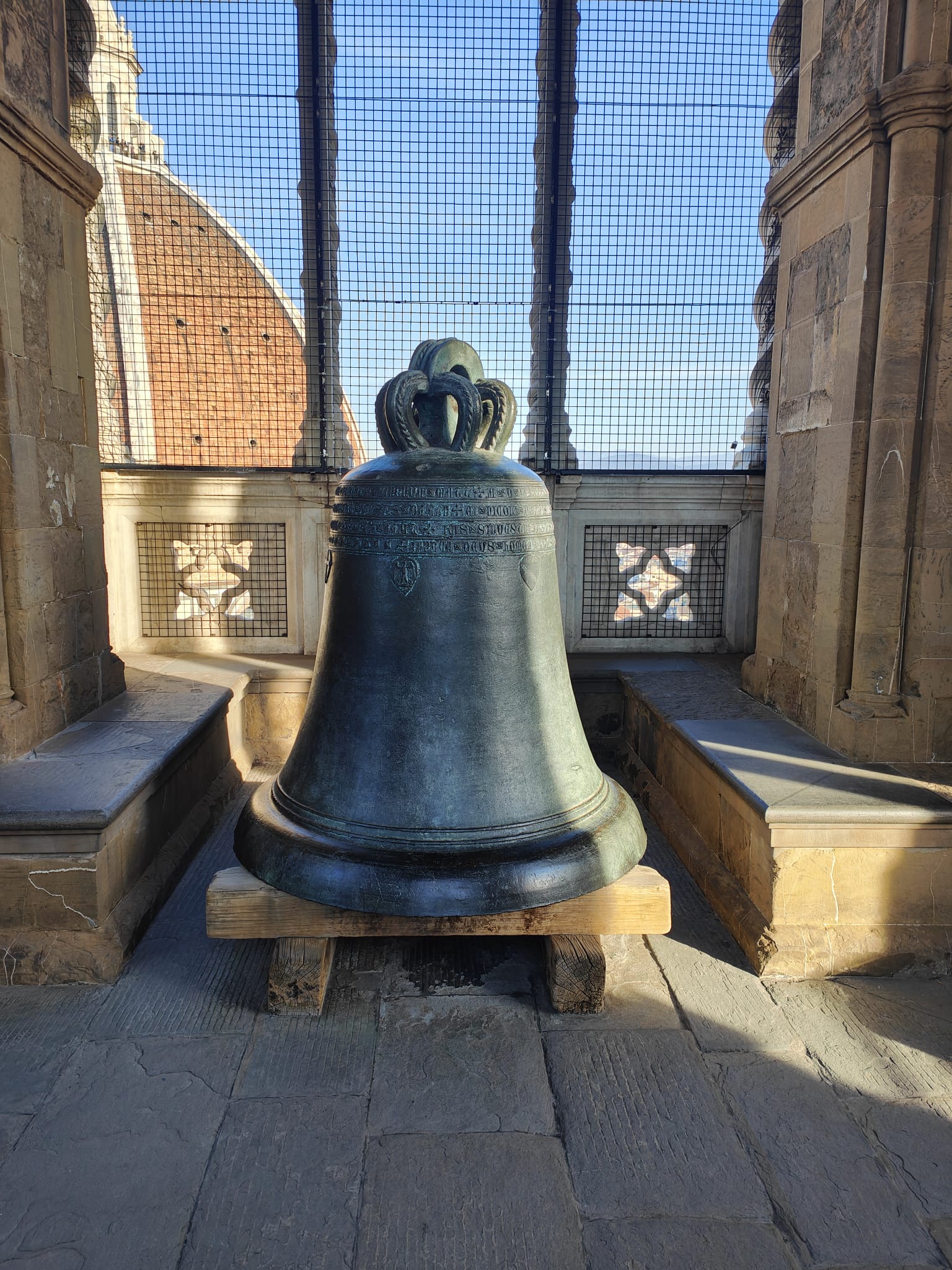
There are some similarities between the ‘Tower of Pisa’ and Giotto’s campanile in Florence. Building began on the ‘Tower of Pisa’ in 1174 by Bonanno Pisano. Work came to a halt when the tower started sinking into the ground before it was finally finished in the 14th century.  The belltower is home to 7 bells. Walking around the lopsided top floor is a weird sensation. The view, though, is richly rewarding and shows impressive views of both city and cathedral.

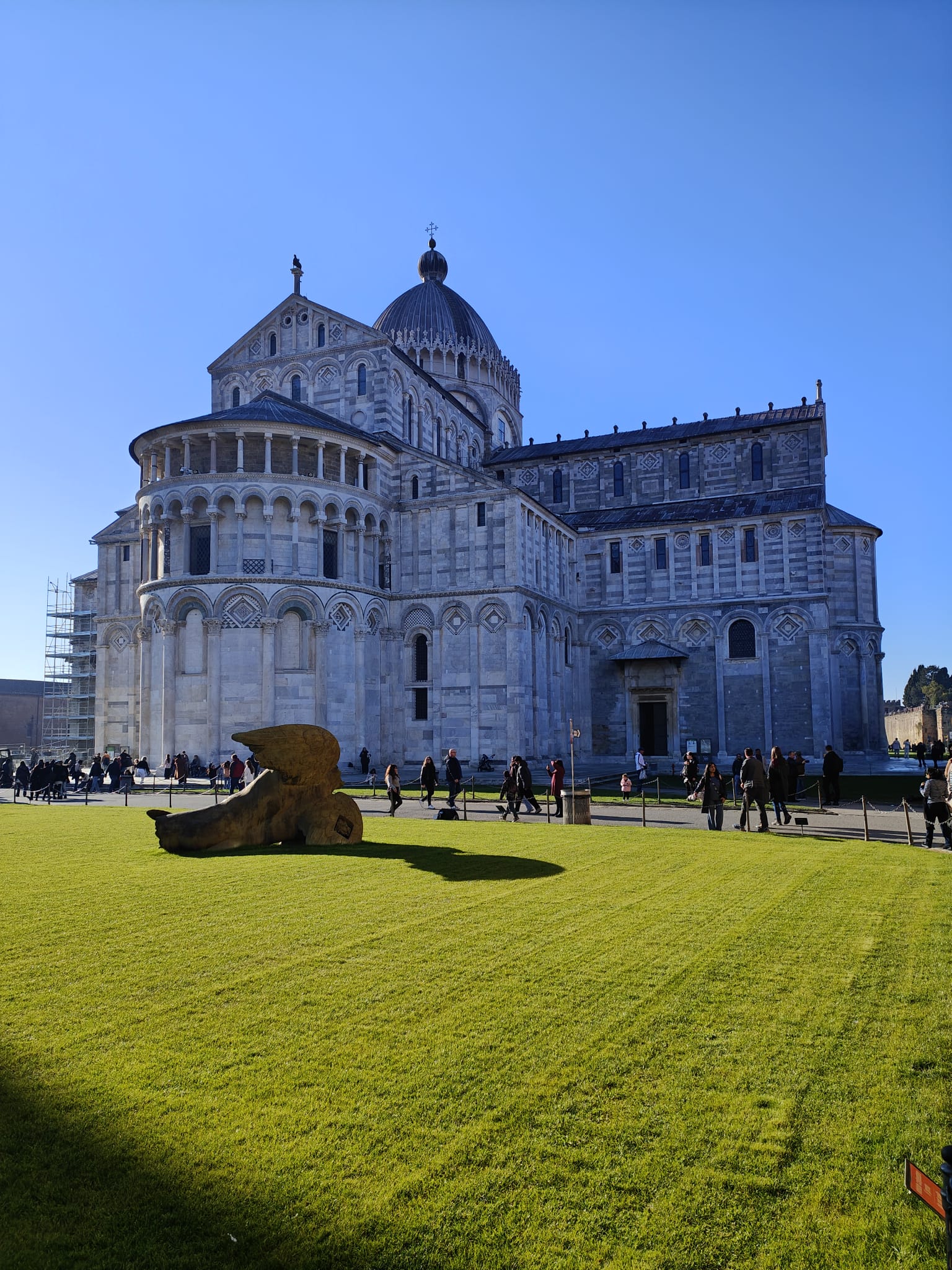
The blogs of my meanderings have often mentioned a cross like shape when visiting cathedrals. When looking from above you immediately see the Latin-cruciform plan. The sheer size of the cathedral is impressive and immediately shows what the Florentines were competing against. Of the bell towers visited thus far around Italy (Bologna & Florence), is this the better one?  

Pisa Cathedral – Metropolitan Cathedral of the Assumption of Mary

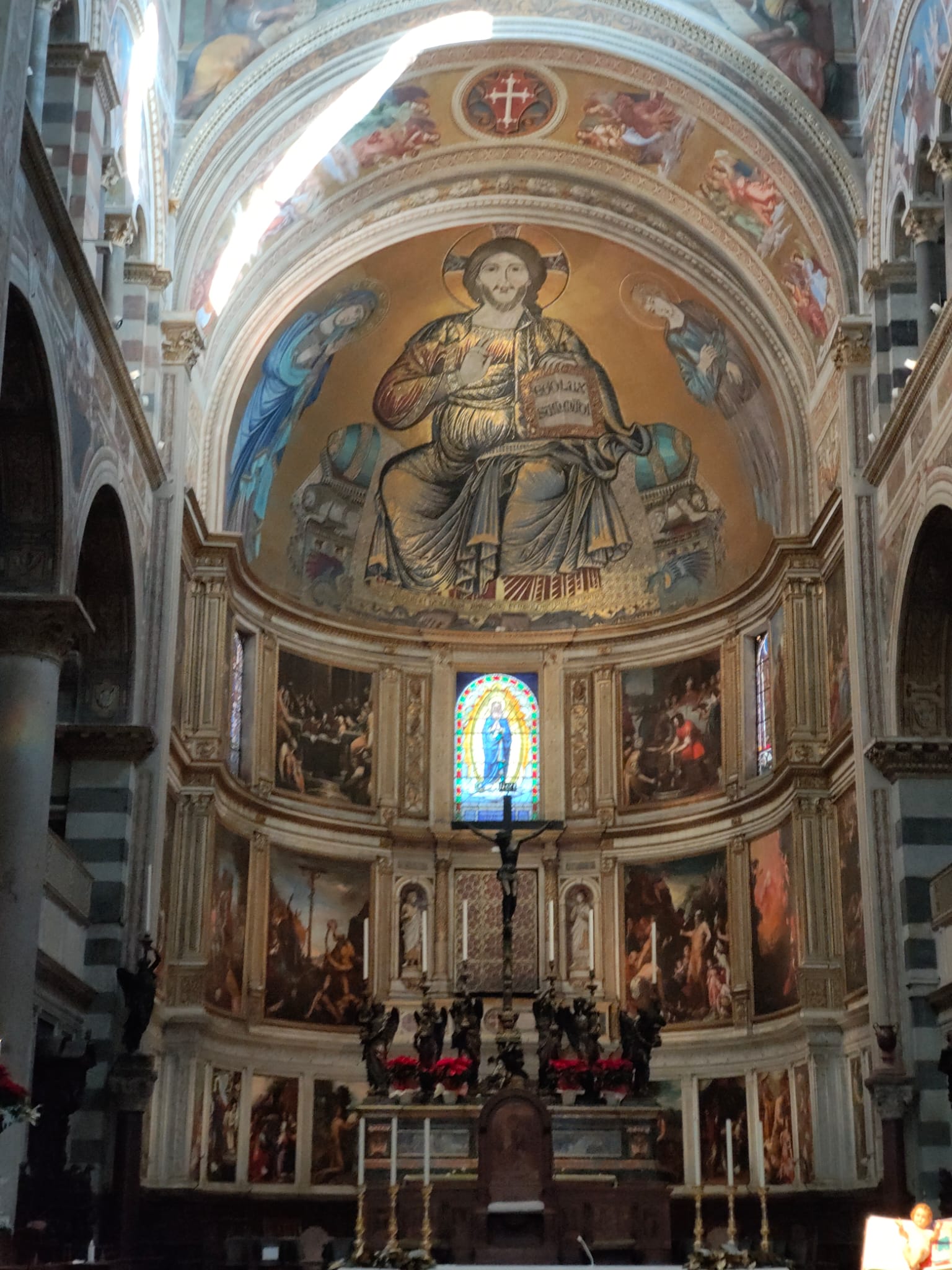
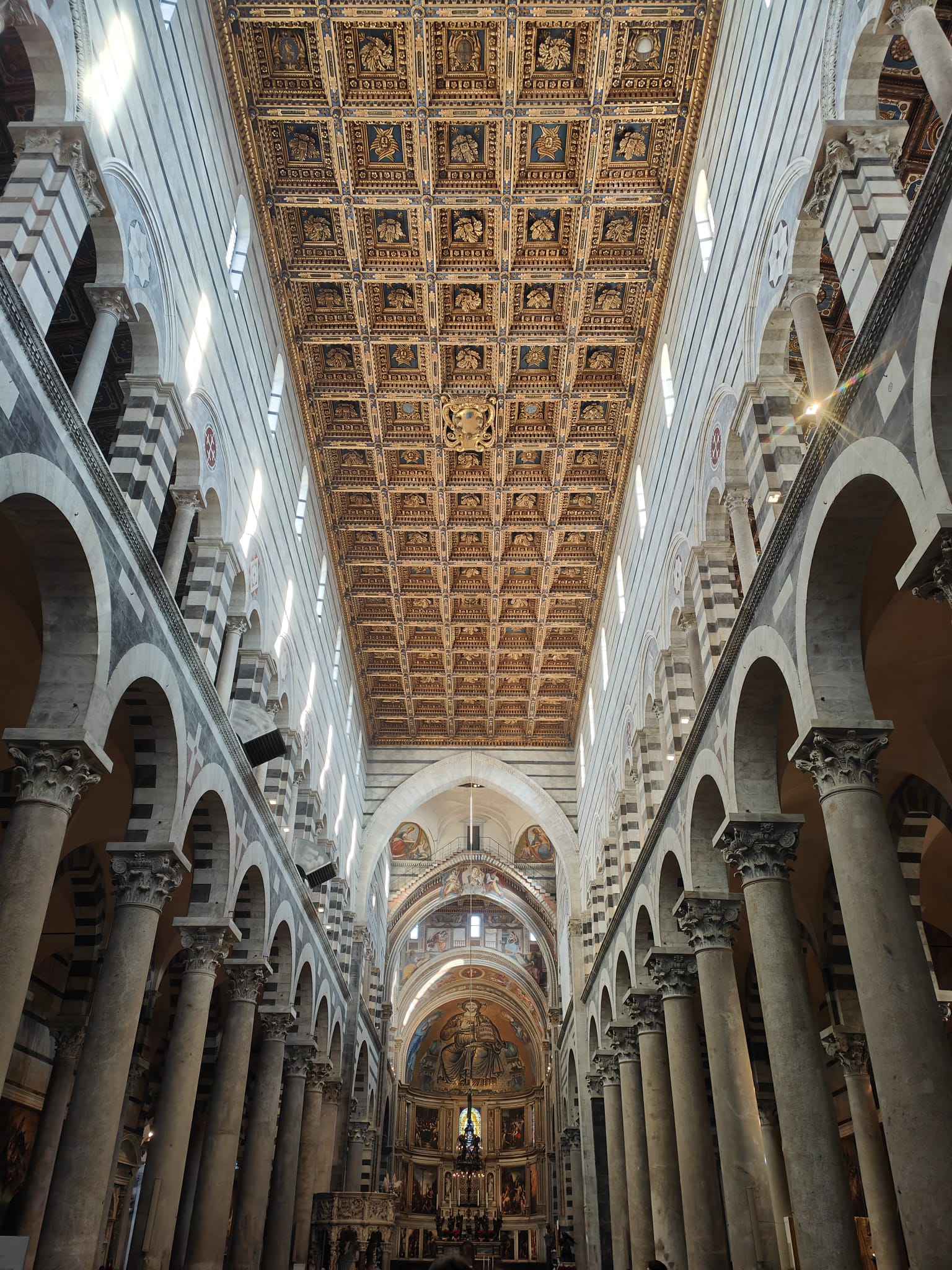
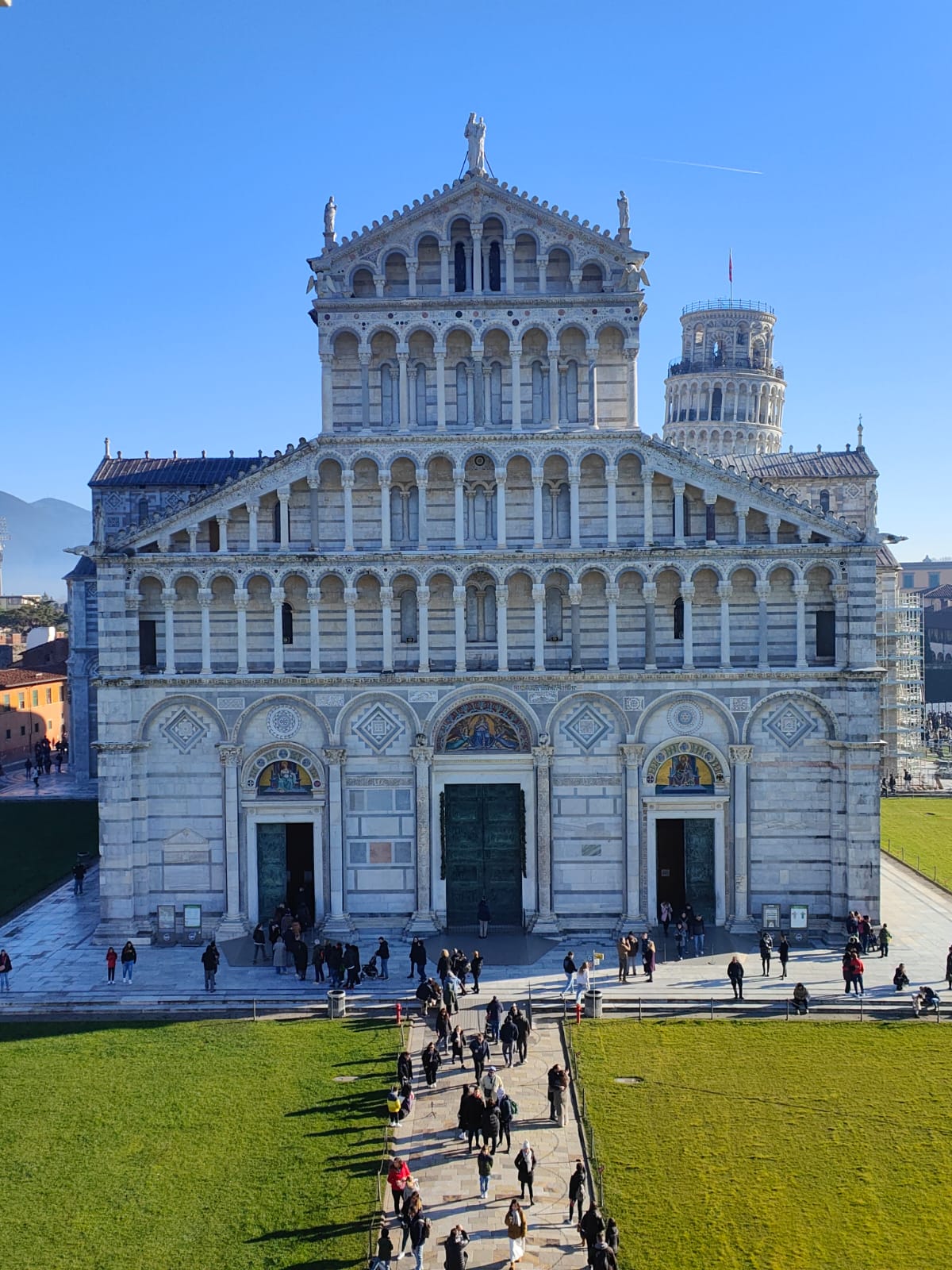
Construction of the cathedral began as early as 1064. Stepping inside shows more clearly the age of the building as examples of plain and simple Romanesque architecture are evident. Further investigation shows influence from around the world. Those influences come from the Moors, Byzantine, Islamic and Armenian cultures – a true testament of the diverse wealth created by the merchants during Pisa’s maritime republic.

Construction finished in 1092, and consecration took place in 1118. Enlargements took place over time until a devasting fire broke out in 1595. This took the roof off, damaged the entrance doors and many pieces of art. The doors seen today are not those of Bonanno but made by the artists of the school of Giambologna.

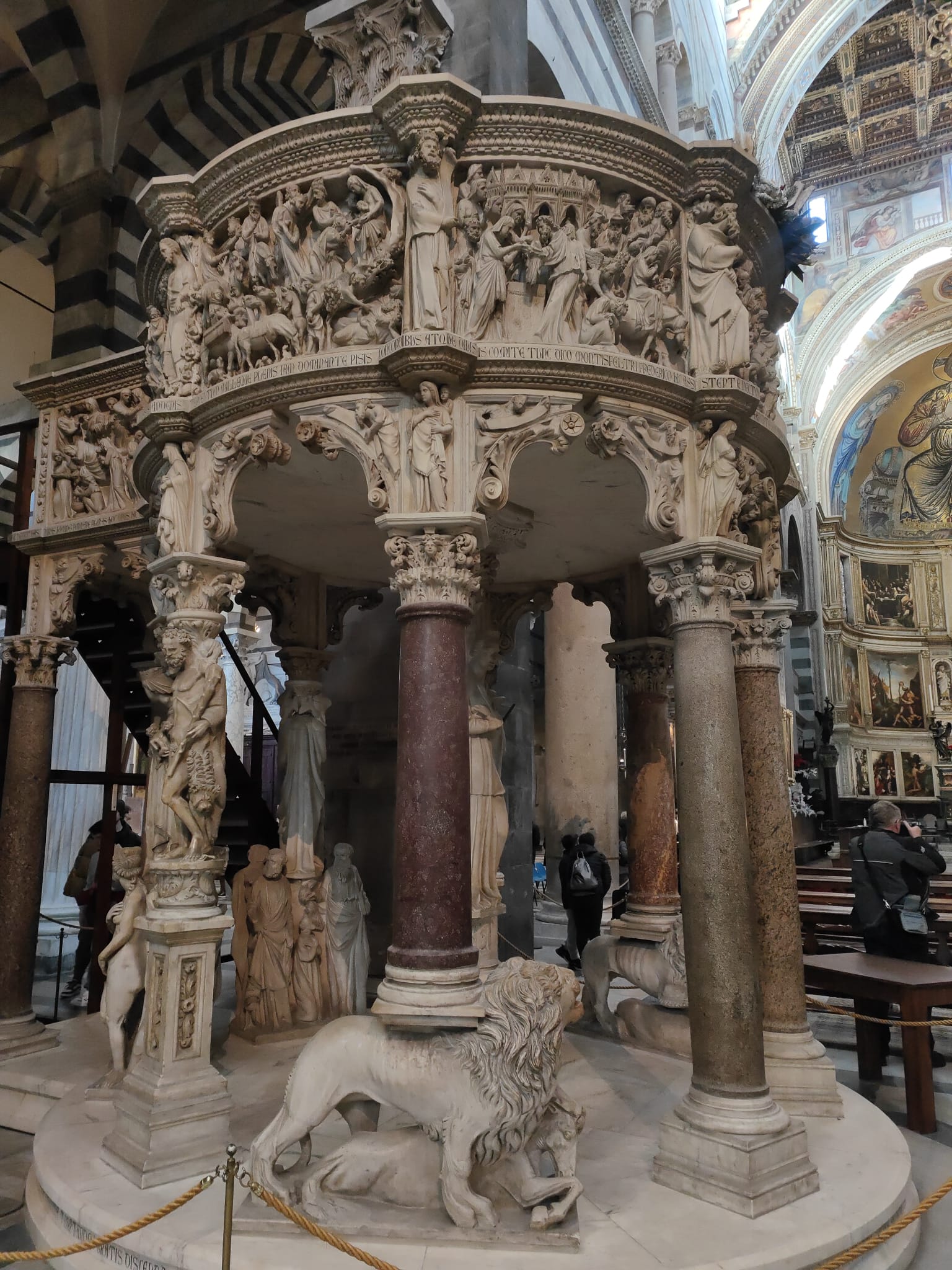
The pulpit in Pisa cathedral is incredible. Carved by Giovanni Pisano in 1302 and completed it in 1311. The pulpit is certainly elaborate with the carvings showing the main episodes of the life of Christ.  

Pisa Baptistery of St. John and Camposanto Monumentale

Once you have completed visits to the cathedral and its famous tower take the time to explore the two other points of interest that may be seen on purchase of a full ticket – the largest baptistery in Italy and the Camposanto.

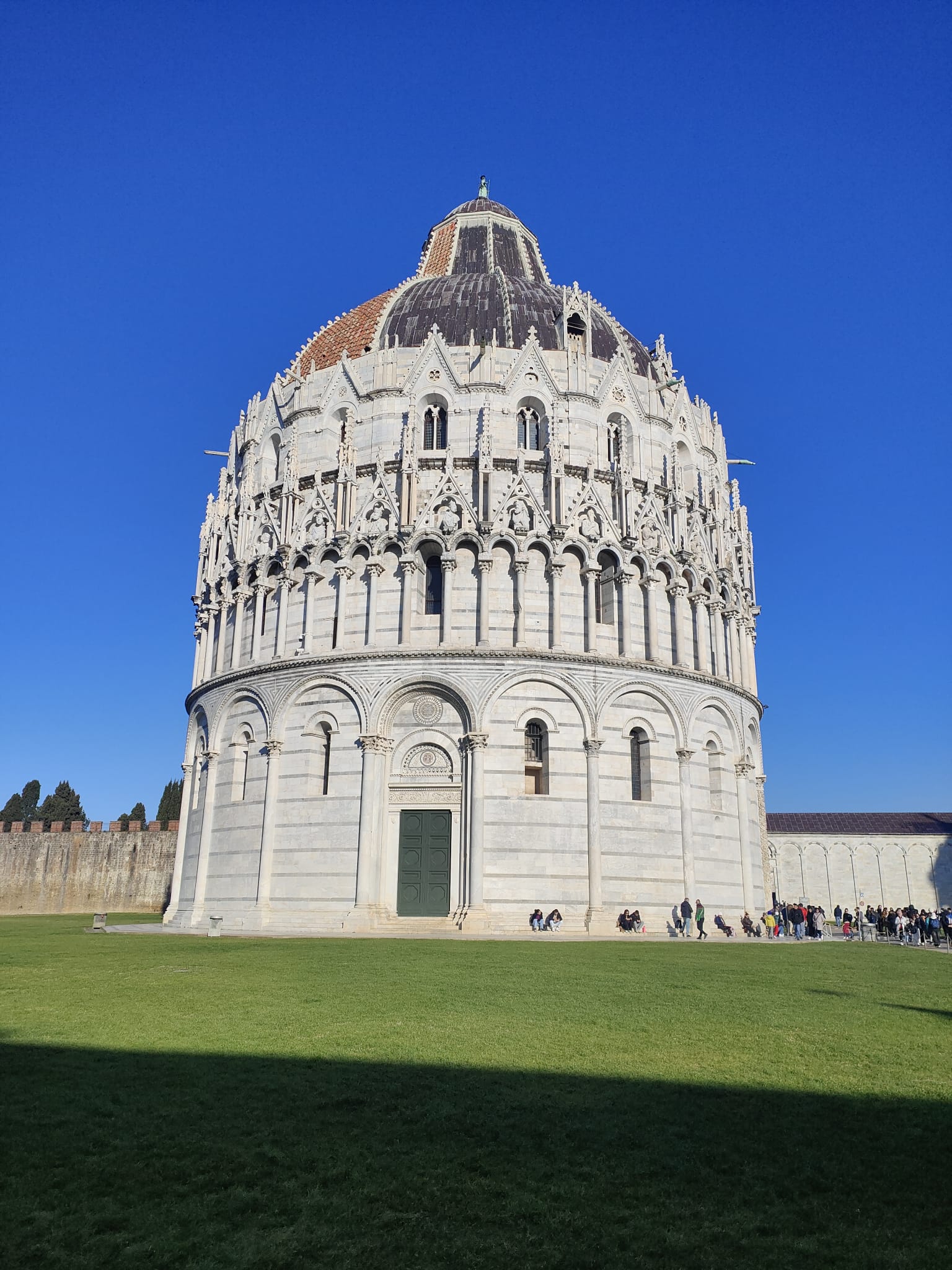
The baptistery is perhaps best viewed from the outside where you will notice that the roof is unusual. The roof is split into two halves. One half of the roof faces the sea and is finished in rich red tiles that glow at sunset. The other half is covered in lead and catches the rays of the rising sun. It’s hard to believe but the baptistry is taller than the leaning tower.

Inside the baptistry is rather plain and simple. 12 columns which represent the 12 apostles tower up to the upper gallery which is the best place to listen to acoustics of melodies that are performed daily. Also, on the upper floor, there is one window which offers a fantastic view (and perfect photo spot) of the cathedral front and tower behind.

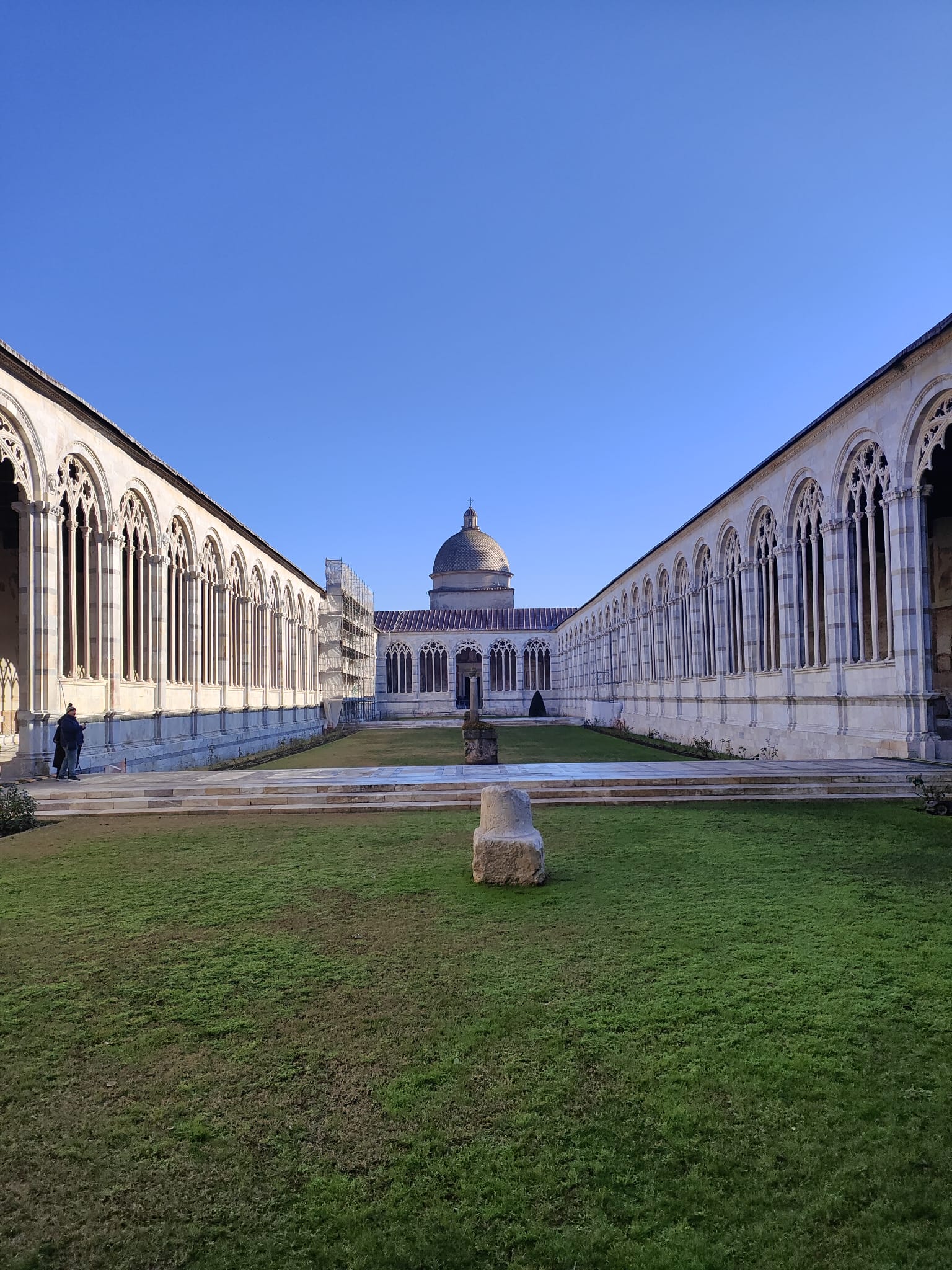
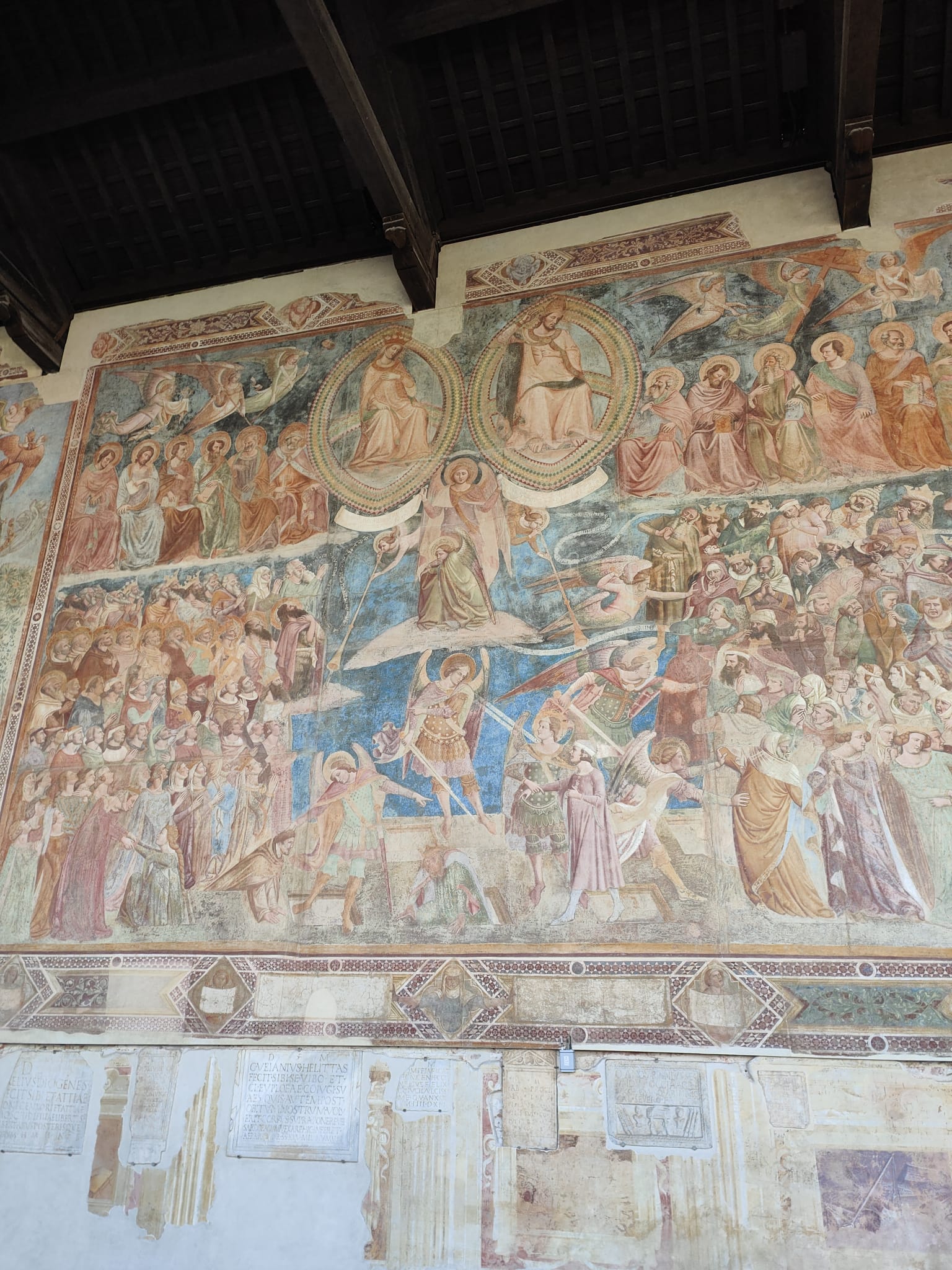
Less visited of all the 4 sites is the Camposanto Monumentale (monumental churchyard). Inside you will find evidence of medieval paintings and sculptures. It was also decided that the Roman coffins should be housed rather than randomly scattered around the Duomo. Built in 1276 at the behest of Archbishop Federigo Visconti the architecture is outstanding. Legend has it that the churchyard was built on a mound of soil brought back from the Holy Land in 12th century.

Mura di Pisa – Pisa’s City Walls

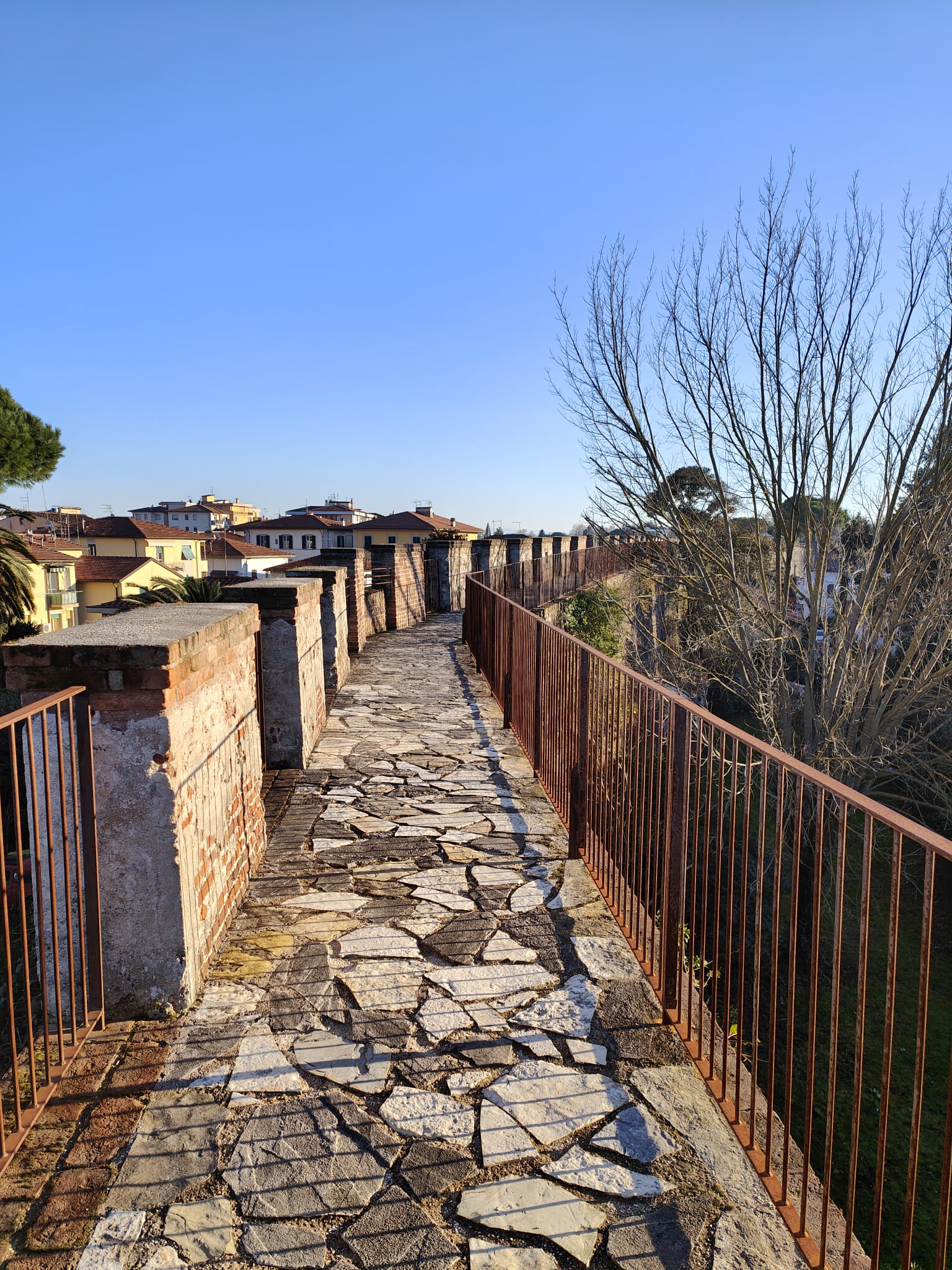
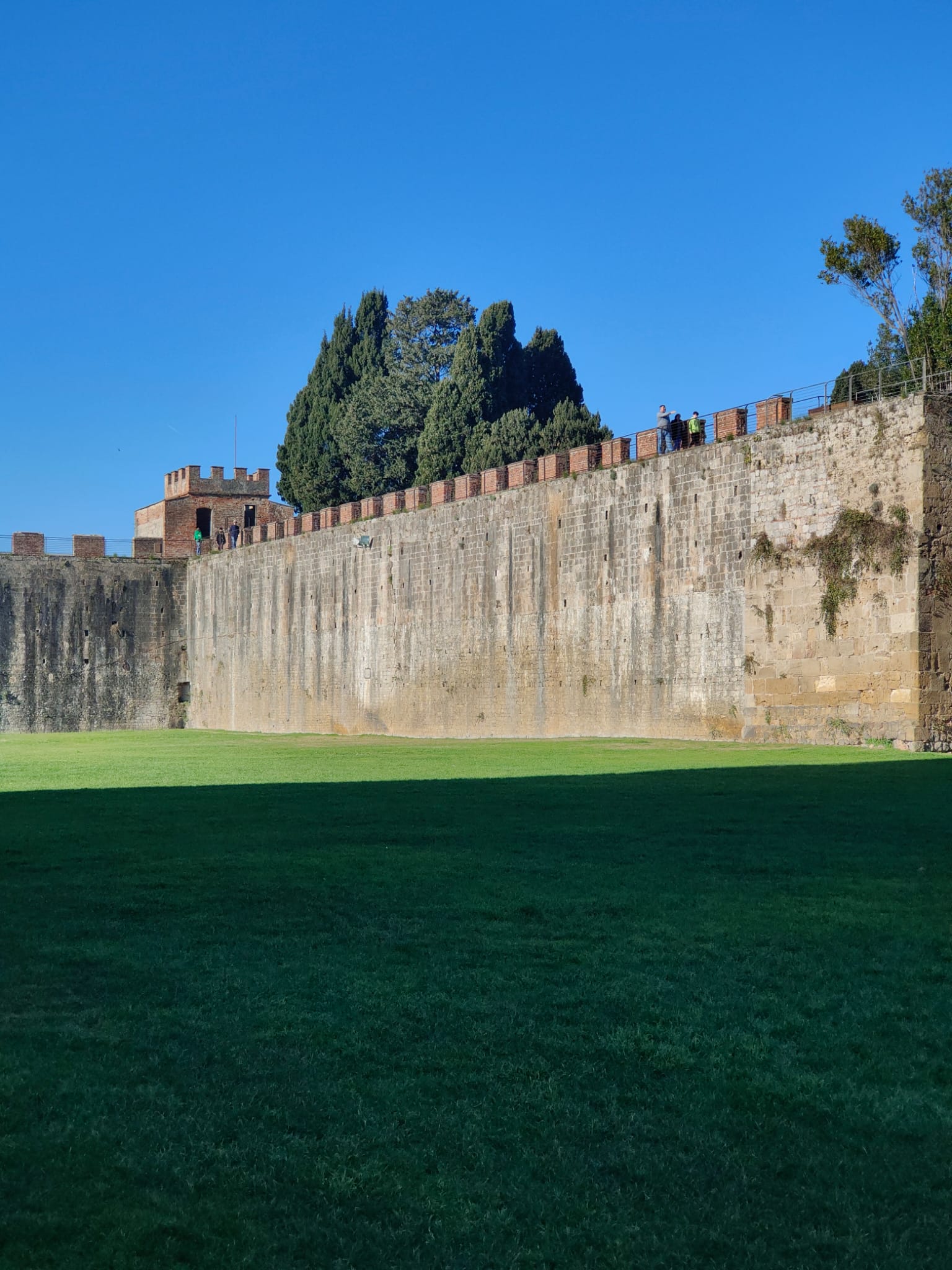
After completing the ‘square of miracles’ take time to explore the rest of the city. From the square an alternative and more serene route is to walk the old city walls. Entrance is located just behind the Camposanto where a small entrance fee is required. The towering 11m high medieval walls provide a different and interesting perspective of the city. Along the 3km route there aren’t many points of interest once you leave the square of miracles.

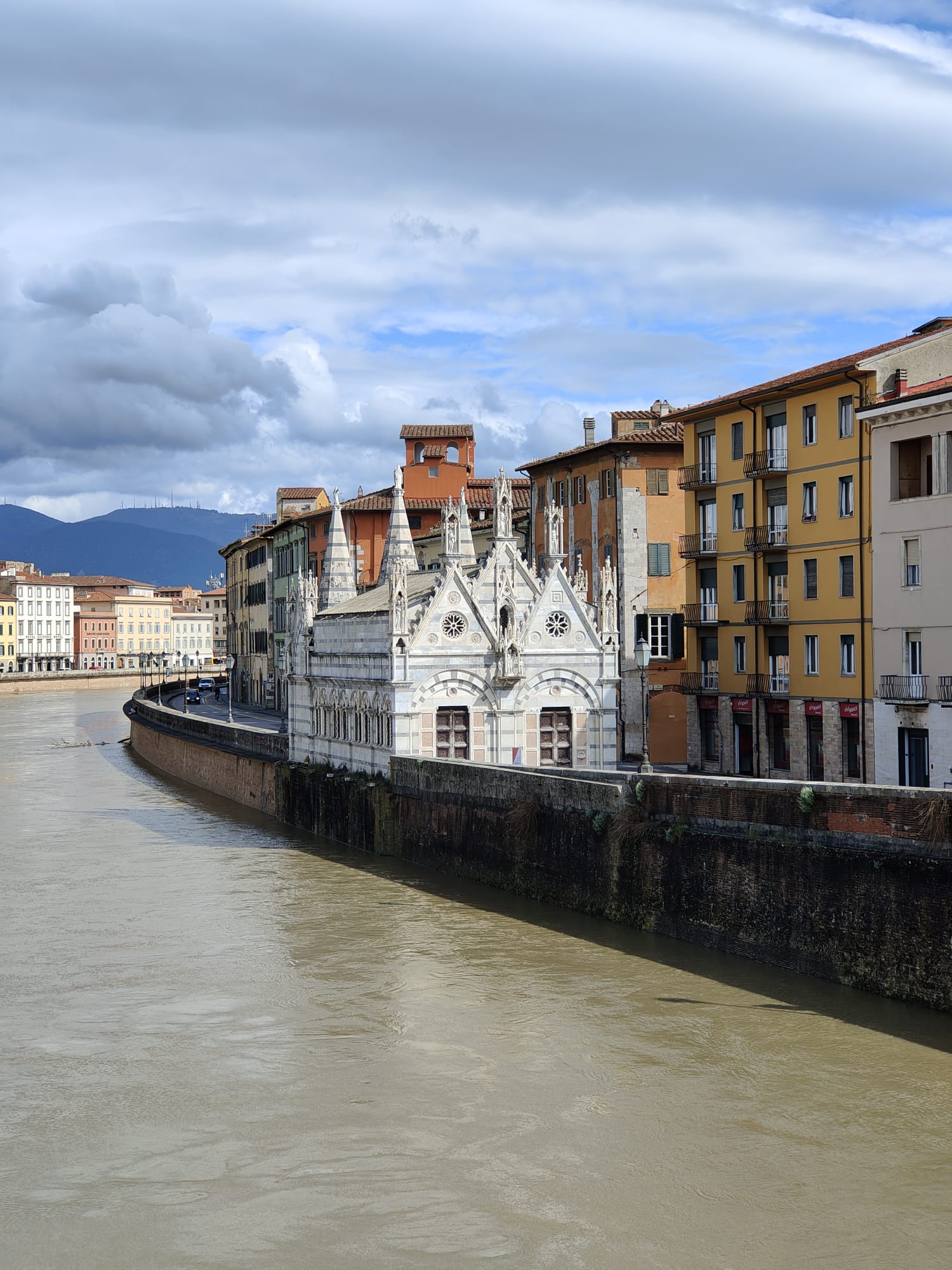
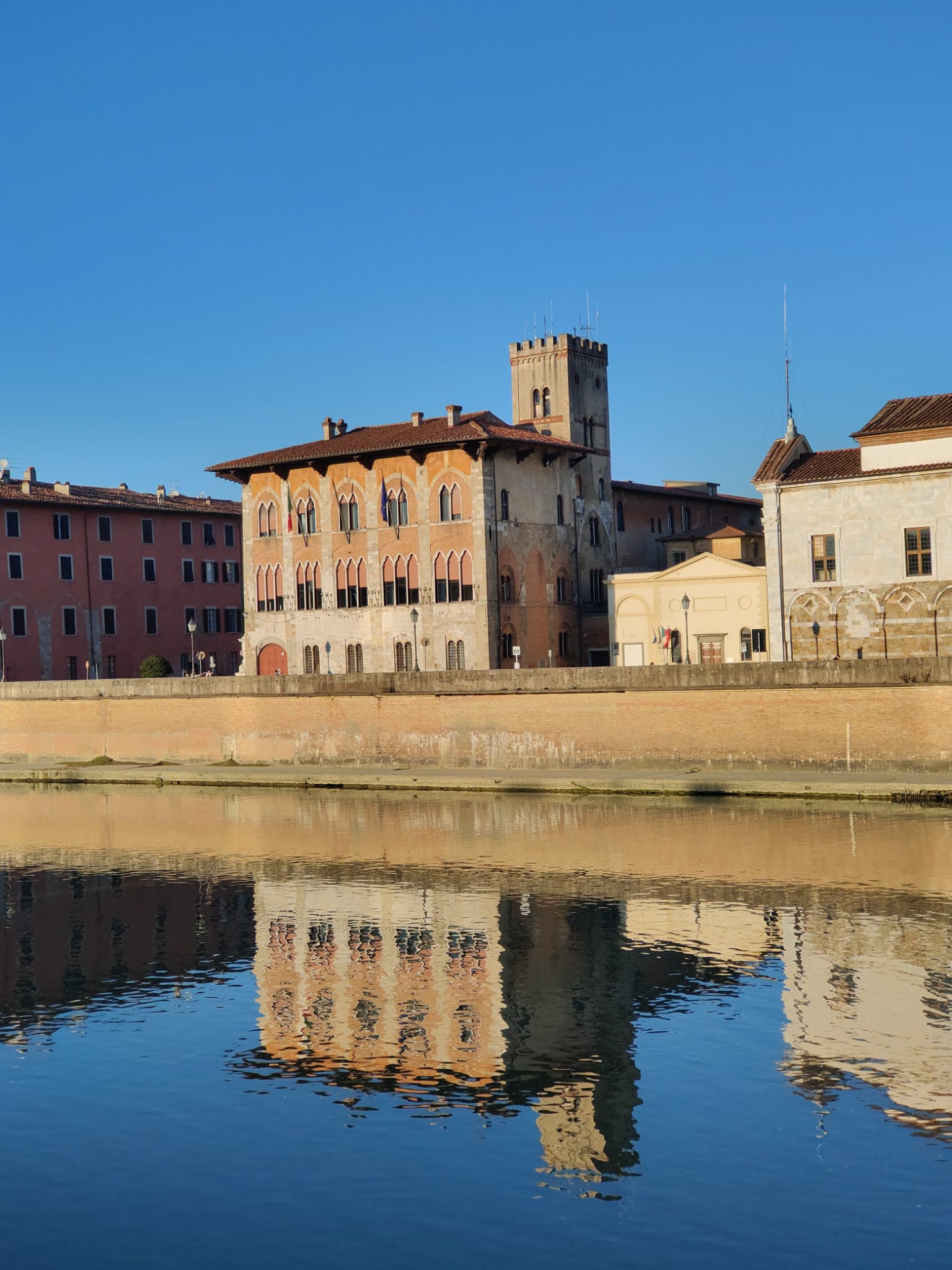
The end of the city walk brings us out on the edge of the River Arno, the famous river that flows from its source in the Tuscan Apennines through Florence and now Pisa. On this fine day its simmering reflections greet us with our weary limbs as we head to the city centre in search of refreshments. Our exhaustion and lack of time mean visits are not made to some of the interesting and historical places along the river. The Medici family villa was easily recognisable on the other side of the river as we walked past. You shouldn’t ignore Chiesa di Santa Maria della Spina – sadly it wasn’t open when we passed.

Medici in Pisa

Pisa is often referred to as the other Medici capital. In the winter they would hold their court in the city. With hindsight I should have acquainted myself with details of the influence the Medici family over the city before the visit and should have dedicated more time to explore this part of their history.

We stop close to the Logge dei Banchi, formerly Logge dei Mercanti or del Buontalenti, which was built by Grand Duke Ferdinando I de’ Medici in 1606. The Medici coat of arms is emblazoned on the outside of the building. We then cross the river and head back into the city and back towards the square of miracles.

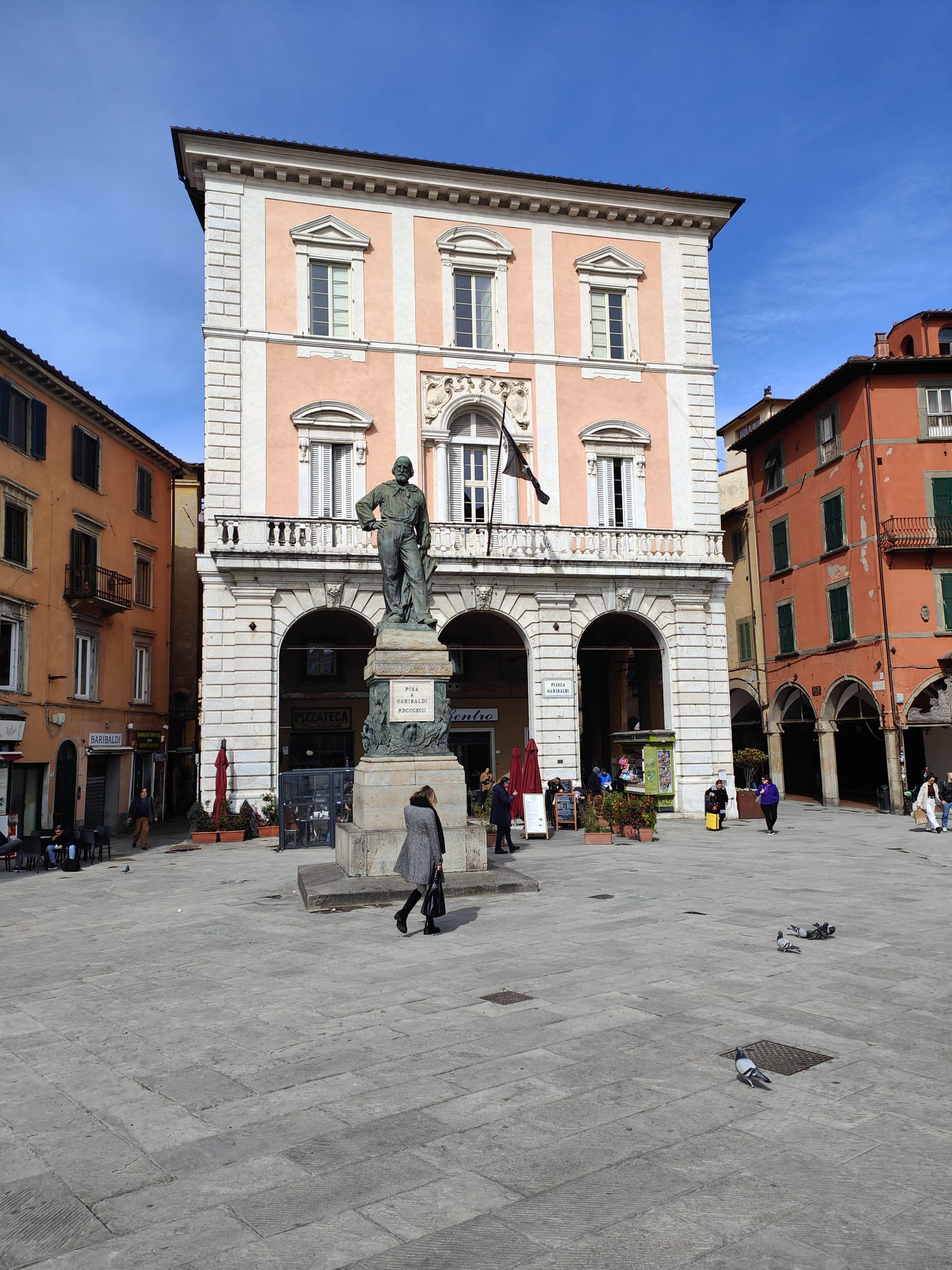
Directly opposite us on the other side of the river is Piazza Garibaldi which, as you guess, is named after the statue of the general who played a key role in the unification of Italy. This is another major part of Italian history I need to learn about. I can recall seeing his statue in Bologna and now Pisa – evidently, he was a man of clear importance in Italian history.

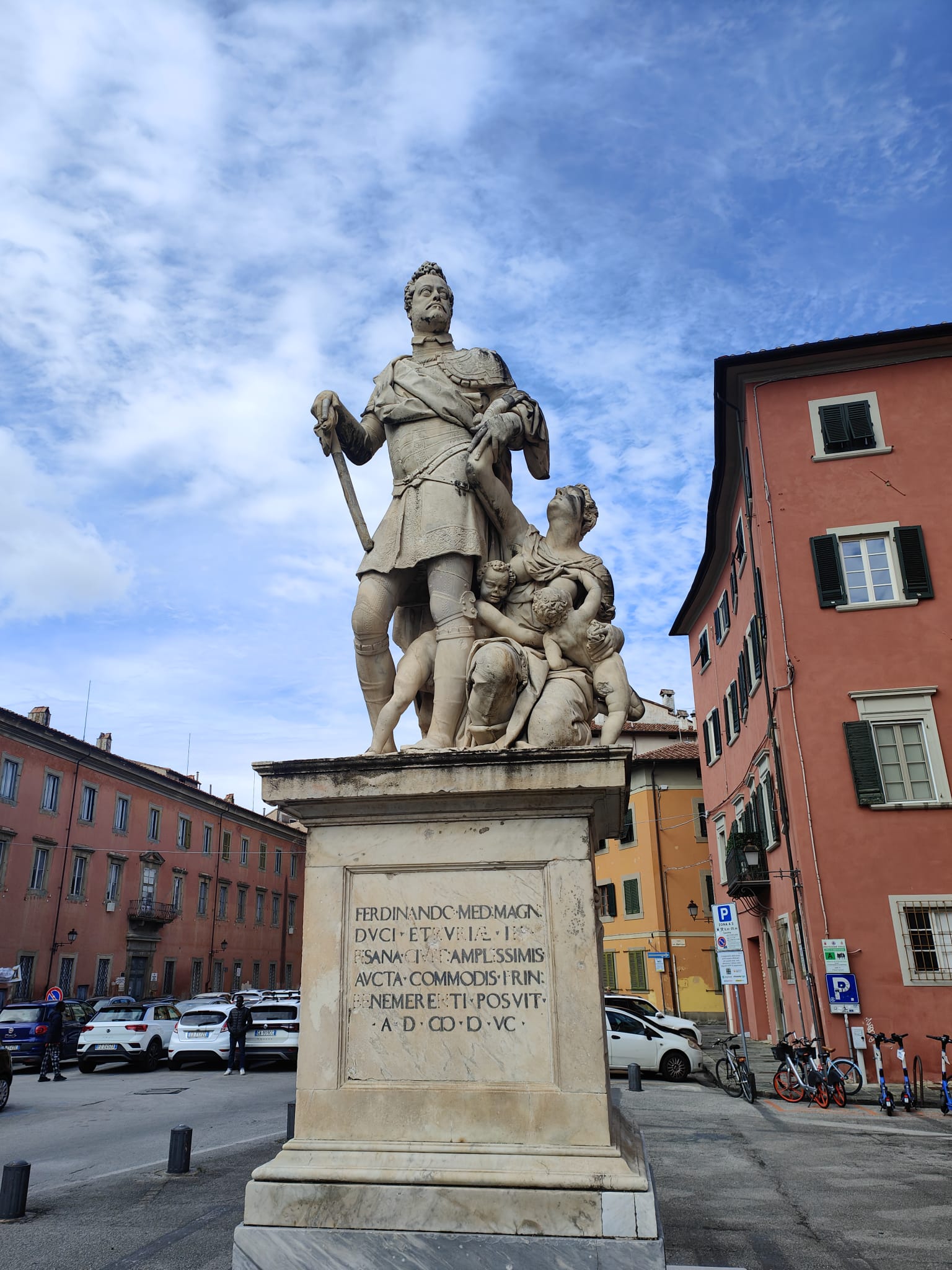
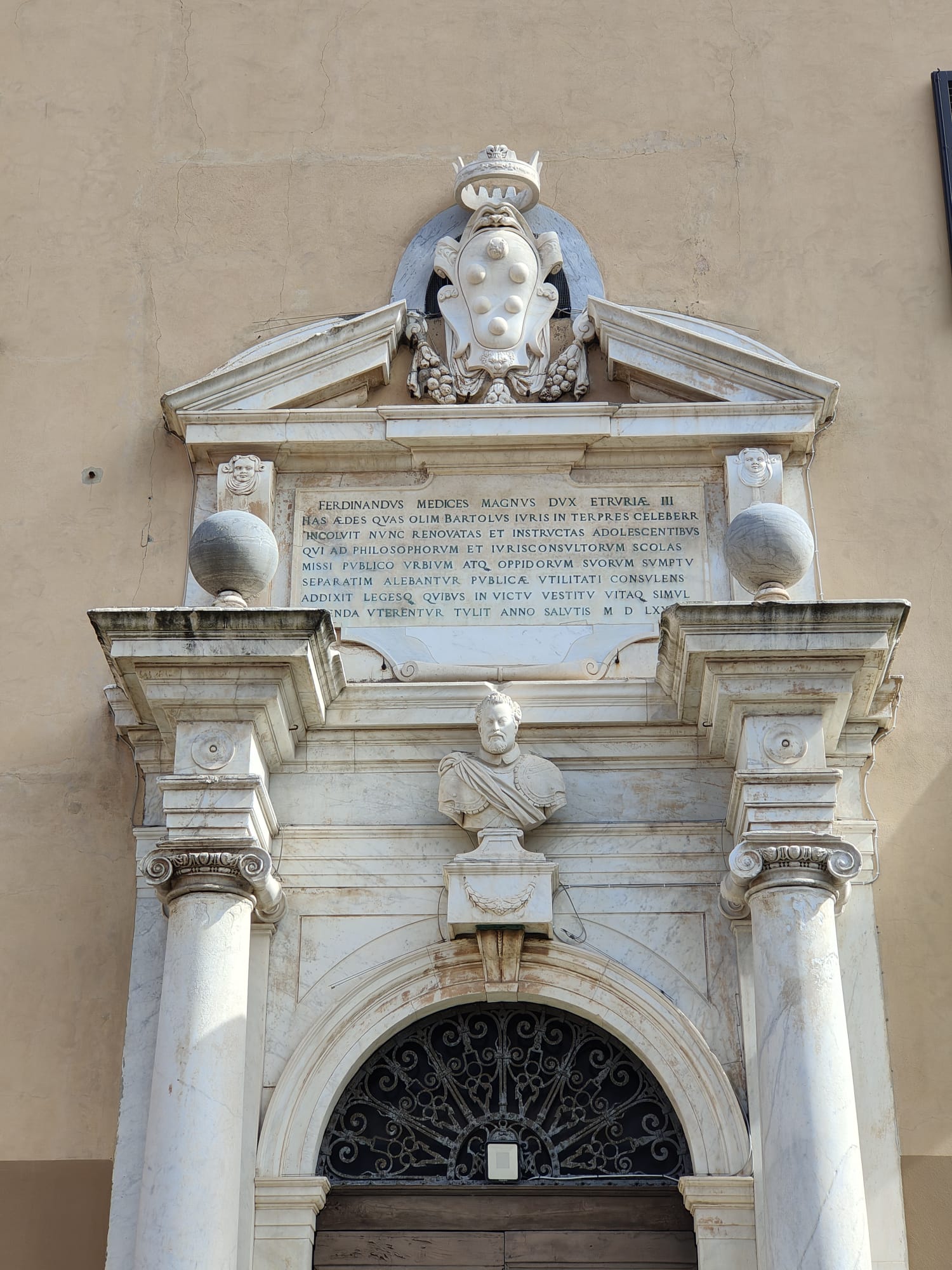
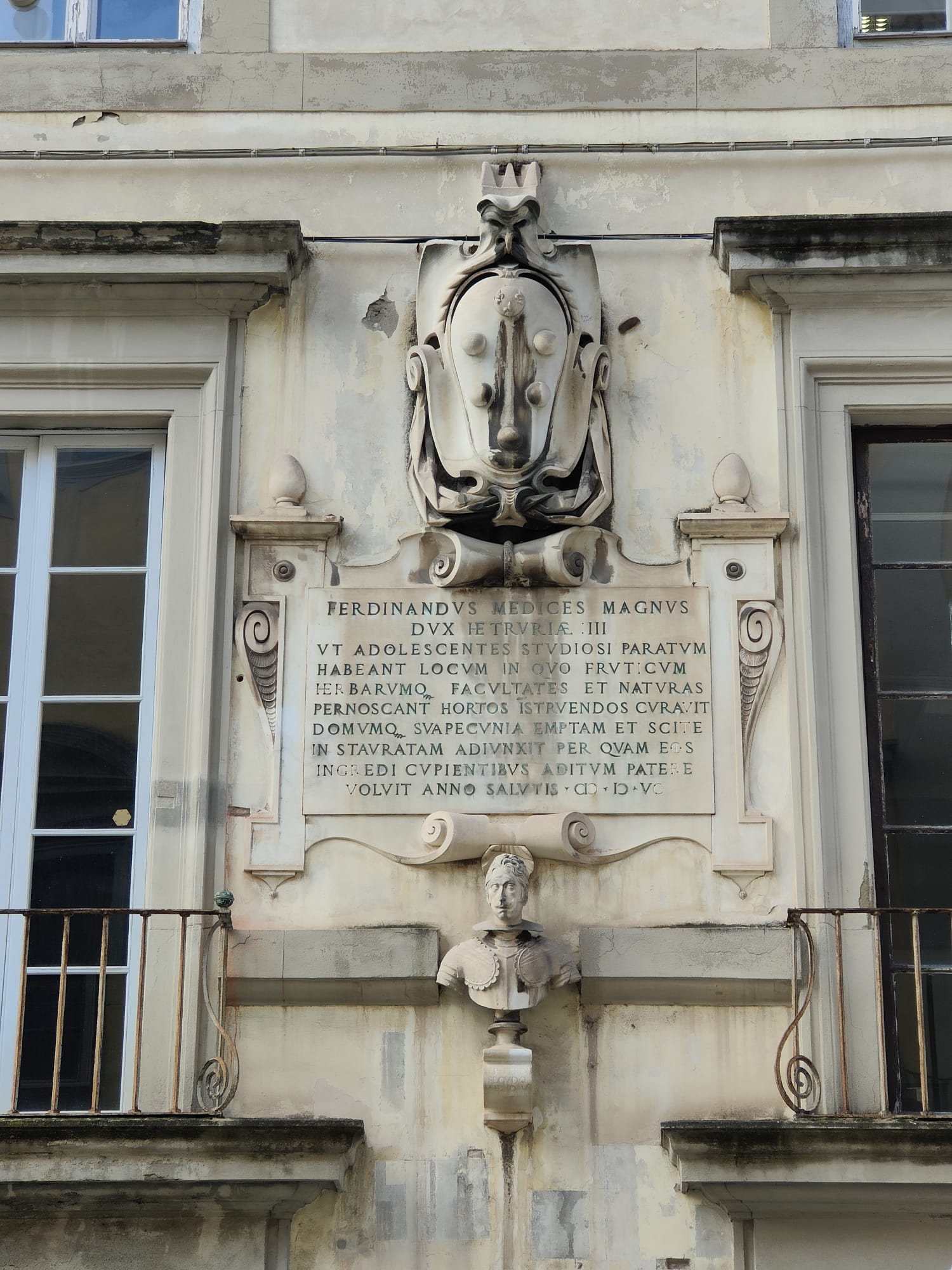
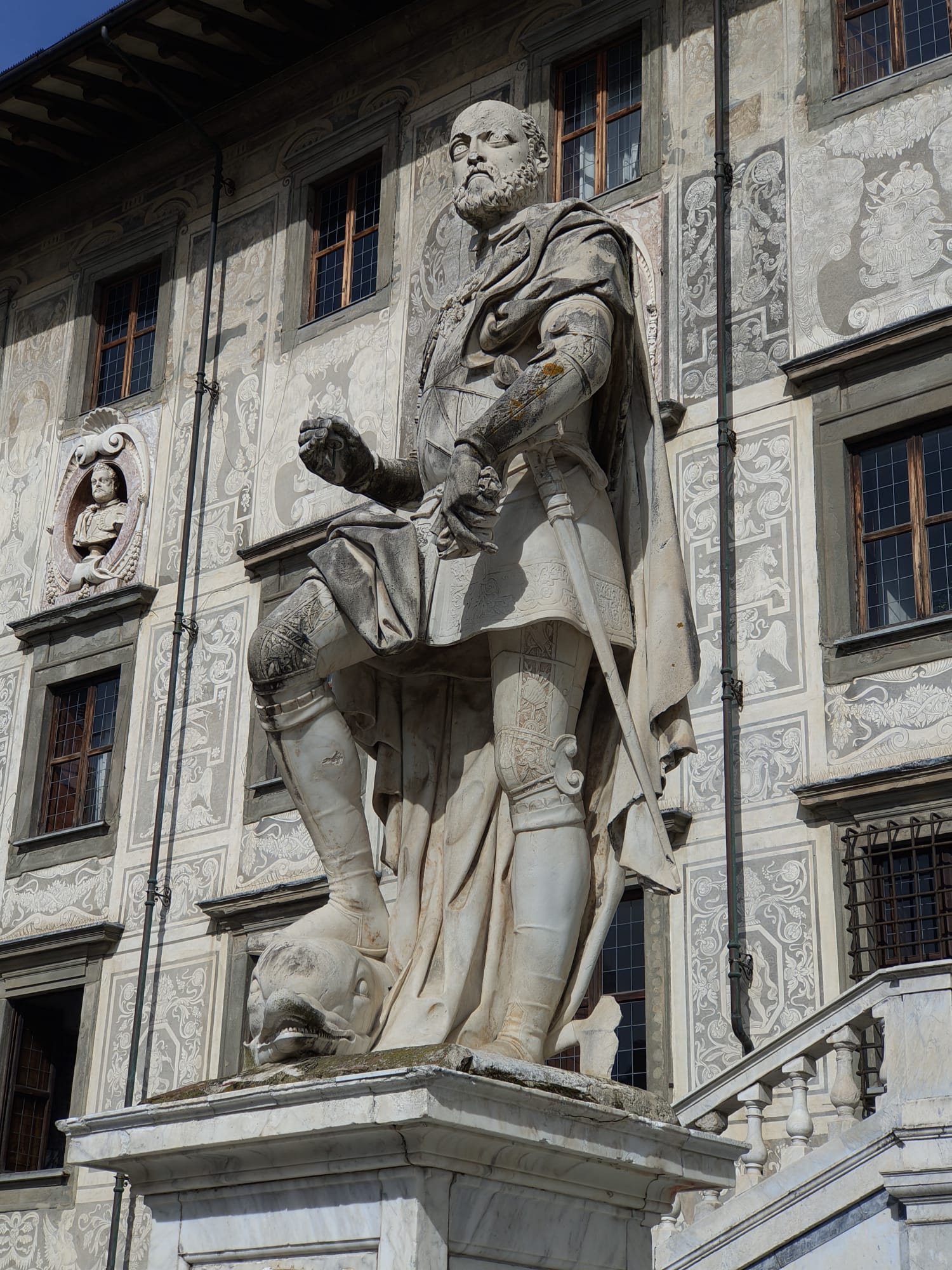
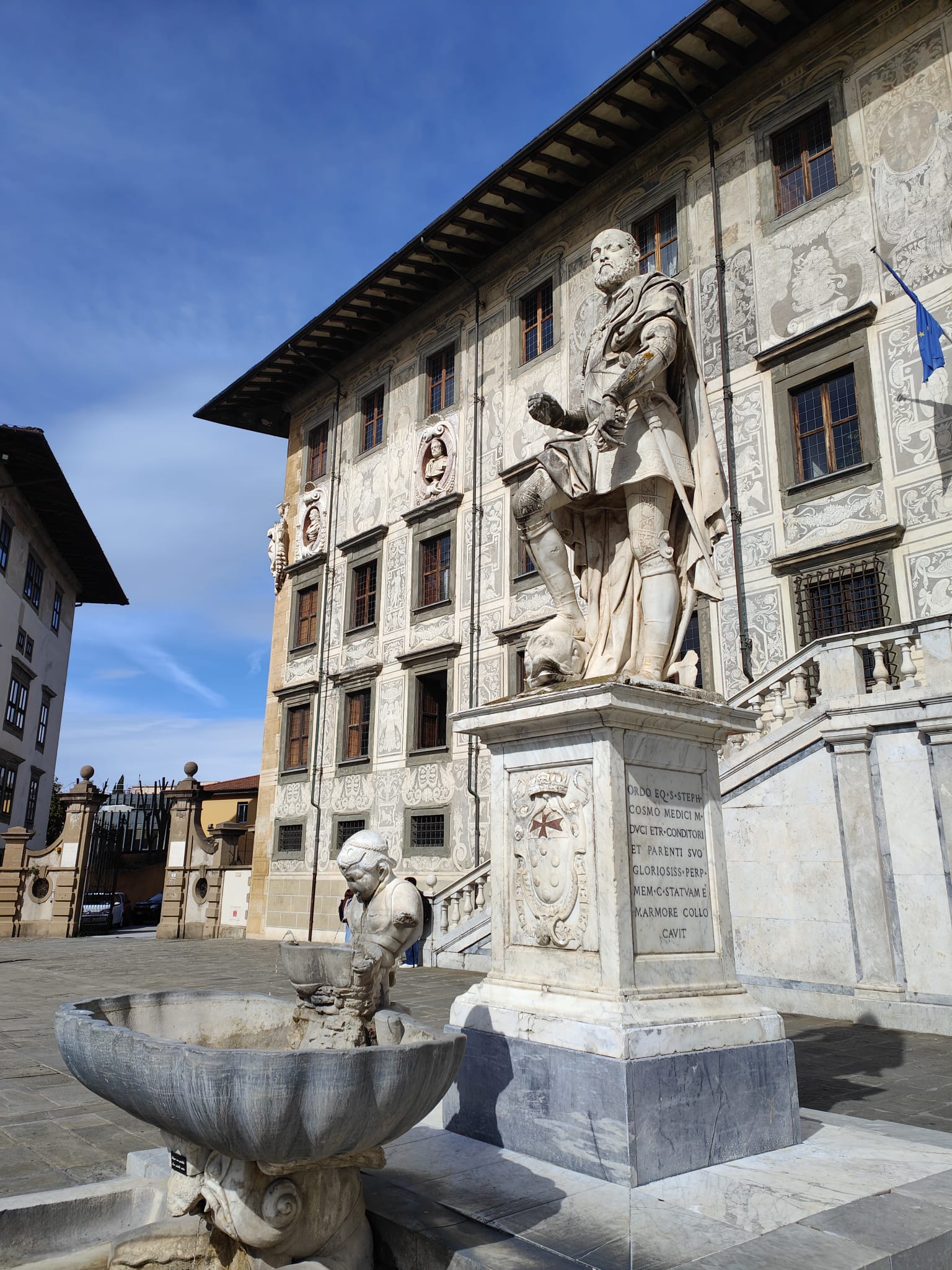
We meander our way along the streets in a northernly direction. Having no plan and getting lost is part of the fun. Did you know that Pisa was the birthplace of Galileo Galilei? His grave was discovered in Santa Croce in Florence. Somehow, we stumble upon a statue to Ferdinando I de’ Medici who invested much into the university of Pisa. Further evidence of his involvement with the university was seen when a noticeable doorway was discovered of Ferdinando. The Medici coat of arms is noticeable across the city.

Piazza dei Cavalieri

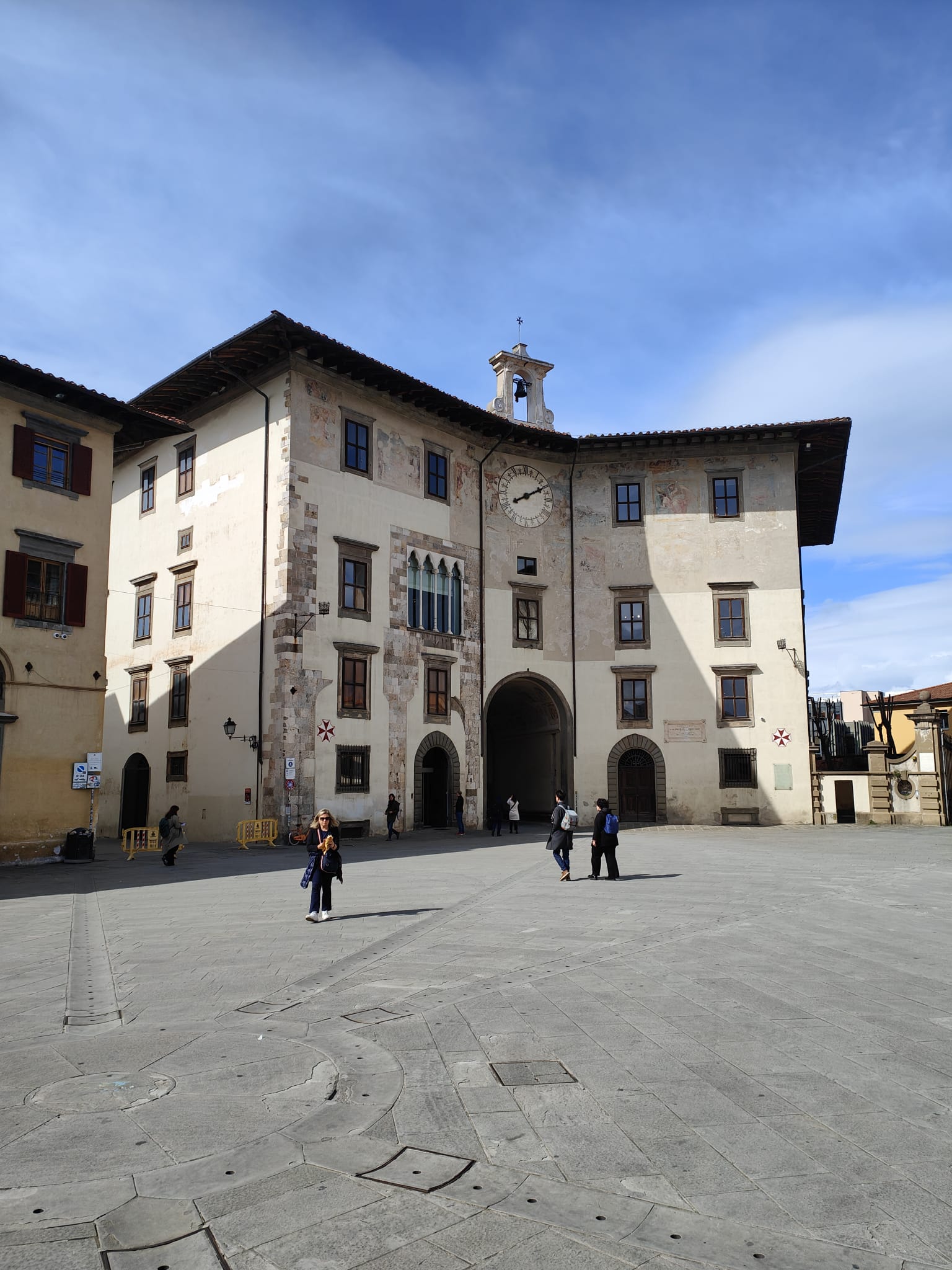
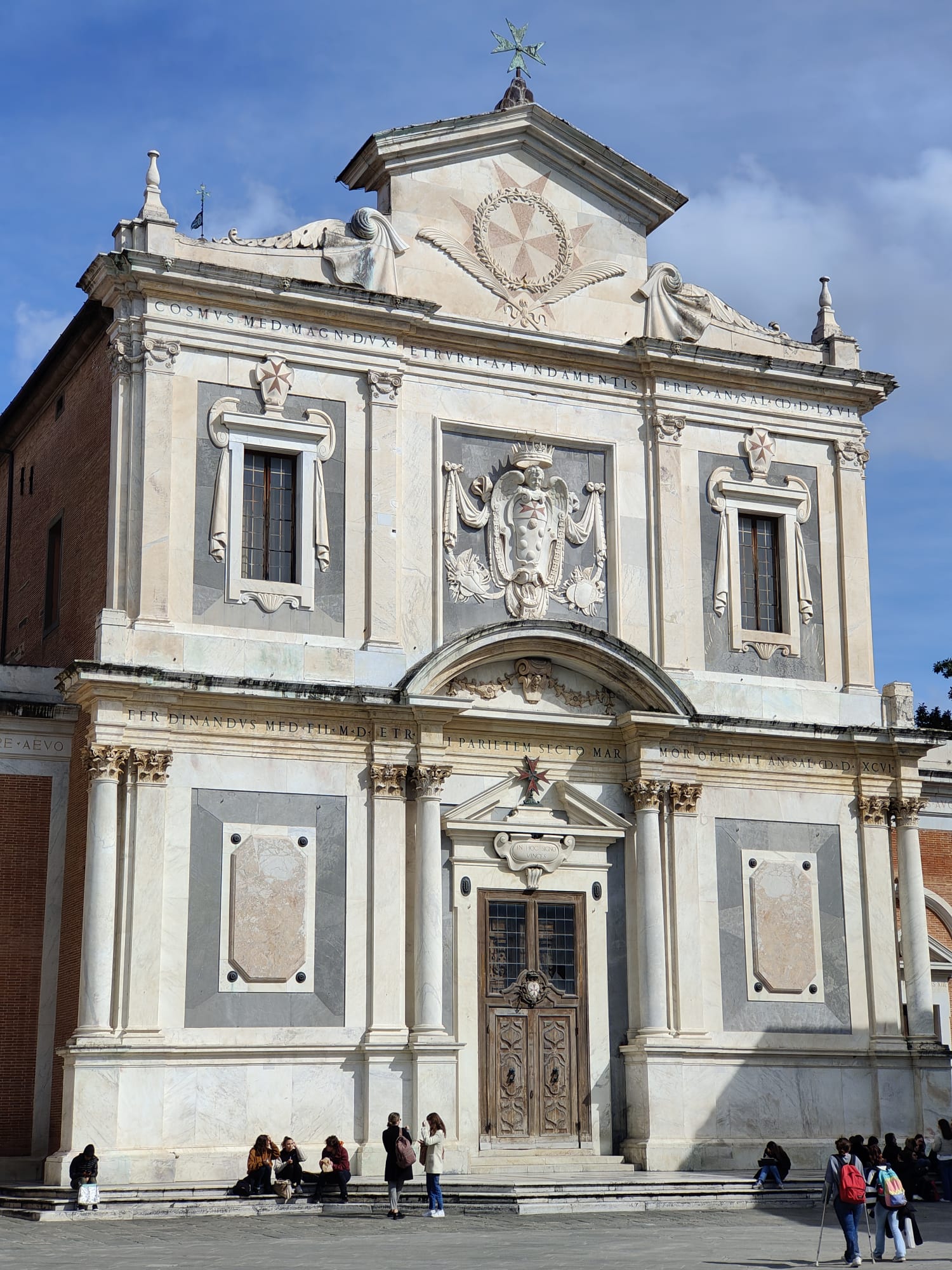
There is evidence of the renaissance in the beautiful Piazza dei Cavalieri. The second most famous piazza in the city is also known as ‘knights square’. A commanding presence in the middle of the square is a statue of Cosimo de’ Medici. The square is surrounded by beautiful buildings which were designed by Cosimo’s architect Vasari. As time has beaten me, I leave through the Piazza through the archway of Palazzo dell’Orologio head back to the square of miracles.

Pisa Summary

I leave Pisa exhausted from a long day walking and exploring. Treading the beaten path can be frustrating and exasperating. Trying to find the untrodden path always brings much joy and reward. The fine weather of course helps.

For me, there is a lot more to Pisa than meets the eye. I’m grateful that I didn’t just come to Pisa to see the tower and get a picture. I can leave knowing that I climbed to the top, visited the cathedral, baptistery and Camposanto Monumentale. Most of all I’m proud to have explored further the beautiful city of Pisa and what it had to offer. I’m fast learning that my fascination with the Medici family shouldn’t be isolated to Florence, and why should it? After all they were the Grand dukes of Tuscany and Tuscany is larger than Florence. I shouldn’t be surprised to find evidence of the Medici influence in each place that I visit in Tuscany.

Pisa supposedly has a rich maritime history, which is hard to believe as not one boat or harbour was seen on my visit. Further exploration is clearly required. It is hoped that such explorations will provide the valuable information to be able to write about the city in full detail and cover its history.

Let’s see what other delights Tuscany has to offer and how far the Medici influence spread.

Cathedral of Santa Maria del Fiore, Florence, Italy

Cathedral of Santa Maria del Fiore

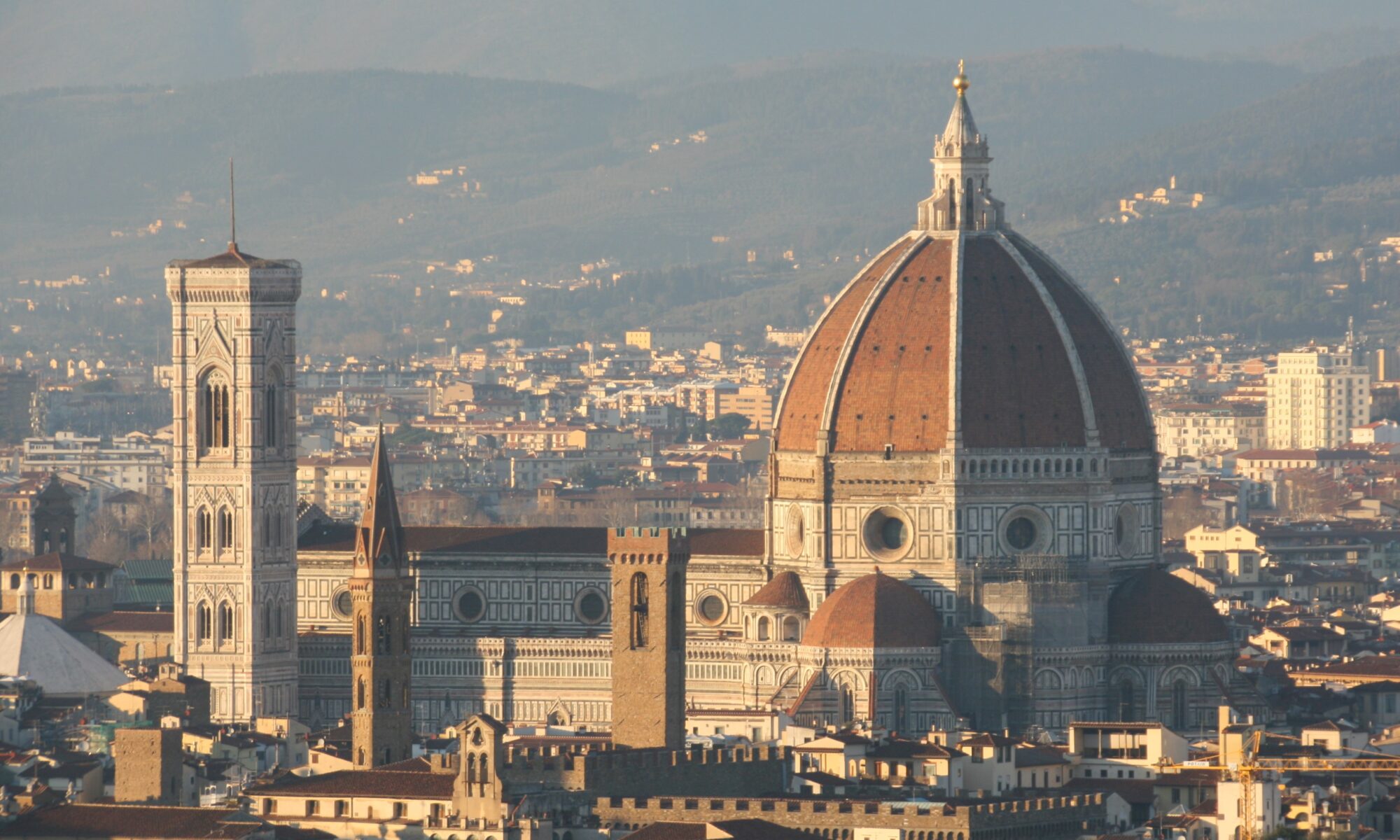
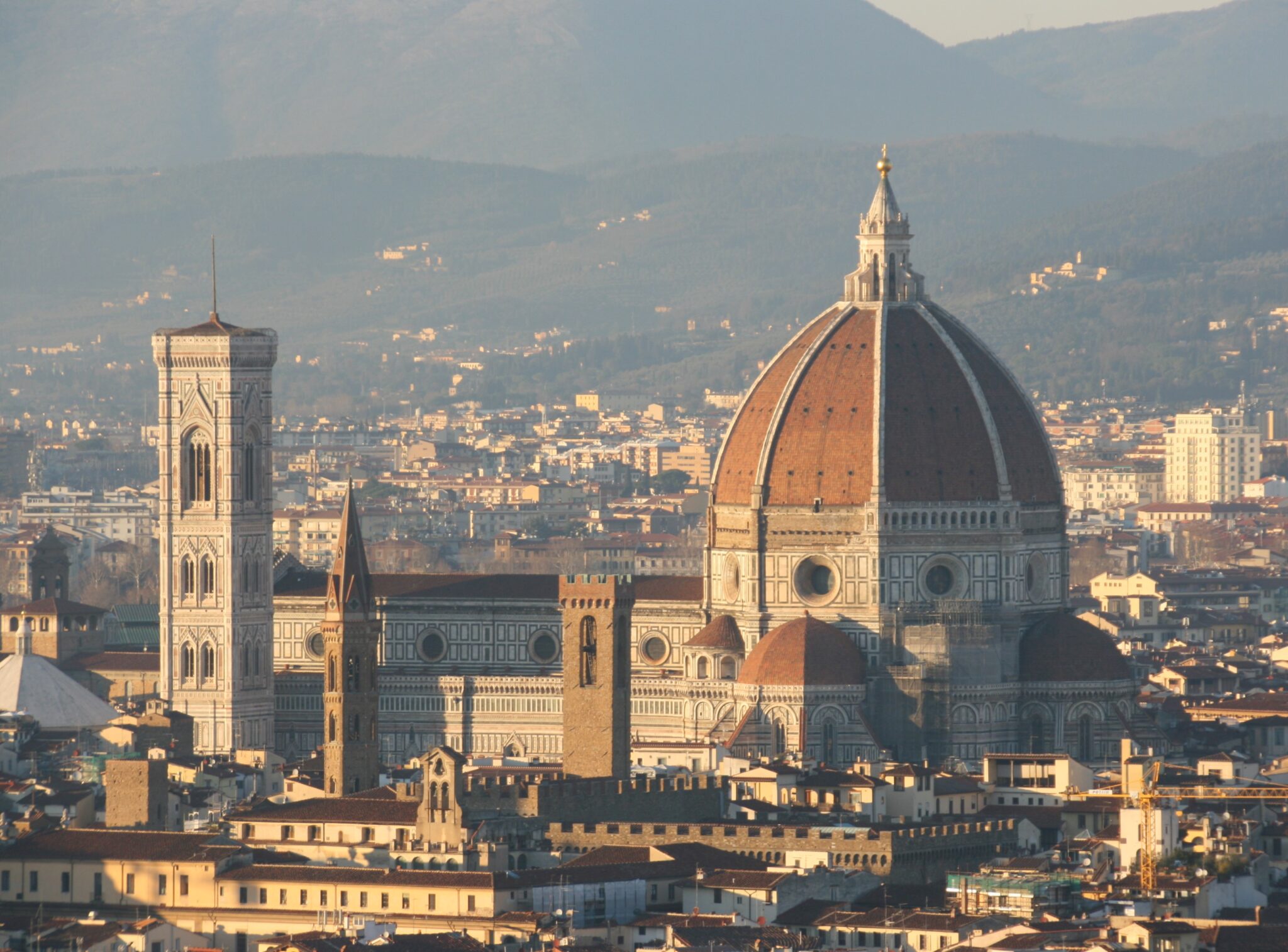
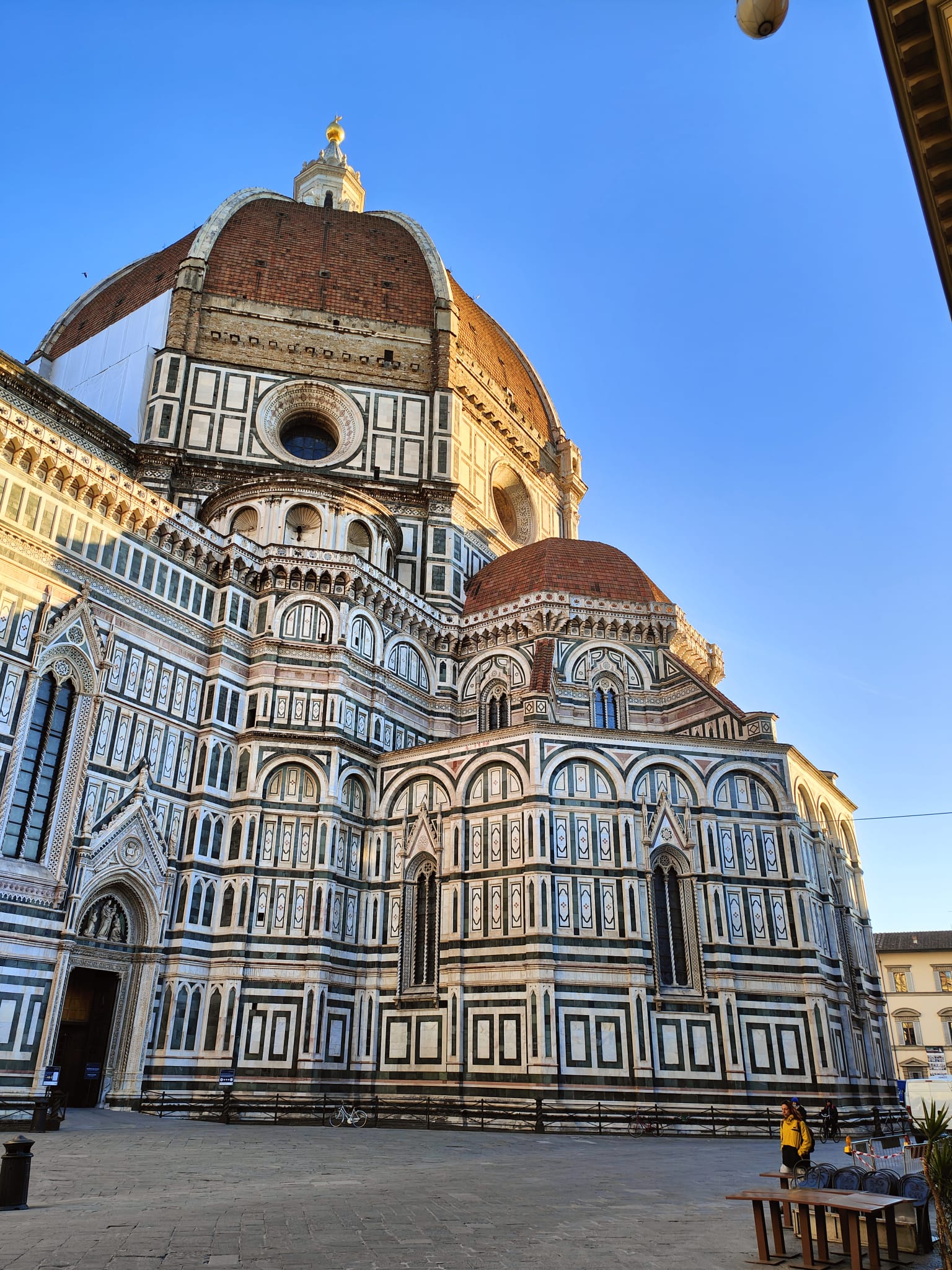
The symbol of Florence! Often called the Florence Duomo. But to use its proper name the Cathedral of Santa Maria del Fiore. A precursor to renaissance Florence. Brunelleschi’s brilliance. A sublime statement. An architectural achievement. Superb and spectacular. The master of masterpieces. The crowning glory.

Florence was determined to be the leading city in Tuscany; it compared itself to former glory days of Rome. Florence, like other Italian cities (notably in Tuscany) was competing to build the largest, grandest and most impressive cathedral. Florence began work on its cathedral in the 13th century after Pisa had started its cathedral in 1063 and Siena built its cathedral by around 1260. The Cathedral of Santa Maria del Fiore took over 140 years to build. The result definitely from the outside is breathtaking, the interior is open for debate. Join me as I explore the incredible Duomo of Florence.  

History of Cathedral of Santa Maria del Fiore

On my meanderings I’ve discovered that during the medieval years much wealth poured into Florence. Trade in wool and an extensive banking system brought untold wealth to the city. As a result, the people of the city thought of themselves in a city similar to ancient Rome. They decided they needed the grandest church in Tuscany, to compete with the cathedrals of Pisa and Siena. At the time population of the city was around 100,000 people, and it was expected that they would all be able to fill the church when completed.

Construction on a new cathedral began on the site of the old cathedral of Santa Reparata in 1296, with the first stone laid on 8th September. The renowned architect Arnolfo di Cambio was entrusted with plans and building the church. A familiar name from my meanderings around Florence thus far. His other building works I have discovered were the Church at Santa Croce and Palazzo Vecchio. Remember the tower at the Palazzo Vecchio is named after him.

How much of his plan was achieved maybe be minimal. His planned size a small comparison compared to the colossal size it finished. As he died 6 years after he started. Several architects were to continue working on the church after his death. This included Giotto, Talenti, Giovanni Ghini and Brunelleschi.

In the year 1366 a model was created to illustrate the shape and scale of the design. This was not to be altered. This was the plan, and they were going to stick with it. For all the plans made there was a major flaw. They didn’t account for how the Dome would be engineered and constructed. They hoped as time passed this problem would solve itself, through advancements in engineering and building techniques.

In 1418 a competition was opened to find someone who could build the dome. 200 florins was the winner’s reward. The winner was a certain Phillipo Brunelleschi. I will explore his plan in more detail when I cover the Dome later in the post.

When the dome was completed the Cathedral of Santa Maria del Fiore was consecrated by Pope Eugene IV on March 25, 1436.

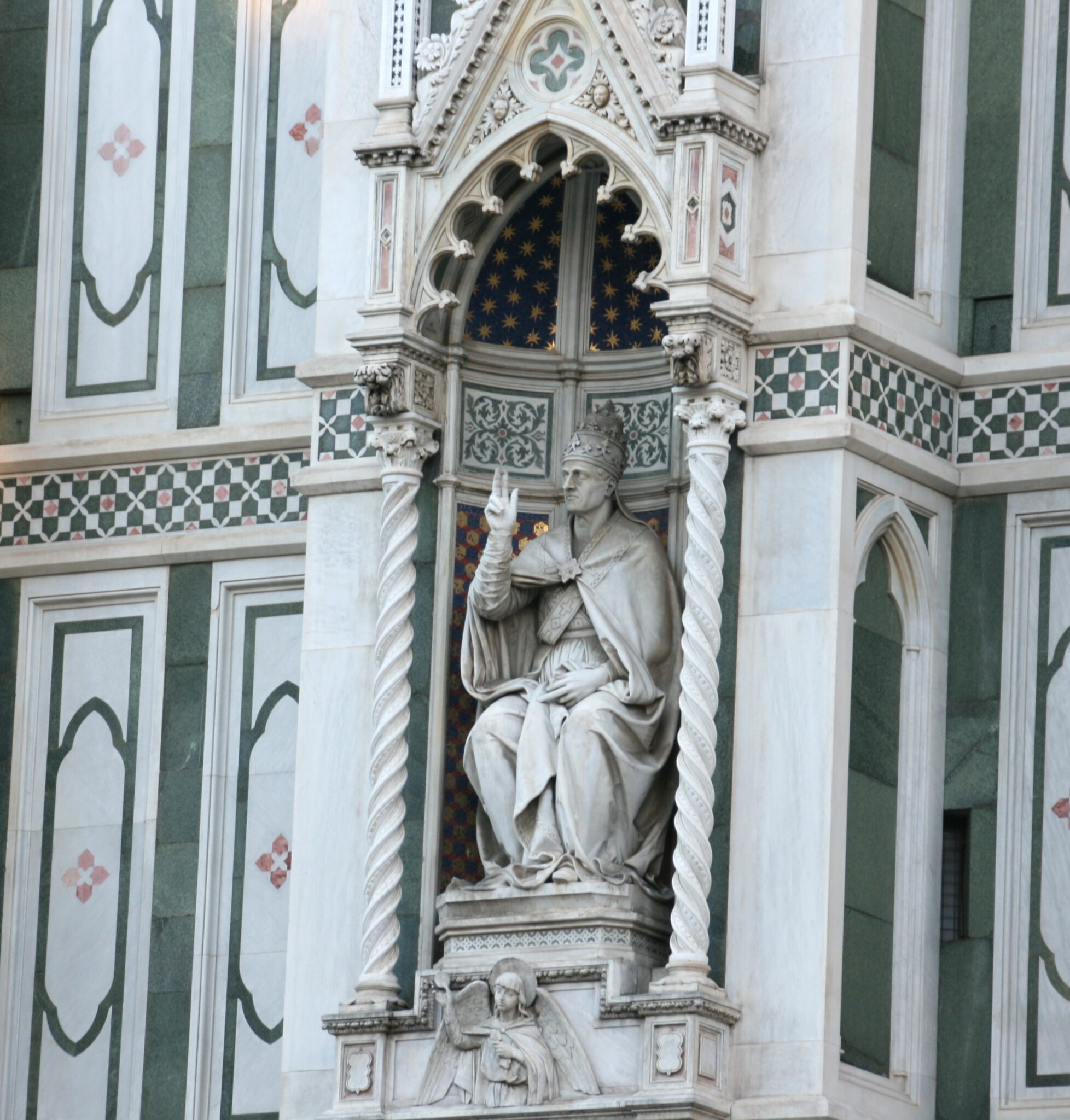
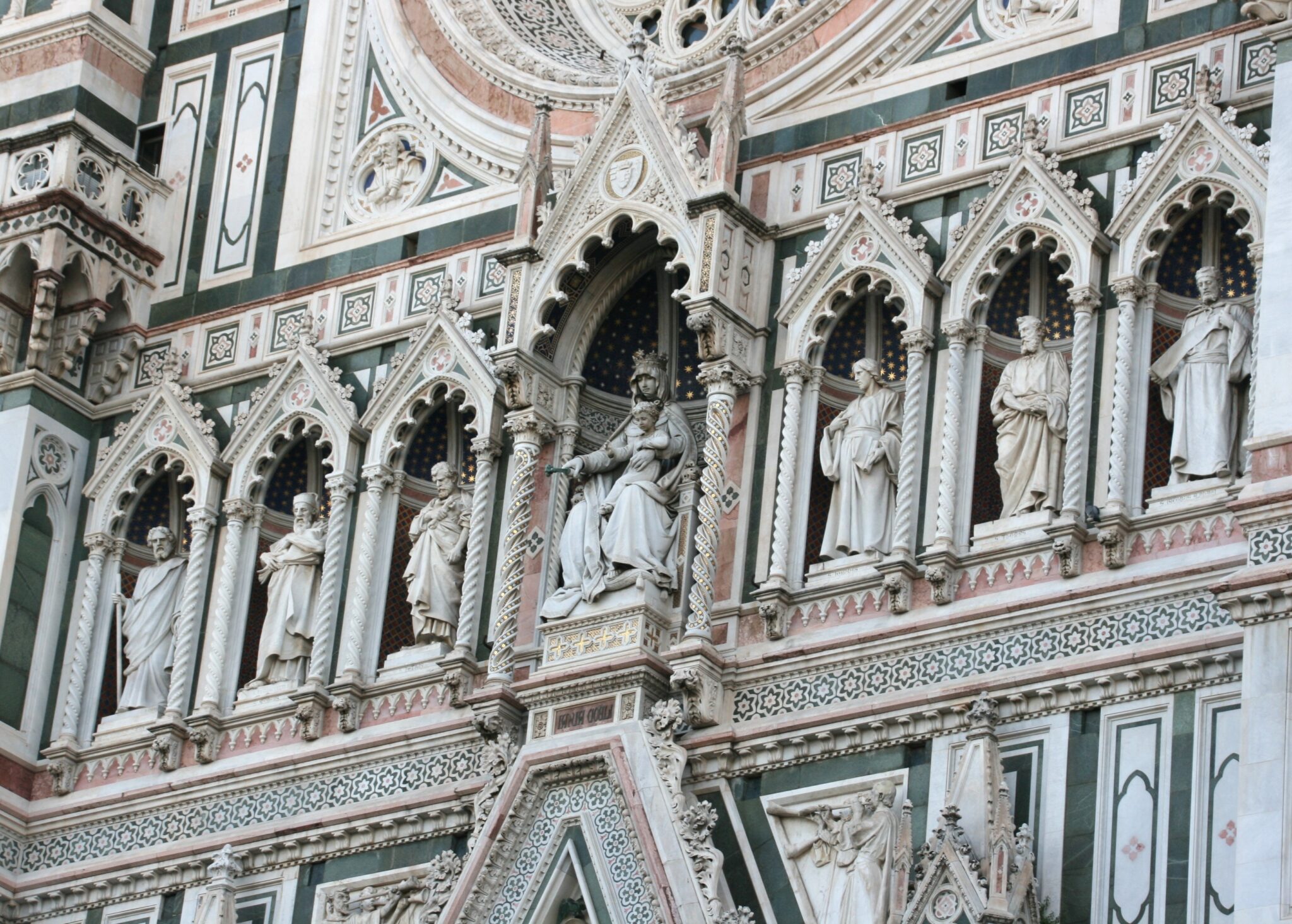
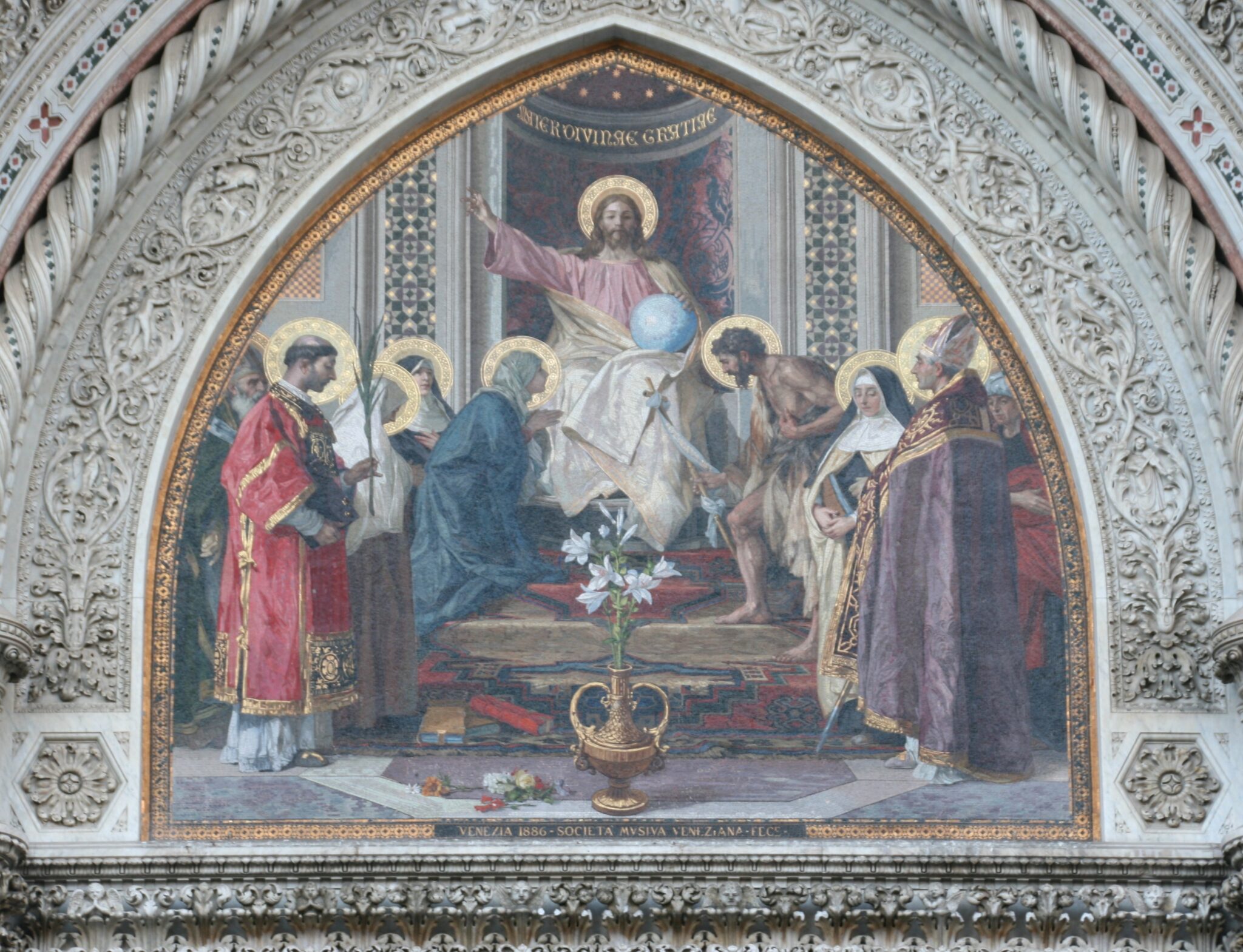
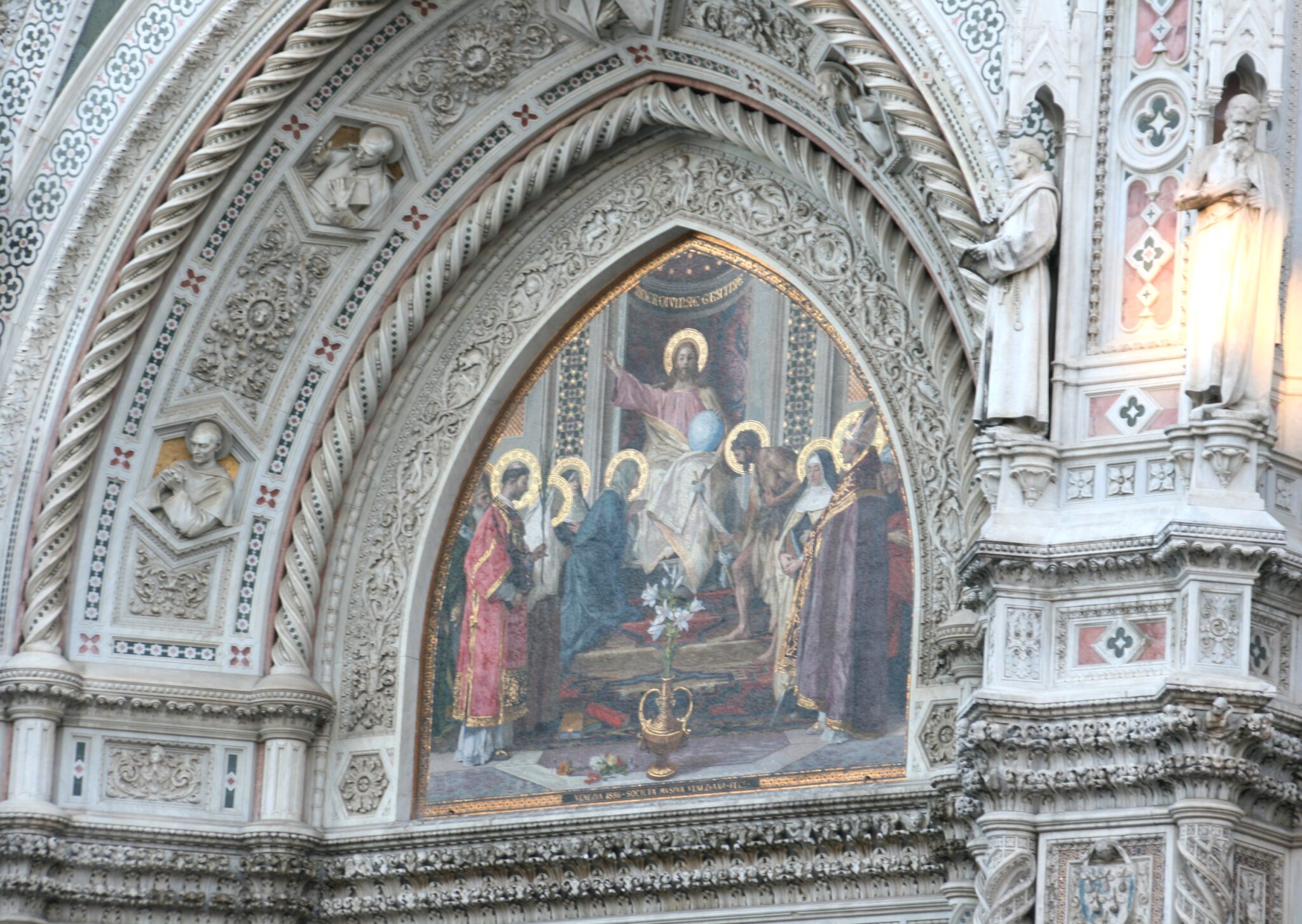
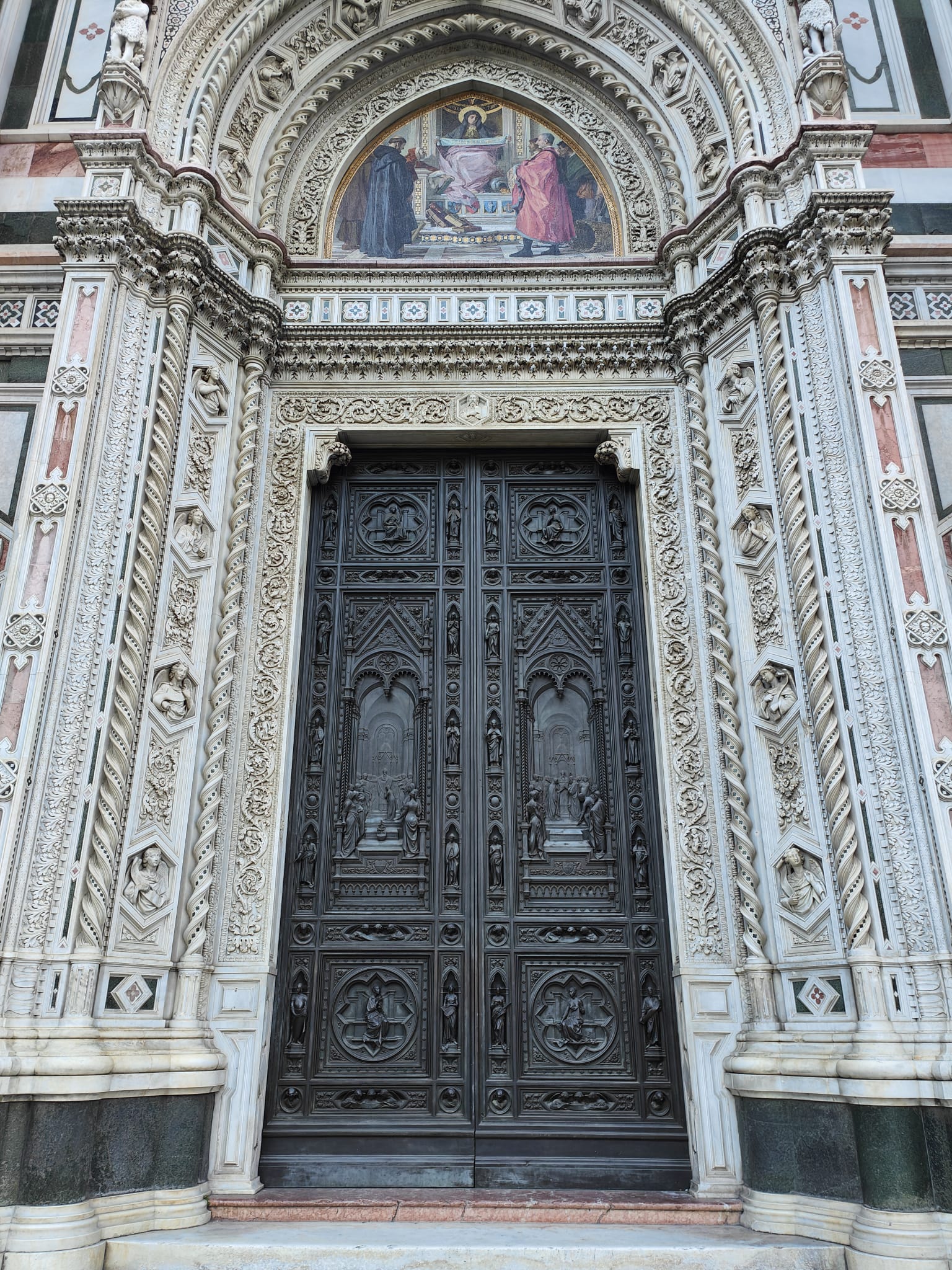
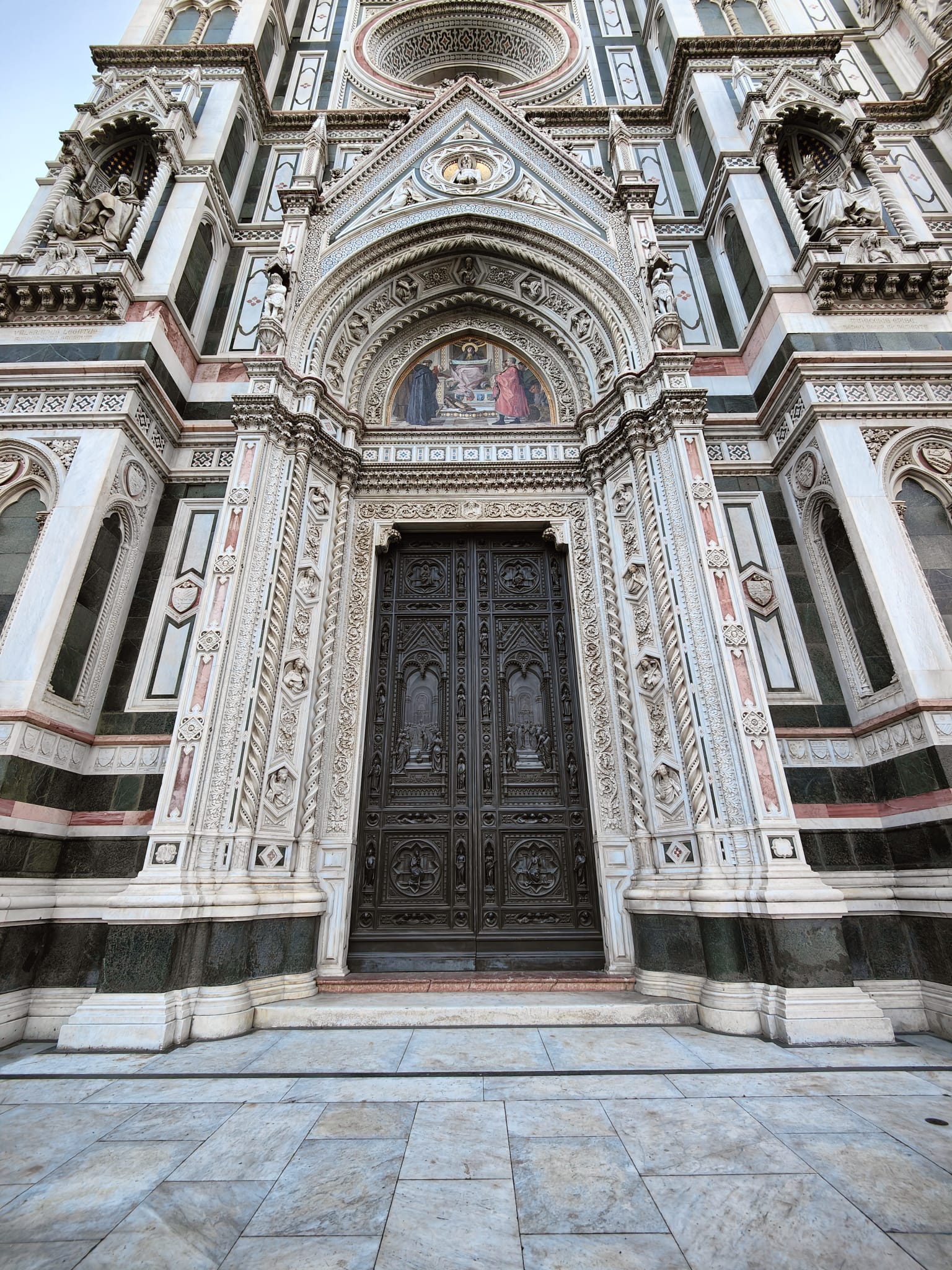
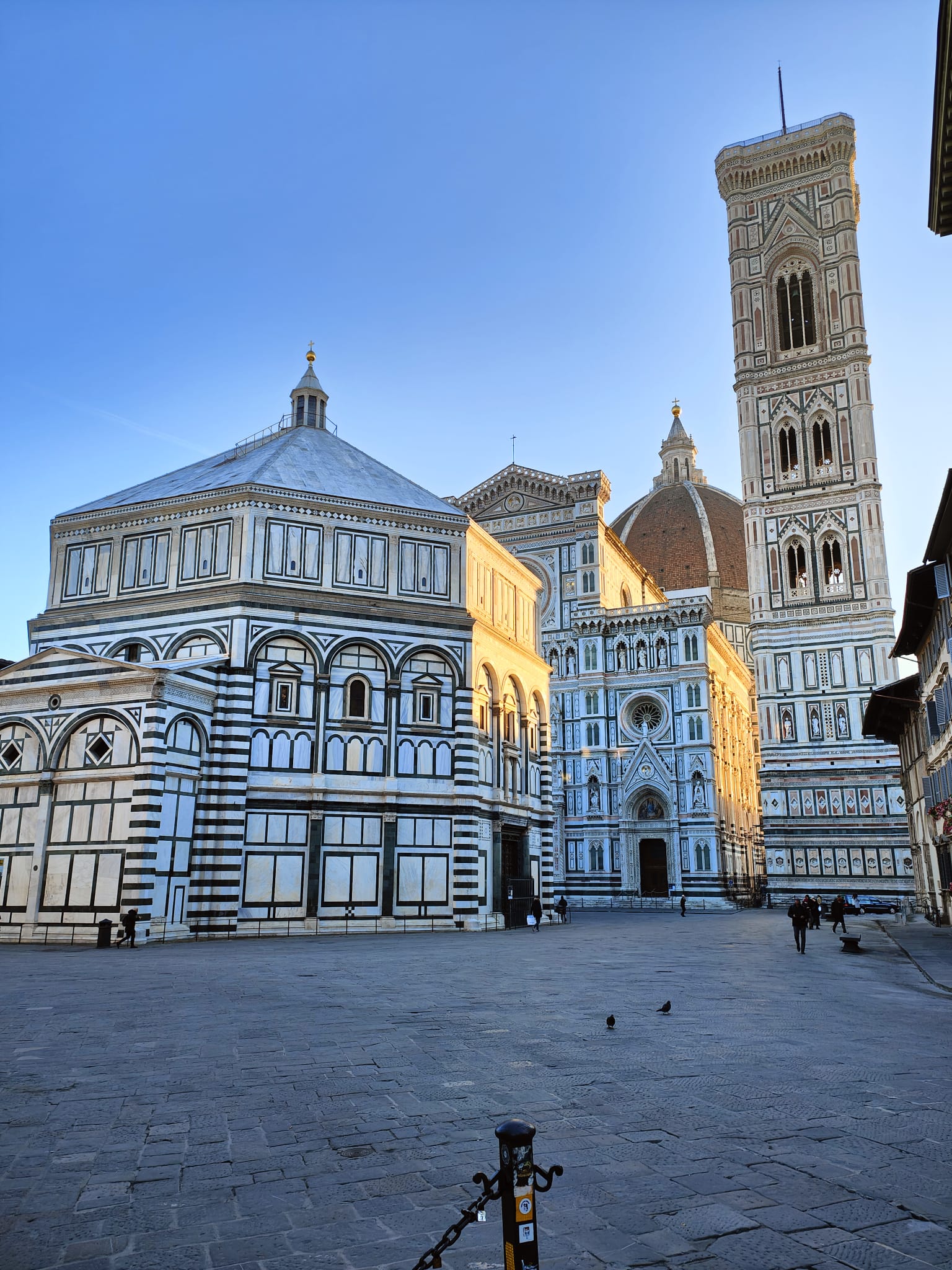
The outward appearance that is admired today shares a similar tale as Santa Croce in that it wasn’t completed until the 19th century. The façade of the Cathedral of Santa Maria del Fiore is a neo-gothic masterpiece. It was designed by De Fabris. If you look closely, you will see that it is adorned by the greatest Tuscan artists. The external walls are covered in white, green and red marble.

Design of Cathedral of Santa Maria del Fiore

The cathedral of Florence is one of the largest churches in the world. The cathedral is a Latin cross design. The plan consists of a triple nave, where the main central nave is joined with adjacent smaller aisles either side. The aisles are separated from the nave by towering pillars. In this visit I’ve learned that the area between the arches is referred to as bay. The bays here are larger than normal, which creates a much more open feel to the nave. 

The designers didn’t want the Cathedral of Santa Maria del Fiore to be similar to the cathedrals of the north, most notably in France and Germany. The Cathedrals in the north focused more on their vertical elements where Florence’s Santa Maris del Fiore placed an emphasis on horizontal elements.

Like all other churches and cathedrals, the nave stretches from the entrance (at the bottom of the cross) to centre of the cross. The High altar is located at the centre of the cross. To the north, south and east of the high altar is an arrangement of three apses. Each of the apses has 5 chapels. The design when looking from above was to suggest the form of a flower. With more time, I would explore possible links between the name of the cathedral (Our Lady of the Flower), with the city’s coat of arms (its emblem the Florentine lily) and the city’s name (“Florentia”, that is, “city of flowers”). 

The inside of the cathedral I found to be a very dull affair, which is perhaps why I’m lacking in photos of the interior. There is a distinct lack of windows in comparison to other cathedrals visited here in the UK and the rest of Europe. I must admit that the sheer size of the nave is incredible to see. Thankfully I had booked tickets to the visit the Dome which would provide the best view of the fresco painted on the ceiling.

Brunelleschi’s Dome

The Done was built between 1420 and 1436. In the competition to find a suitable designer, Phillips Brunelleschi beat his longtime rival, Lorenzo Gilberti.

Lorenzo had beaten Phillipo in a previous competition to build the bronze doors for the baptistry. Brunelleschi was named the chief architect (capomaestro) in 1420 and would hold that position until his death in 1446.

Brunelleschi was a sculptor and architect who had left Florence after his aforementioned defeat in competition to Gilberti. He decided to explore and survey Rome. Here he gathered ideas and drew inspiration from Rome’s ancient buildings. In particular the Roman Pantheon provided him with the knowledge and ideas to succeed with his dome.

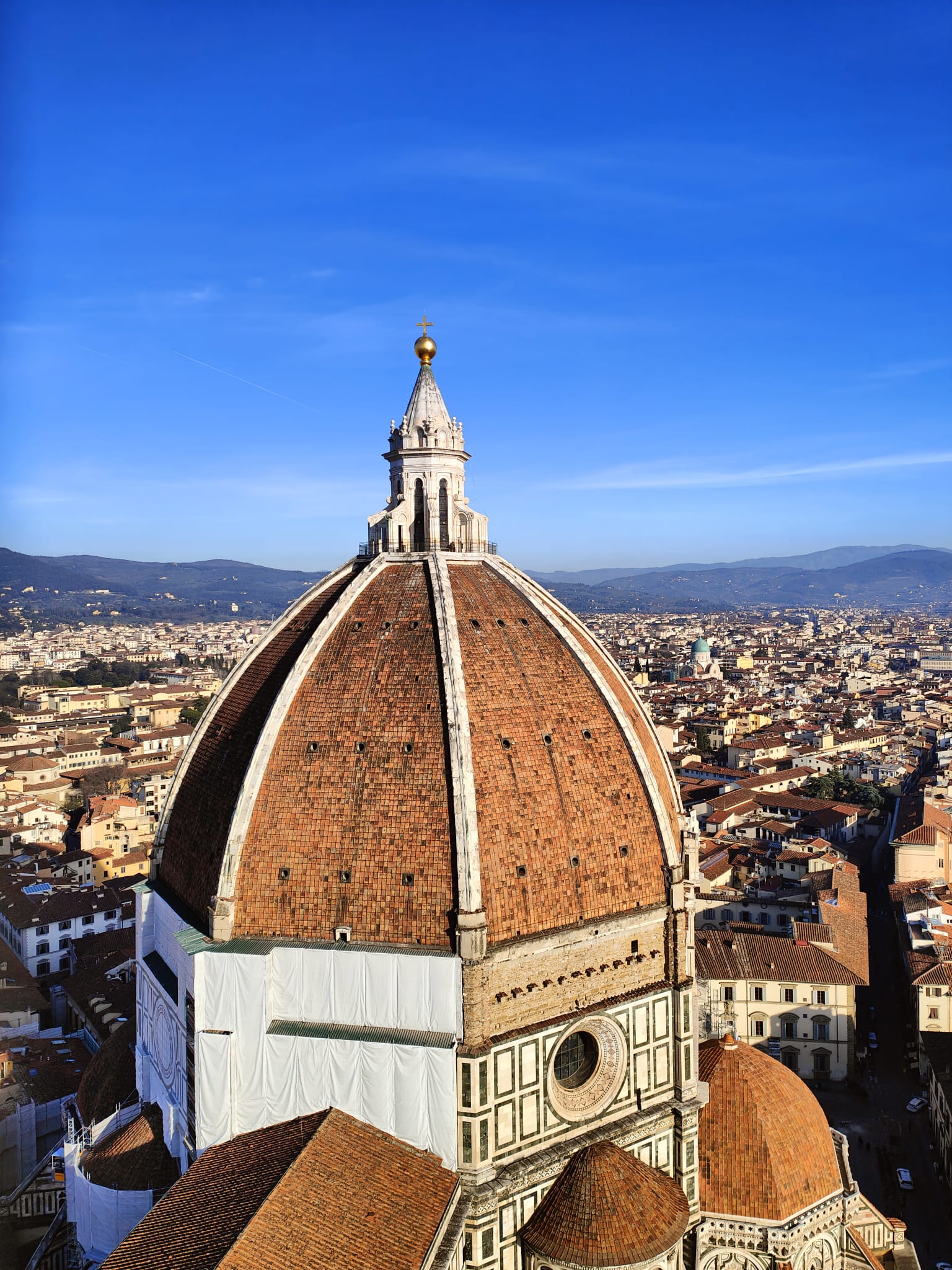
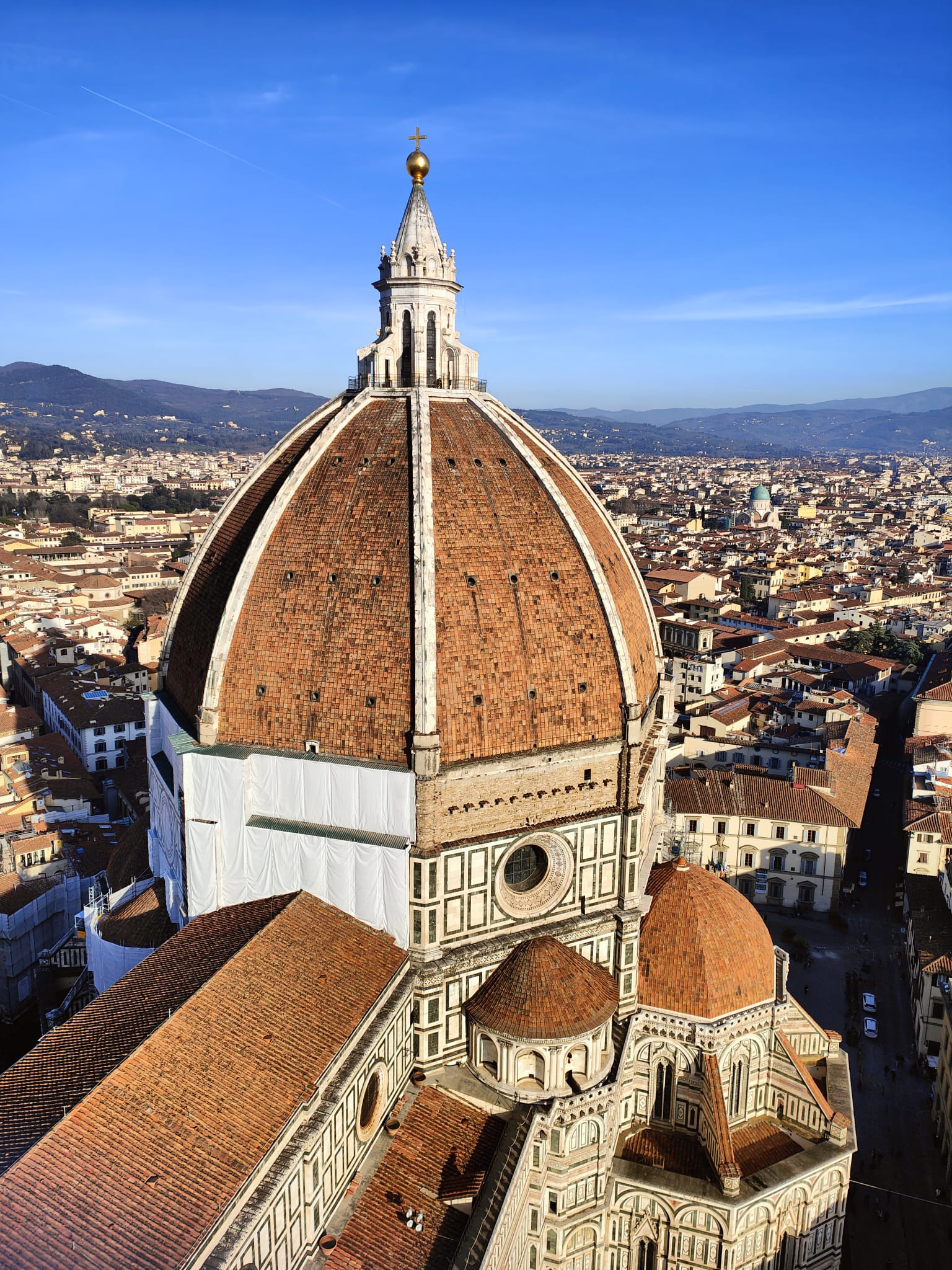
Brunelleschi’s design was a double-shell dome. The two domes working together but with separate purposes. The outer shell covered in terracotta tiles, would protect the inner shell from the elements whilst the inner shell would be used to support the outer shell. The inner shell spans the diameter and is self-supporting. He would use a unique brick pattern on the inner dome referred to as herringbone pattern.

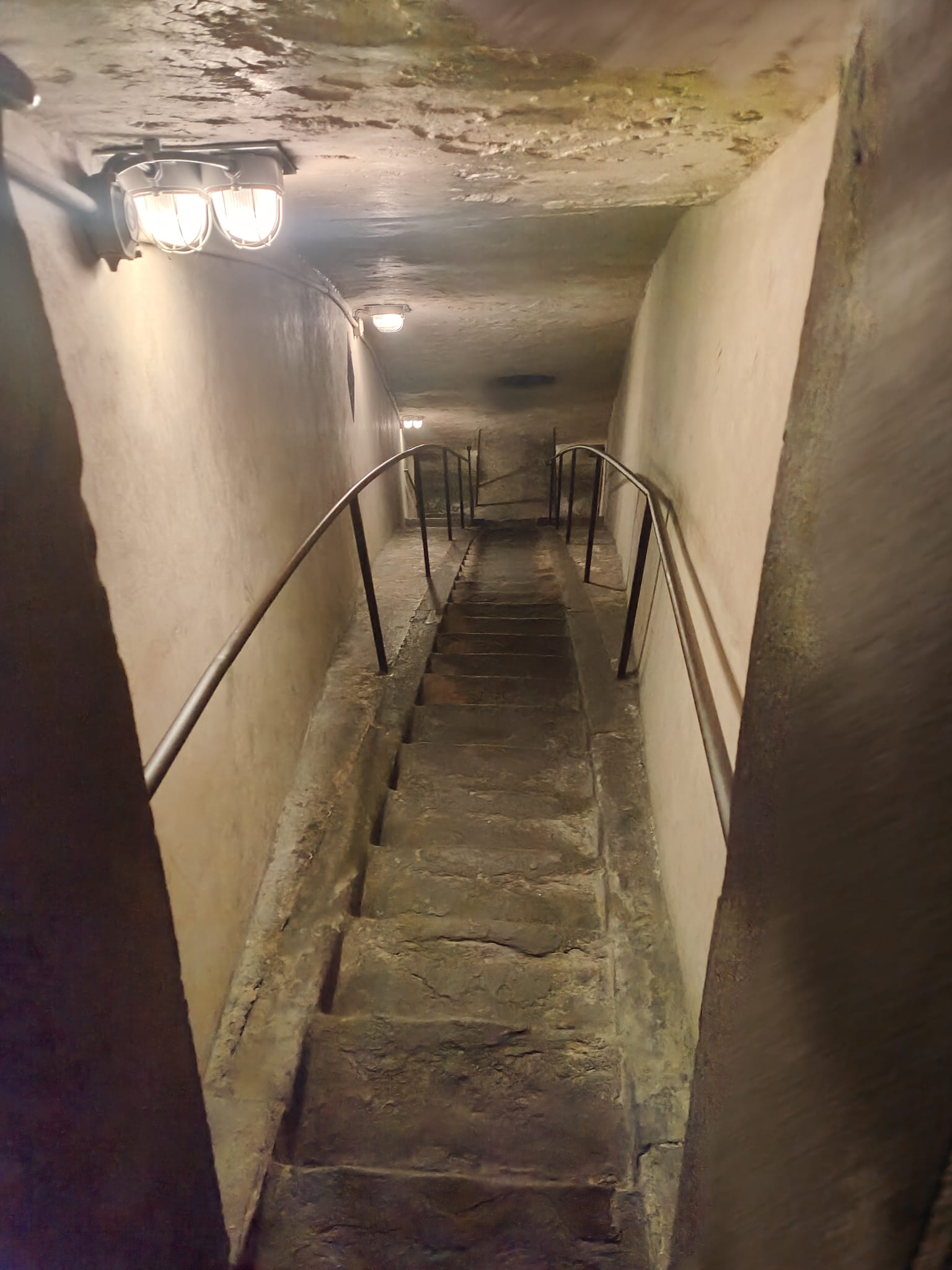
Brunelleschi used a series of compression rings around the inner dome’s circumference. These were to stop the dome from collapsing. The gap between the two domes would act as a stairwell to the top. At the top of the dome is Brunelleschi’s lantern. This was another competition that he won though the lantern was not built until after his death. The 463 steps to the top are worth it for the panoramic views gained over the city of Florence.

Brunelleschi had to think on his feet during the construction process. The challenges must have been relentless. A masterful piece of work and engineering genius. It’s beyond impressive.

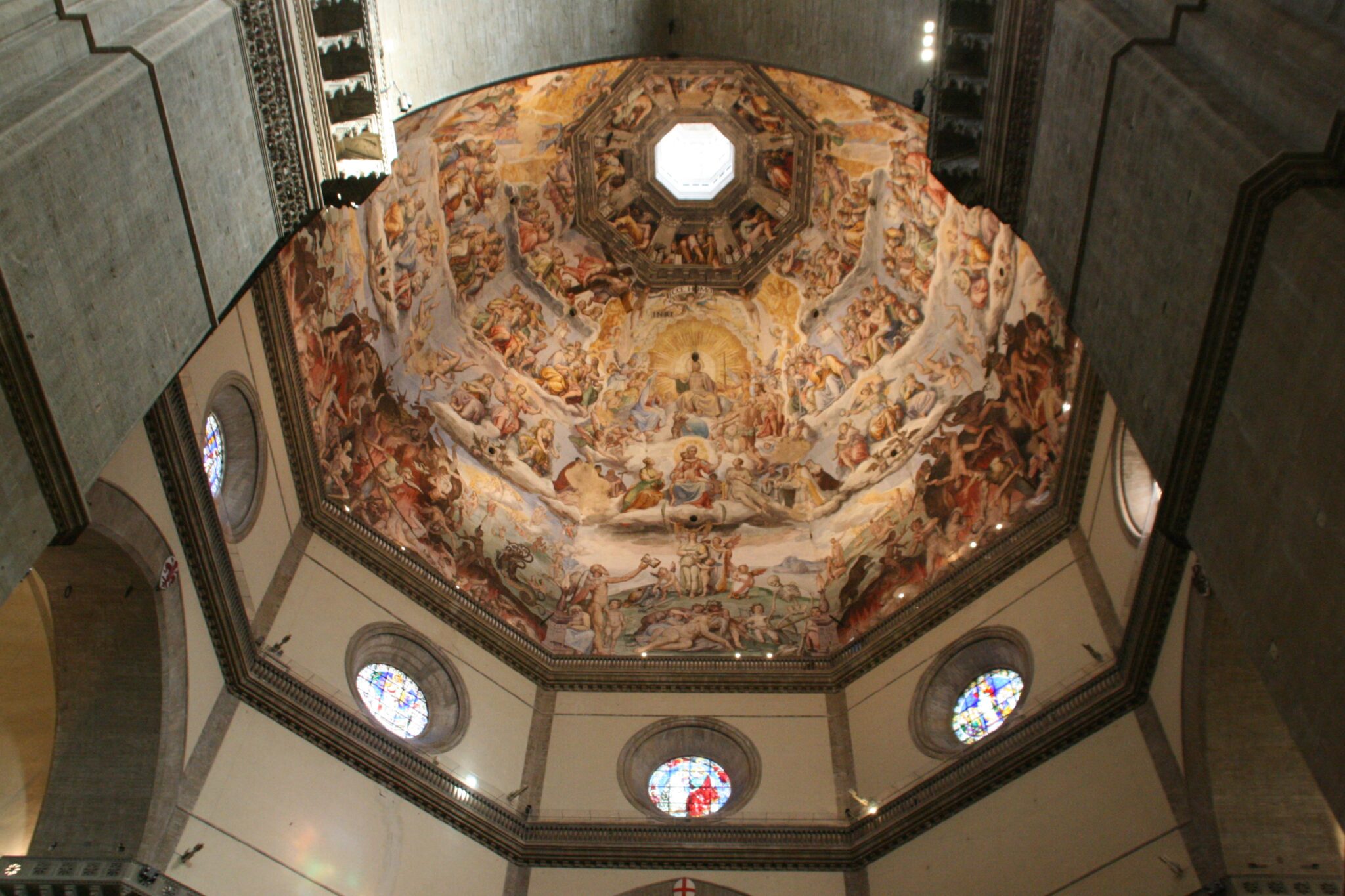
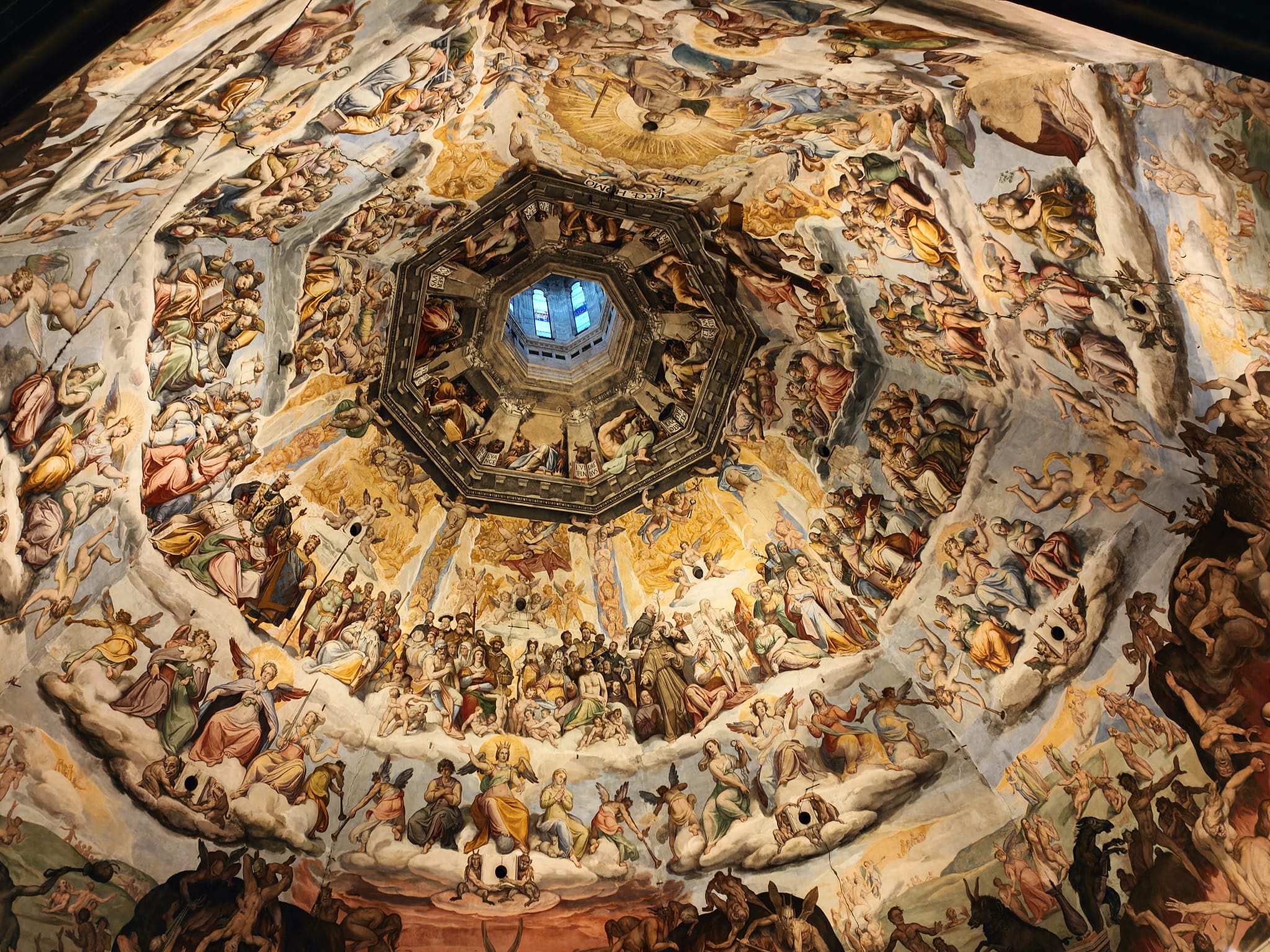
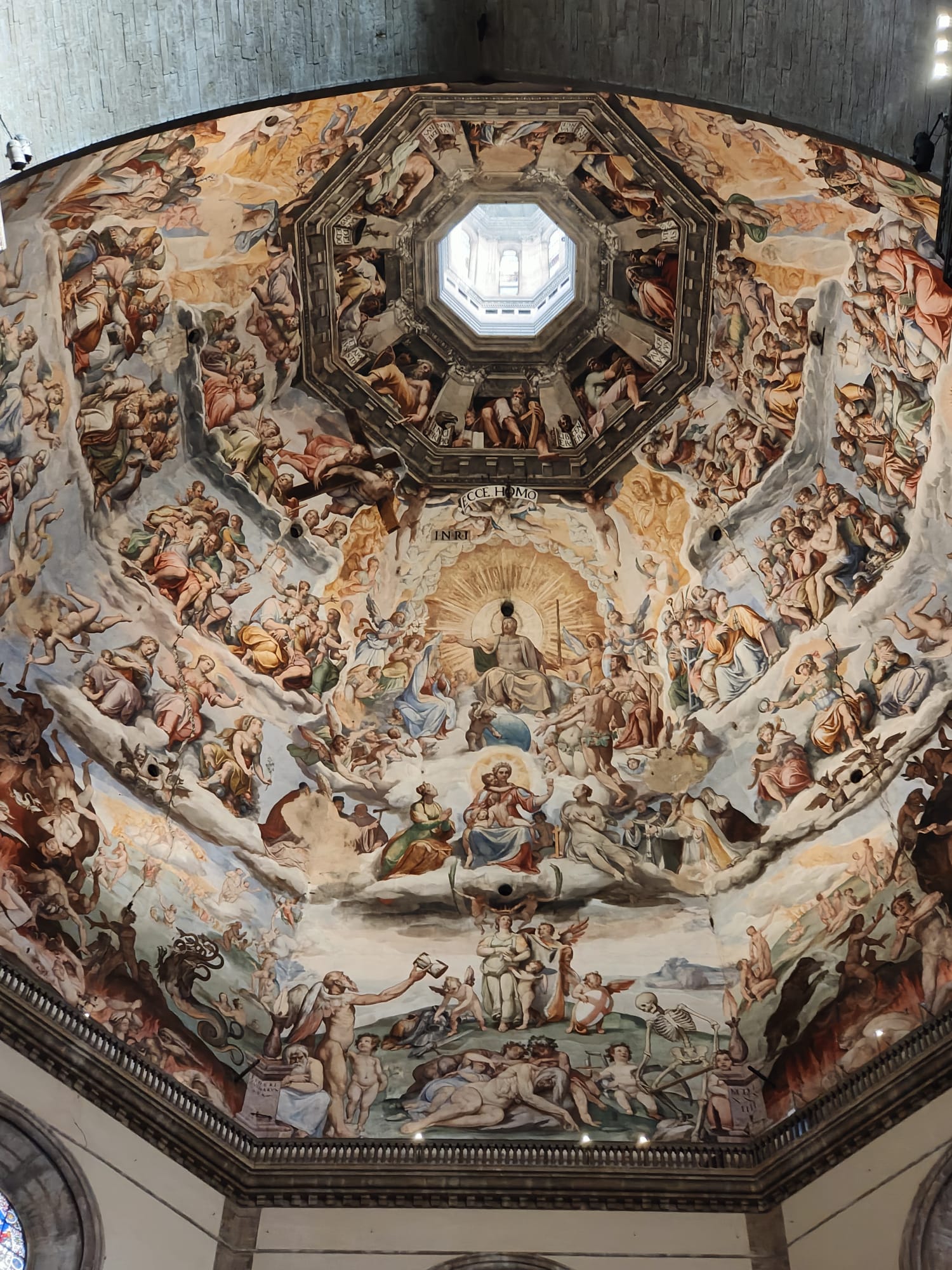
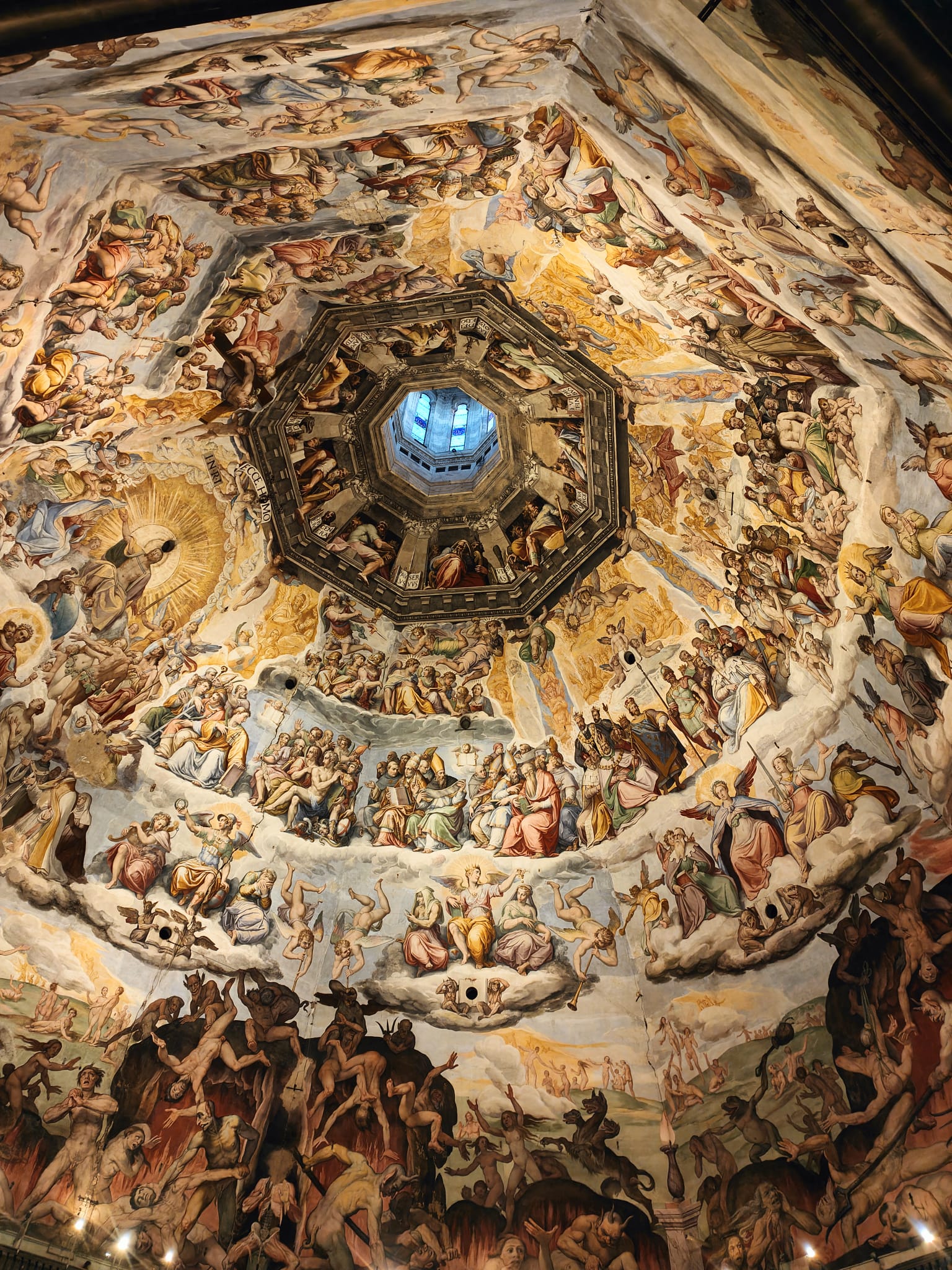
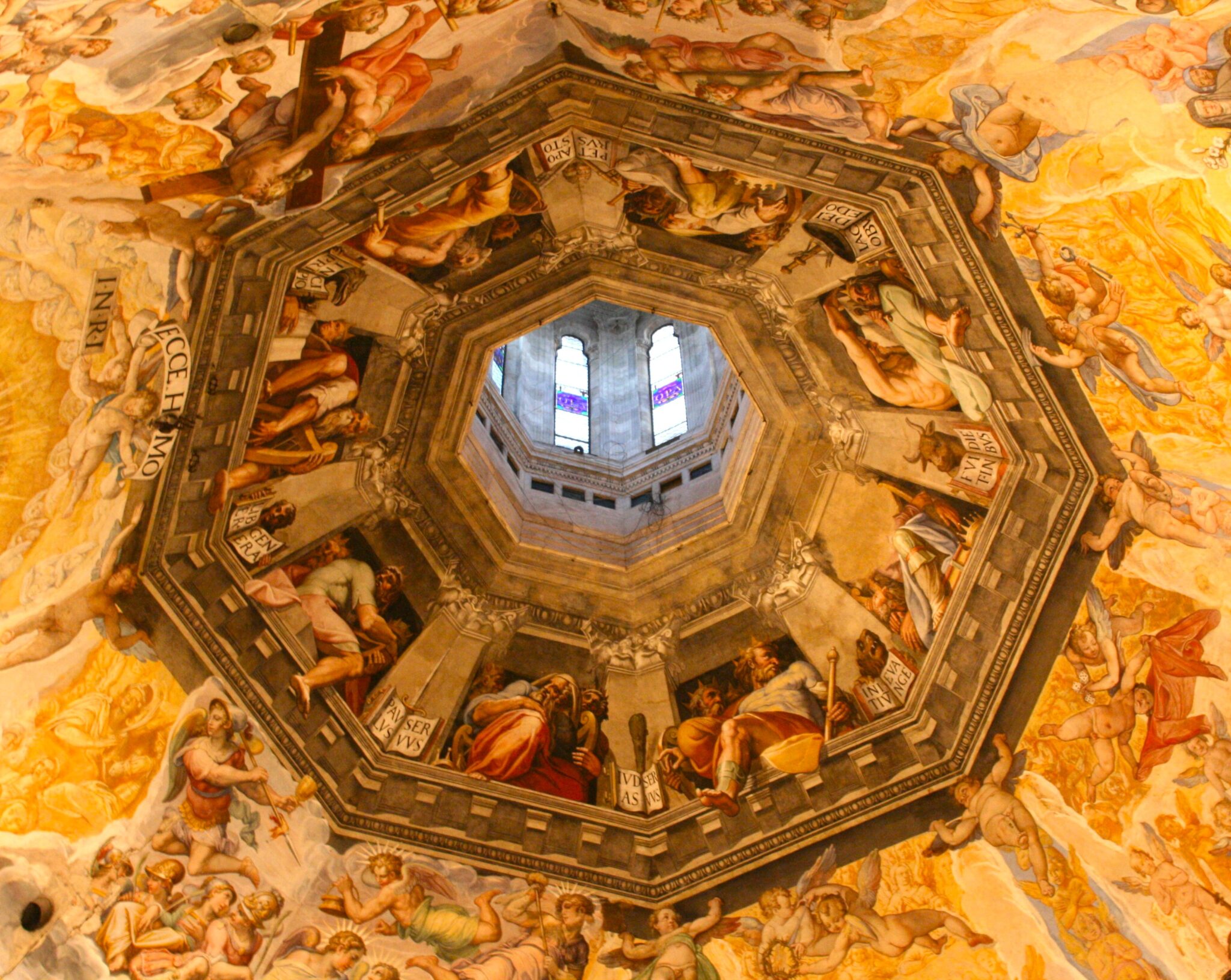
When climbing the stairs to the top of the dome, rest maybe taken at internal balcony. Here you can admire the ‘Last judgement’, a fresco painted on the inside of the internal dome. Cosimo and Vasari combine yet again for another incredible piece of Art. It was started in 1572. Completed at first by Giorgio Vasari (died in 1574 the same year as Cosimo) and finished by Federico Zuccari in 1579.

At 3,600 square metres the completed fresco represents one of the largest paintings in the world. Vasari worked with Cosimo’s literary and theological adviser Vincenzo Borghini. With around 700 figures used in the painting trying to understand its meaning would take some time that is unavailable as you must be at the top of the dome in a certain time.

It really is something to admire and admire you should. I was so taken back that I ignored the stained-glass windows at this level. There are eight drum windows, by Donatello, Ghiberti, Andrea del Castagno and Paolo Uccello.
Campanile di Giotto

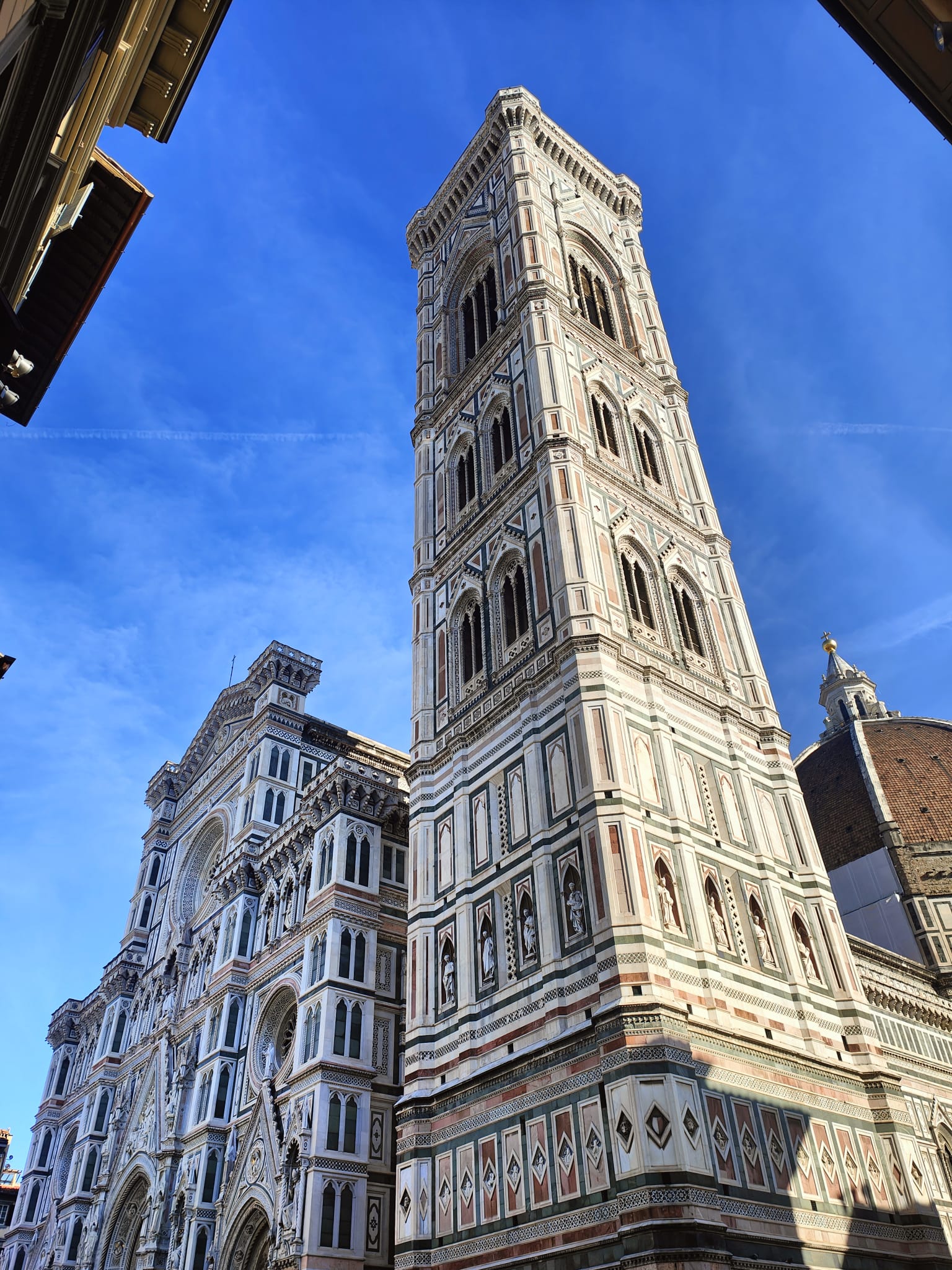
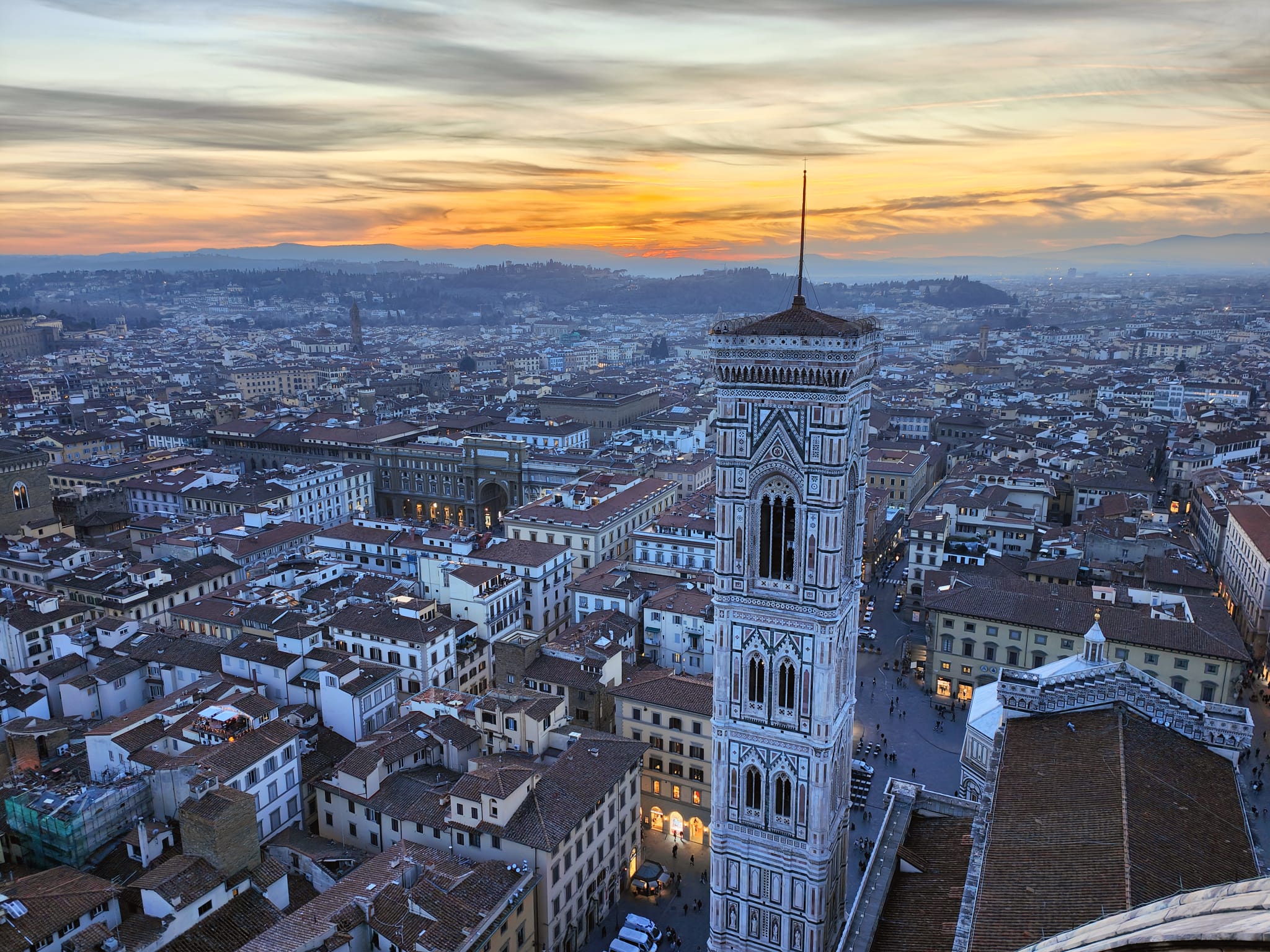
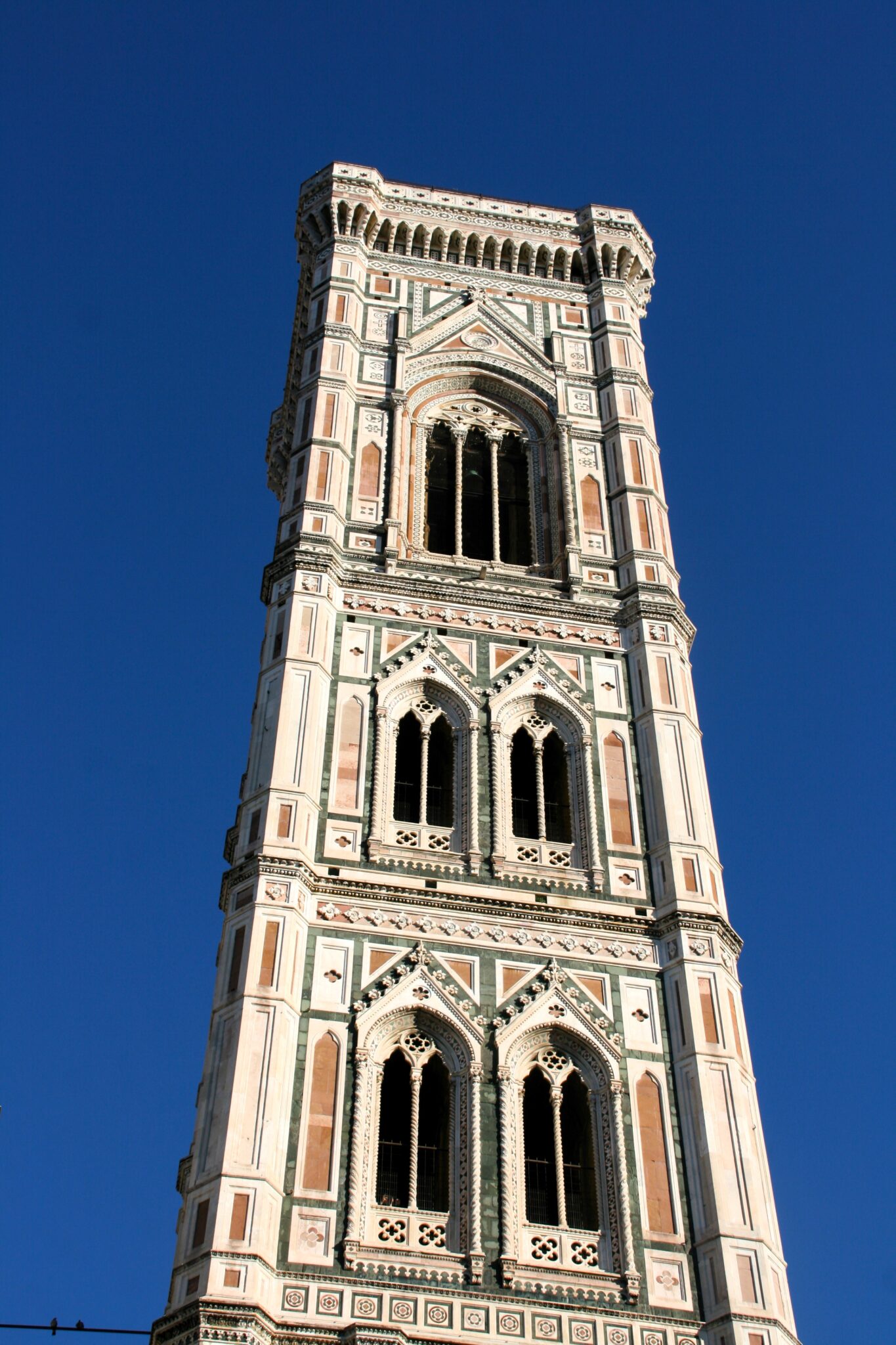
The Italian lesson continues as I learn than Campanile means bell tower. Giotto is the name of the famous 13th century painter, whose artwork I discovered in the church at Santa Croce. Giotto began work on the tower in 1334, and just like Arnolfo di Cambio he died before he could finish the tower in 1337. The tower was completed in 1359 after Andrea Pisano and Francesco Talenti had continued the construction.
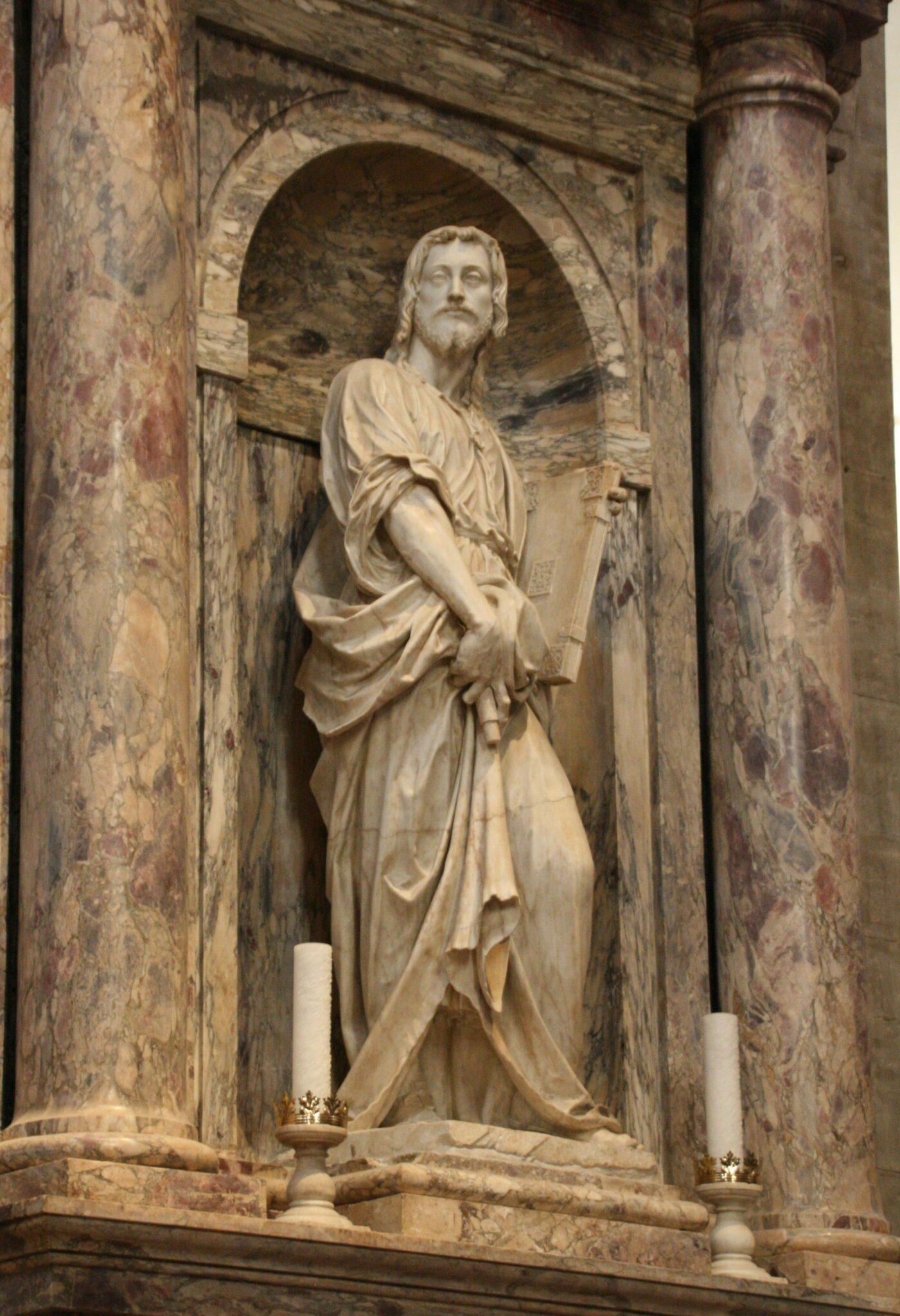
Giotto’s bell tower stands 85m high on a square 15m base. Giotto planned for the tower to be 115m in height but ultimately it was to fall short. 414 steps will get you to the top of the tower which provides a different perspective of the cathedral and another view of the city. The tower is a masterpiece of Italian Gothic architecture. A theme I’m starting to pick up when visiting churches and cathedrals around Italy has been the separation of a tower to house the bells.

Conclusions

Towering above the buildings of Florence the imposing Cathedral of Florence can’t be missed. Such a dominating structure draws the attention of all visitors to the city. Brunelleschi’s dome really is something to behold. It defies logic. I can’t recall a city where a building dominates its skyline as much as this cathedral. It really is the central focus.

My visit has provided me with an enhanced appreciation of cathedrals. I’m still dumbfounded at how they managed to build them. I continue to pick up the odd Italian word here and there to boost my meagre knowledge of the local language along with increased fascination of the arts. A visit to Florence Cathedral allows you to see some of the great work completed by so many famous names.

The visit has given fresh zeal to visit some more cathedrals. In order to see what the competition was, visits to cathedrals at Pisa and Siena are necessary along with some further afield that are larger than Florence cathedral. These include the Basilica of St. Peter in Vatican City, St. Paul’s Cathedral in London, the Cathedral of Seville and the Cathedral of Milan.